Gaspee Virtual
Archives Virtual
Archives |
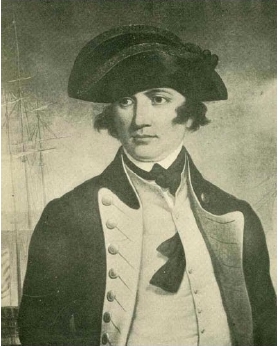
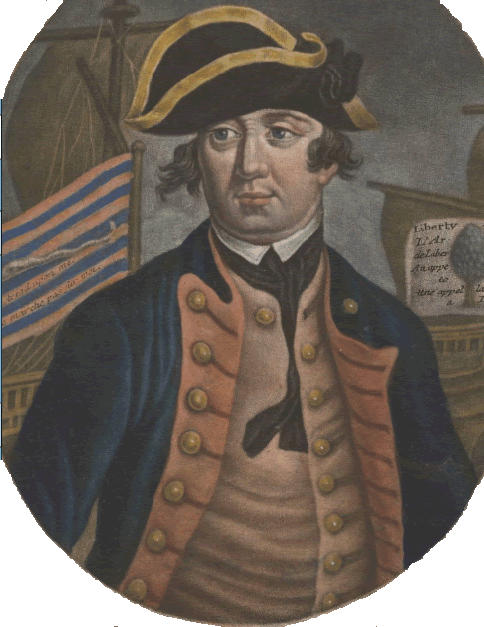
| Admiral Esek Hopkins (1718-1802) The Gaspee Days Committee at www.gaspee.COM is a civic-minded nonprofit organization that operates many community events in and around Pawtuxet Village, including the famous Gaspee Days Parade each June. These events are all designed to commemorate the burning of the hated British revenue schooner, HMS Gaspee, by Rhode Island patriots in 1772 as America's 'First Blow for Freedom'®. Our historical research center, the Gaspee Virtual Archives at www.gaspee.ORG , has presented these research notes as an attempt to gather further information on one who has been suspected in, or being associated with, the burning of the Gaspee. Please e-mail your comments or further questions to webmaster@gaspee.org. |
| Evidence to indict Esek Hopkins: From the Washington Post, Sunday April 14, 1907, page 3: "Earliest of Sea Fighters: The First Captain Ever Appointed in the US Navy (a short biography of Esek Hopkins): Certain townsmen of
Providence made a daring attack on the British war
vessel Gaspee, which vessel had been in the habit of
boarding and examining all examining all incoming and
outgoing vessels. They caught the Gaspee when she was
aground, boarded and fired her. She was burned to the
water's edge. Amont the boarders were the personal
friends of Hopkins, which, fact leaked out afterwards,
and it was understood that Hopkins was among them.
Now, granted, the Washington Post is a newspaper with a fairly good reputation through the years, but we feel that the comment that "...it was understood that [Esek] Hopkins was among them" is not a terribly strong argument that he did, in fact, participate in the burning of the Gaspee. After all, his son, John B. Hopkins, was known definitively to have been on the raid, and was prominently cited as having been a commander of one of the attacking boats by eyewitnesses. Had Ezek Hopkins been directly involved, it seems a man of such community standing would have surely been mentioned by one of the several eyewitness accounts. On the other hand, as an editorial policy, the Gaspee Virtual Archives will respect the identification of any attacker made by a reputable source of history. We have discovered no evidence that refutes the claim, as weak as it may be. |
|
From:
An Historical Sketch of The Town of Scituate, R.I.;
Part 2 Esek,
soon after the death of his father in the summer of
1738, a stout, tall and handsome young man, then in
the twentieth year of his age, bid adieu to the old
homestead and journeyed to Providence and became a
sailor, soon rising to the position of Captain.
He married when he was twenty-five years of age, Miss
Desire Burroughs, daughter of Mr. Ezekiel Burroughs,
of Newport, and took up his residence there. His
conspicuous services in the war of the revolution, as
the first commodore of the navy are well known. His
fleet, consisting of the ships Alfred, Capt.
Dudley Saltonstall, and the Columbus, Capt. Whipple,
the brig Andrew Doria, Capt. Nicholas Biddle, and the
Cabot, Capt. John B. Hopkins, son of Esek, and
the sloops Providence, Fly, Hornet and Wasp, put out
to sea Feb. 17, 1776, with a smart north-east wind,
and cruising among the Bahaman Islands, captured the
forts at New Providence, Nassau. This was a very
fortunate affair, for the heavy ordinance and stores
taken proved quite acceptable to the country. He
captured two British armed vessels on his return. During King George's War of 1743 to 1748 and the French and Indian War of 1754 to 1763, Esek Hopkins was heavily involved in privateering against the both the Spanish and French merchant fleets. and he steadily gained experience, wealth, and reknown for his captures on the high seas. Esek Hopkins is one of the subjects of an early American painting (1755) by John Greenwood entitled "Sea Captains Carousing in Surinam", one of the originals of "Dogs Playing Poker" genre. Surinam (Suriname) was a Dutch colony on the North coast of South America known for its slave plantations. It was a predominant trading destination for Rhode Island merchants during the 18th century who exchanged lumber, horses, rum, and African slaves for sugar, coffee, and cocoa in what is known as the Triangular Trade. Esek Hopkins was a mariner who often sailed for the Brown family, and commanded the disasterous slave trading voyage of the Sally in 1764, during which most of his cargo of 140 African slaves died. Details of the voyage of the Sally, as well as original source documents, and more information about Rhode Island's involvement in slavery are found at Brown University's Steering Committee on Slavery and Justice. 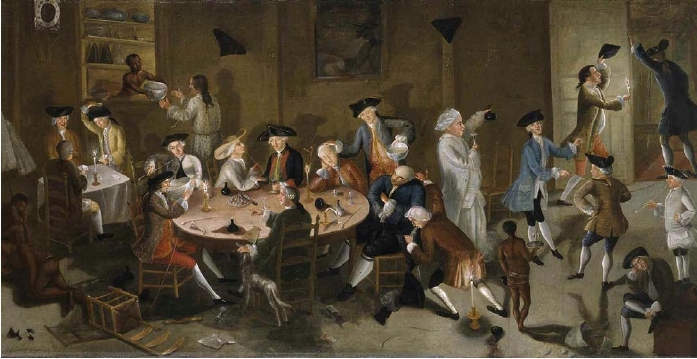 Right: Detail inset from Sea Captains Carousing
in Surinam (c1752-1758) by John Greenwood (1727-1792)
courtesy St. Louis Art Museum. Left
to right at table: Nicholas
Cooke, Esek Hopkins, Stephen Hopkins
(asleep), and Joseph Wanton.
Click to view entire image. There is some
controversy as to whether this man in red was
actually Stephen Hopkins, as per the said tradition
of the original owners of the painting, the Jenckes
family. Brown University professor Robert Kenney
believed that this man must have been Esek and
Stephen's other brother, William, since Stephen was
at the time
running for re-election as Governor, and tied up in court in
Worcester MA while suing his arch rival Samuel Ward
for slander. Right: Detail inset from Sea Captains Carousing
in Surinam (c1752-1758) by John Greenwood (1727-1792)
courtesy St. Louis Art Museum. Left
to right at table: Nicholas
Cooke, Esek Hopkins, Stephen Hopkins
(asleep), and Joseph Wanton.
Click to view entire image. There is some
controversy as to whether this man in red was
actually Stephen Hopkins, as per the said tradition
of the original owners of the painting, the Jenckes
family. Brown University professor Robert Kenney
believed that this man must have been Esek and
Stephen's other brother, William, since Stephen was
at the time
running for re-election as Governor, and tied up in court in
Worcester MA while suing his arch rival Samuel Ward
for slander.After the colonial wars Ezek, along with his equally famous brother Stephen Hopkins, bought a store in Providence that led to a successful and profitable career in a mercatile and ship-building partnership. Per the 1770 List of Providence Taxpayers, Esek Hopkins owned two properties, and his brother Stephen Hopkins, as well as a Christopher Hopkins and a Rufus Hopkins. This Rufus was probably the Rufus Hopkins (c1726-1809) that was the son of Stephen Hopkins, but we have no idea who Christopher Hopkins was. We do not hear much about the whereabouts of Ezek Hopkins along the time of the burning of the Gaspee in 1772. His home was actually 25 miles south in Newport where he and his wife Desiree Burroughs Hopkins had nine children. But as a close associate of John Brown and his brothers, he had plenty of reason to have been in Providence on the night of June 9th. As the dark clouds of impending war further settled on the region, as early as May, 1773, the Rhode Island Assembly ordered gun platforms to be installed in the fort protecting Newport under the directions of John Jepson and Captain Esek Hopkins. Later, the Legislature thought better of reinforcing the defences of exposed Newport and withdrew all the cannon to defend Providence in 1774. On October 4, 1775 the RI Assembly appointed Esek Hopkins as overall commander of Rhode Island militia forces, and conferred on him the rank of brigader-general. While at Congress, Esek's younger brother Stephen Hopkins served on the committees that prepared the Articles of Confederation. Stephen's' knowledge of the shipping business made him particularly useful as a member of the Naval Committee. He persuaded the Congress in 1775 to outfit 13 armed vessels and to commission them as the Navy of the united colonies. He also saw to it that Rhode Island received a contract to out fit two of these, and appointed his brother Esek Hopkins as its commander-in-chief on November 5, 1775. From: Lucia Hammond Wheeler writing in Revolution In Three Acts One morning in February, 1776, it sailed past the Capes of the Delaware with Hopkins' flagship, the Alfred, (formerly the Black Prince) flying the yellow-and-black rattlesnake flag "Don't tread on me!" Hopkins was under secret orders to proceed to the island of Abacco in the Bahamas and capture a large supply of gunpowder and other war munitions stored there. The fleet arrived off Abacco on March 1 - and then and there Hopkins gave the time-honored phrase, "The Marines have landed," a start in life, for he sent 200 of them ashore and shortly alter captured Fort Nassau and the supplies. On the way home the little fleet took two prizes and let a third, the Glasgow, a heavily-armed vessel, get away. Hopkins arrived in New London April 8 with the sorely-needed munitions, having carried out a daring exploit which earned him the thanks of Congress. All this might be expected to presage a brilliant career but it didn't. Hopkins had an almost unexampled run of bad luck. He was court-marshaled for misconduct in allowing the Glasgow to escape and though he was acquitted the incident didn't help him any. Congress didn't approve of his act in donating Newport 26 captured guns to be used in defending the city against the then-expected British. Sickness whittled down his crews; Washington sent him 200 men and then took them away from him. The sailors didn't get: their pay and expressed themselves on the point with nautical force and fluency. On May 14 Hopkins was up before the Marine Committee to answer to a charge of breach of orders. He was tried Aug. 12 and censured by Congress, which then sent him to Newfoundland to operate against the fisheries and British merchantmen. Privateering was rampant then and he couldn't get crews. The fleet didn't sail. They ordered him to Cape Fear. Again he was unable to get men to man his ships. The sailors of New England were all at sea reaping a rich harvest of prize money. There is no more tragic figure than Esek Hopkins, commanding a fleet which couldn't sail because the seafaring population of New England had turned to legalized piracy. Privateering was the most profitable form of patriotism then extant and everybody was going in for it enthusiastically, with a yo-heave-ho and a letter-of-marque. The British fleet bottled Hopkins and his fleet up in Providence harbor in December, 1776. Even a blockade didn't end Hopkins troubles. He got in trouble because he didn't go after the Diamond when that British ship went aground on an island off the Warwick shore. Wrote Hopkins to William Ellery, signer of the Declaration of Independence and delegate to Congress from Rhode Island: "We are now blocked up by the enemys fleet the officers and men are uneasy, however I shall not desert the cause but I wish with all my heart the Hon. Marine Board could and would get a man in my room that would do the country more good than it is in my power to do, for I entered the service for its good and have no desire to keep in it to the disadvantage of the cause I am in." A manly letter -
and a heartbroken one. Hopkins was dismissed from the
service of the United States on January 2, 1778, an
action for which Congress ought to have been kicked.
Field, Edward. Esek Hopkins, Commander and Chief of The Continental Navy... Providence: The Preston & Rounds Co. 1898. Page 172 (on-line in Google Books) . Cooper, James Fenimore. History of the Navy of the United States of America. New York: Stringer & Townsend, 1856. Page 32. (on-line in Google Books). In January 2012 we received an e-mail from Nanci Kendall who is doing research at the Gilder Lehrman Collection. According to a letter written to his wife by the illustrious hero Henry Knox in April 1776, Esek Hopkins was prone to a profane streak: I have been on
board (with) Admiral Hopkins - and
I’ve been in Company with his Gallant son who was
wounded in the engagement with the Glasgow - the
admiral is an Antiquated figure, he brought to my mind
Van Tromp the famous Dutch admiral - Tho’ antiquated
in figure he is Shrew’d & sensible [2] I who you
think am not a little enthusiastic [struck: as you
think] should have taken him for an Angell only he
swore now & then which to be sure is not angelic,
his Son Capt John Hopkins is a
sensible genteel man about 30 Years old and who will
one day (if he don’t get kill’d) make a most
formidable figure in American History
from: http://www.famousamericans.net/esekhopkins/ |
| While he
did not directly participate in the 1772 burning of the
Gaspee, we recognize
Admiral Esek Hopkins for his role in leading the early
stages of the American Revolution. His dealings in
the detestable slave trade, however, inhibit our
considering him as a hero. |
| See
excellent work of Christian McBurney, Esq on why we
should NOT honor Esek Hopkins |
| Genealogical addendum: From: Descendants of William HOPKINS, Fifth
Generation Esek HOPKINS was born 26 Apr 1718 in Providence, RI. He died 26 Feb 1802. He was buried in North Providence, RI. In 1741 Esek married Desire BURROUGHS daughter of Ezekiel BURROUGHS. Desire was born ABT. 1720 in prob. Newport, RI. They had the following children:According to the Whipple Genealogical Database at http://whipple.org, Esek Hopkins of 1718 had 9 children, of which his eldest was John Hopkins born 25 AUG 1742 in Newport, RI.M John B. HOPKINS, Capt. b1742 In 1776 our Ephraim Bowen (1753) married Sarah (possibly referred to as Sally) Angell (1757-1788 ), daughter of Nathan and Abigail Angell, and granddaughter (or niece--there are conflicting claims in Genealogy of the Descendants of Thomas Angell, Avery Angell, 1972) of Commodore Esek Hopkins. |
Sources consulted:
Bibliography from the Congressional Biography of Stephen Hopkins:
|
| Genealogical
Addendum: Stephen HOPKINS Birth: 7 MAR 1707 in Cranston, RI Death: 13 JUL 1785 in Providence, RI Father: William HOPKINS (1682) son of William Hopkins (1647) and Abigail WHIPPLE Mother: Ruth WILKINSON b: 31 JAN 1686, dau of Samuel WILKINSON & Plain WICKENDEN Marriage1 1726: Sarah SCOTT (c1707 - 1753) dau of Silverman SCOTT c1665 & Jeanna JENCKS Children: (all born in Scituate, Providence, RI) Marriage2 1755: Ann SMITH b:5OCT1717 in Providence, dau of Benjamin SMITH & Mercy ANGELL. Died 26 JAN 1782 Stephen Hopkins' brother John married a Catherine Turpin., and his sister Hope married a Henry Harris. According to Whipple.org, Gaspee raid leader Abraham Whipple was the brother-in-law to Stephen Hopkins. Actually, Abraham Whipple's wife was Sarah Hopkins, the daughter of John Hopkins, (the brother of Stephen), so Abe's wife was Steve's cousin. |
| Back to Top | Back to Gaspee Virtual Archives |