Gaspee Virtual Archives Virtual Archives |
| Joseph
Brown (1733-1785) The Gaspee Days Committee at www.gaspee.COM is a civic-minded nonprofit organization that operates many community events in and around Pawtuxet Village, including the famous Gaspee Days Parade each June. These events are all designed to commemorate the 1772 burning of the hated British revenue schooner, HMS Gaspee, by Rhode Island patriots as America's 'First Blow for Freedom' TM. Our historical research center, the Gaspee Virtual Archives at www.gaspee.ORG , has presented these research notes as an attempt to gather further information on one who has been suspected of being associated with the the burning of the Gaspee. Please e-mail your comments or further questions to webmaster@gaspee.org. |
| Evidence implicating
Joseph Brown:
The source of the name of Joseph Brown comes from
Robinson, Natalie: Revolutionary
Fire: The Gaspee Incident, 1984, RI
Committee for the Humanities. The author is no
longer reachable for us to get her research notes, and
how she came across his name. It might be assumed
that Joseph Brown was named by John Howland,
the first director of the RI Historical Society in 1839.
Howland had been a boy of 11 or 12 years old during the
Gaspee Affair, but claimed to have been there
when the boats put off from Providence for the attack in
June 1772. Howland later gave the names of individuals
he knew were in the raid, and he grew up among many of
them. Gathered from Staples, Documentary History of
the Destruction of the Gaspee: Joseph Brown seemed to be conscious of keeping control of who was in the cabin. From: Saul Ramsdale Friend of William Thayer, a Providence shoemaker recently moved from Mendon, Massachusetts. He claimed to have heard the preparations for the Gaspee and identified the "heads of the gang" as John and Joseph Brown, and someone named Potter. He told his friend Thayer what he had heard, but neither of them testified, before the Royal Commission. |
| Biographical Notes:
The most recognized source book regarding Joseph Brown and his brothers is generally considered to be The Browns of Providence Plantations-Colonial Years, by James B. Hedges. Harvard University Press, Cambridge, MA, 1952. From: http://www.rilin.state.ri.us/studteaguide/RhodeIslandHistory/chapt3.html In the economic realm, the famous Brown family of Providence rose to new financial, commercial, and industrial heights, surpassing in stature even the celebrated merchants Aaron Lopez, Joseph Wanton, and Christopher Champlin in Newport and James D'Wolf of Bristol. The resourceful Brown brothers -- Nicholas (1729-91). Joseph(1733-85), John (1736-1803), and Moses (1738-1836)- guided by uncles Obadiah (1712-62) and Elisha (1717-1802), laid the groundwork in this turbulent age for the remarkable commercial and industrial advances of the early national period.From the Joseph Bucklin Society: The four Brown brothers were prominent merchants and ran several businesses in common. The initial key to the Browns' business success was a candle works. But in the same year, 1762, they also formed Nicholas Brown and Company for their shipping and commercial activities. That was the business that was large and complex and quickly became one of the most successful businesses in the English colonies. According to claims put forth by the Masonic Order, John, Joseph, and Moses were all active members of the St. John's Lodge Number 1 Providence Free and Accepted Masons, Joseph being the master of the lodge (Providence Evening Bulletin, Letter to the Editor, June 7, 1966). It should be pointed out that the Masons make many such claims of leaders of the American Revolution It is important to remember that younger brother, Moses Brown, the famous abolitionist and Quaker leader converted to Quakerism later in life. The Brown brothers were all born as Baptists. Joseph Brown was known to have held slaves; one of whom drowned in 1769 while bathing in the Providence River.
Of the Brown brothers, Joseph was the most active
politically. In History
of Providence County, Rhode Island, by Richard
M. Bayles, New York, 1891, page 181, he is found
in a list of December 1773 appointees to the Town of
Providence Committee of Inspection, and was actively
involved in the manufacturing saltpeter for use in
gunpowder, planning fortifications at Fox Point, and
procuring fire-ships for the defense of the Colony. Joseph Brown served as a Deputy (equivalent to a modern
State Representative) from Providence to the RI General
Assembly, and is found in a list published in the Providence Gazette
on May 8, 1784 as an Assistant (now known as State
Senator) from Providence. He was also listed as being
appointed to represent the State of Rhode Island in
newly-formed Congress, but apparently never served since
he is known to have suffered a stroke in 1784, and he is
not listed in the files of the Political
Graveyard.
Although he did engage in the merchant business of
Nicholas Brown and Company for income, his political and
social activities overshadowed his business
activities. His scientific skills were put to good
use, though, and he was left by his brothers to be
largely in charge of the mechanics of the Hope furnace
and the spermeceti candle factory his family owned. He
was an architect, leaving as part of his legacy the
design of the Joseph Brown House (1774), the John Brown
house, University Hall at Brown University, the Market
Building, and the First Baptist Church of America
(1774). He's listed in the Biographical Dictionary
of American Architects. The John Brown House is
the centerpiece of the RI Historical Society
holdings. This brownstone-and-brick mansion, was
designed by Joseph Brown for his brother John
(1736-1803), and was built between 1786 and 1788 and has
been restored. See http://www.rihs.org.
The Joseph Brown house is also in Providence, and has
also been restored. It became the site, after
Joseph's death in 1785, of his brother John's Providence
Bank in 1791. According to First Baptist Church historian Dr. J. Stanley Lemons, Joseph Brown was an original member of the Charitable Baptist Society, organized c 1770 to fund and build the First Baptist Church meeting house which he designed and that still stands today as the largest wooden structure from the Colonial period in the United States. The meeting house spire and style have inspired church goers in Providence for three centuries. He was a pew owner, and later a baptized member of the Church as were his ancestors.
From the 1770 List of
Providence Taxpayers we get the following long
list of Brown families: Brown
Allin
I A 1
Brown Chad III D 5 Brown Esec III A 2 Brown George I A 2 Brown George XI D 4 Brown Elisha’s Brick House VI C 4 Brown Elisha’s Home VI C 4 Brown Elisha’s Mill VI D 1 Brown Hope III B 3 Brown Isaac VI C 2 Brown James’ Widow Hope III B 5 Brown John III B 5 Known Gaspee Raider Brown John III B 6 Known Gaspee Raider Brown John VI B 4 Known Gaspee Raider Brown John VI C 4 Known Gaspee Raider Brown John VI C 4 Known Gaspee Raider Brown Joseph III B 5 Known Gaspee Raider Brown Molly III A 4 Brown Moses III A 3 Brown Moses III B 5 Brown Nathaniel House see William Brown III B 1 Brown Nicholas III B 5 Brown Obadiah, Widow III A 4 Brown Richard, Jr. VI C 5 Brown William III B 1 Brown Zephaniah XI B 5 The only property listed by Joseph Brown at that time was held in common with his brothers, Nicholas and John, on the West side of North Main Street in a choice location only two buildings South of the Town Parade
All of the knowledge of optics came in handy later on
in 1775, when Brown, Joseph Bucklin, and Benjamin
Thurber were assigned to build an 80 foot beacon tower
on Prospect and Meeting Streets on College Hill to
signal a British invasion. According to Stewart Crump (in "Joseph Brown, Astronomer", Rhode Island History Vol. 27 January 1968) although he had lttle formal education, Joseph Brown was elected a member of the American Academy of Arts and Sciences, awarded an honorary Masters degree in 1769, and was the first Professor of Experimental Philosophy at Brown University. He had agreed to teach without salary, but unfortunately, a stroke in 1784 prevented him from serving his full professorship. The RI Historical Cemetery Database finds Hon. Joseph Brown buried in the Old North Burial Ground in Providence as were many other Gaspee raiders. From the 1790 census available through USGenWeb, there is no Joseph Brown in Providence, but there is one in Cumberland at: 3-1-4-*-* (white adult/male child/females/other free/slaves). A Nicholas and a John Brown are listed there as well, so this is our most likely candidate. This would be about twenty miles distant from the Hope Furnace operation. There is also Joseph Brown in Gloucester: 1-1-2-*-*, which is 12 miles from Hope. |
|
From:
http://web.bryant.edu/~history/h364proj/sprg_97/pease/millhist.htm
(Stale link 2006): Founded by the Brown Brothers (Nicholas, Joseph, John and Moses) and copartners in the business, Stephen Hopkins, Israel Wilkinson, Job Hawkins, and Caleb Arnold. This was an iron furnace producing, initially tea kettles, hollowware, nails, hinges, and iron hoops; but in 1775-1783 produced guns and canons cast for the Revolutionary War. The furnace structure was hearth and stack made of stone and located on the Pawtuxet River south of Salmon Hole. The river provided power for bellows and the surrounding woodlands were used for charcoal. Local farmers provided the stone that was heated and melted with the ore that came from the Oaklawn Avenue area in Cranston. The ore, charcoal, and limestone were carted uphill in horse-drawn wagons.This mill was located in the village of Hope, at the southwestern corner of Cranston with Scituate to the west, and West Warwick to the south. |
| Genealogical
Notes: . From the Brown Family Genealogical Society we can track the genealogical background of John Brown and his fellow Gaspee Raider and brother Joseph Brown. We have also supplemented the material here from Wayne G. Tillinghast's The Tillinghasts in America: The First Four Generations (2006). THE BROWN FAMILY. Volume 1, Number I May 1972, "BROWN FAMILIES OF COLONIAL NEW ENGLAND" Compiled and Written by Eleanor Gates Crum(THE BROWN FAMILY, a genealogical quarterly on the surname BROWN is published by J-B PublishingCompany, 430 Ivy Avenue, Crete, Nebraska 68333)Chad BROWN [c1600-c1650], emmigrant ancestor, came from England in the ship "Martin". which arrived in Boston Mass., July 1638. He brought with him his wife Elizabeth [Sharparrowe (died c1672)], son John, then 8 years old, and perhaps younger ones. A fellow passenger died on the voyage and Chad Brown witnessed the will soon after his arrival. He did not long remain in Mass., probably because of his religious views, but soon removed to Providence, where he became at once a leader of that colony. That same year (1638) he and 12 others signed a compact relative to the government of the town. In the capacity of surveyor he was soon after appointed on a committee to compile a list of the home lots of the first settlers of the "Town Street" and the meadows allotted to them. His home lot fronted on the "towne streete" now South Main and Market Square, with the southern boundary to the southward of College and South Main Streets. The college grounds of Brown University now comprise a large portion of this lot. In 1640 he served on a committee with three others in regard to the disputed boundary between Providence and Pawtuxet. That same year he, with Robert Cole, William Harris and John Warner, was the committee of Providence Colony to report their first written form of government, which was adopted and continued in-force until 1644, in which year Roger Williams returned from England with the first charter. Chad Brown was the first of the 39 signers of this agreement. In 1642 he was ordained as the first settled pastor of the Baptist Church. In 1643 he was on a committee to make peace between the Warwick settlers and Massachusetts Bay, but their efforts were unavailing. He died September 2, 1650, on which date the name of his widow occurs in a tax list. Children: -John, James, and Jeremiah, both of whom removed to Newport, R.I.; Judah, or Chad, died May 10, 1663, unmarried; Daniel.II. John Brown, son of Chad Brown, was born 1630, and died about 1706. He married Mary, daughter of Rev. Obadiah and Catherine Holmes, of Newport, R.I. He lived in Providence, at the north end, in a house afterwards occupied by his son James. He served the town in various official capacities - juryman, commissioner on union of towns in 1654, surveyor of highways, 1659; was free man in 1655; moderator, member of the town council, deputy in legislation, assistant. He took the oath of allegiance May 31, 1666. In 1672 he sold the home lot of his father to his brother James, of Newport, who resold the same day to Daniel Abbott. Nearly 100 years later a part of it was purchased by his great grandsons, John and Moses Brown, and then presented to the College of Rhode Island at the time of its removal from Warren to Providence. The cornerstone of University Hall, for many years the only building, was laid by John Brown, May 31, 1770. Historians of the First Baptist Church relate that Roger Williams himself was the first pastor of the First Baptist Church, Chad Brown was the second--or, perhaps as related above, the first 'settled' pastor. Chad Brown was not a founder of the First Baptist Church in 1638, he arrived in Rhode Island a year later. Chad and Elizabeth's
eldest son John Brown (1630-1706) was the
great-grandfather of the Joseph Brown of our
concern. He marrried Mary Holmes (c1632-c1690),
who was a daughter of Obadiah Holmes, the second
pastor of the Newport Baptist Church
Children of John and Mary
(Holmes) Brown::
1. Sarah married Nov. 14, 1678 John Pray Children of Rev.
James Brown and Mary (Harris) Brown included:
Children born at Providence to Capt. James Brown and Hope (Power) Brown were; The
following
children are listed as having been born to Joseph Brown
and Elizabeth Brown in Rhode Island via Ancestry.com and LDS search:
Joseph Brown died on his 52nd birthday (what a bummer). Joseph Brown married Elizabeth Power (his 1st cousin) in 1759. Elizabeth (28Jun1736-6Sep1806) was the daughter of Nicholas Power and Anne Tillinghast Power. Though there seems to be some genealogical confusion here, it appears from the extensive research of Wayne G. Tillinghast in The Tillinghasts in America: The First Four Generations (2006) that Anne Tillinghast was not closely related to Gaspee raider Captain Joseph Tillinghast. According to Life, Times and Correspondence of James Manning (the First President of Brown University) by Reuben Aldridge Guild (1864), the Joseph Brown family line ceased with the death of his grandaughter, Eliza Brown Rogers, since she had no children. The Tillinghast, Smith, and Harris family names are among other known Gaspee Raiders. John's wife, Sarah Smith was the sister of Job Smith who also owned a distillery. We have not been able to establish any relationship between John Brown and the much less famous fellow Gaspee raider, Abial Brown. We also have not been able to establish a relationship to George Brown, the lawyer that falsely denied knowledge of the meeting at Sabin's Tavern to plan the attack on the Gaspee. |
| The Gaspee Days Committee, in recognition of Joseph Brown's participation in the attack on the HMS Gaspee, recognizes him as a true American patriot. |
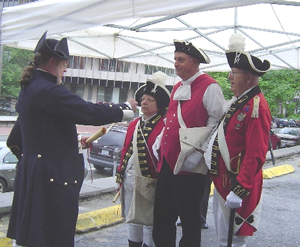 Left:
On June 6th, 2004, Brown descendant Nathanael Greene
Herreshoff of New Jersey was ceremoniously 'indicted'
for his crimes against King George III in ceremonies
conducted by the Gaspee Days Committee. Left:
On June 6th, 2004, Brown descendant Nathanael Greene
Herreshoff of New Jersey was ceremoniously 'indicted'
for his crimes against King George III in ceremonies
conducted by the Gaspee Days Committee. |
| Back to Top | Back to Gaspee Virtual Archives |
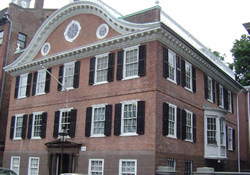 Left:
The Joseph Brown House erected 1774, at 50 South
Main Street in Providence, later the location for
the Providence Bank, then the firm of Brown &
Ives.
Left:
The Joseph Brown House erected 1774, at 50 South
Main Street in Providence, later the location for
the Providence Bank, then the firm of Brown &
Ives.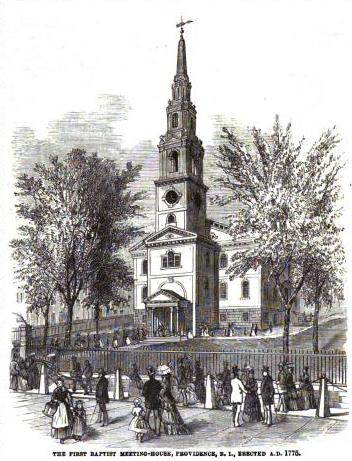
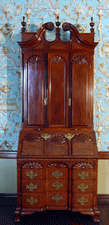
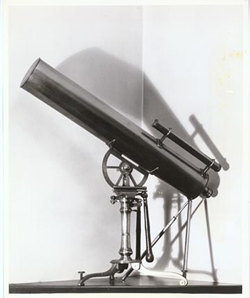 Florence Parker
Simister, in her book Streets of the City: An
Anecdotal History of Providence, p57 relates that
it was Joseph Brown who was at the forefront of citywide
excitement about the transit of Venus across the sun in
1769. He purchased the observatory equipment such
as a reflecting telescope
Florence Parker
Simister, in her book Streets of the City: An
Anecdotal History of Providence, p57 relates that
it was Joseph Brown who was at the forefront of citywide
excitement about the transit of Venus across the sun in
1769. He purchased the observatory equipment such
as a reflecting telescope