Gaspee Virtual Archives Virtual Archives |
| Research
Notes
on Aaron Briggs aka Aaron Biggs (c1755-____) |
|
The Gaspee Days Committee at www.gaspee.COM is a civic-minded nonprofit organization that operates many community events in and around Pawtuxet Village, including the famous Gaspee Days Parade each June. These events are all designed to commemorate the burning of the hated British revenue schooner, HMS Gaspee, by Rhode Island patriots in 1772 as America's 'First Blow for Freedom' TM. Our historical research center, the Gaspee Virtual Archives at www.gaspee.ORG , has presented these research notes as an attempt to gather further information on one who has been suspected of being associated with the the burning of the Gaspee. Please e-mail your comments or further questions to webmaster@gaspee.org. |
| Evidence Implicating
Aaron Briggs: The source of the name of Aaron Briggs comes from the testimony he gave to the royally appointed commission investigating the attack on the Gaspee in 1773, and from Patrick Earle, one of the crewmembers of the Gaspee. The following excerpts are all gleaned from Staples, Documentary History of the Destruction of the Gaspee. Page 34: Patrick Earle, crewman of the Gaspee, said that Aaron Briggs was in the longboat that rowed Earle, Dudingston, and others ashore after the attack. Page 63: Aaron was an indentured servant per the Town of Portmouth to be the apprentice of a Captain Samuel Tompkins of Prudence Island, from the age of 5 until he should be 24. He was approximately 16-18 years old at the time of the attack. Aaron Briggs was constantly in the service of the said Capt. Tompkins, as a laborer on his farm that the reason he went off the island, was to carry the boat round to the east side of said island, to carry a man named Samuel Faulkner, a hired man, to Bristol the next night, and that this young man told the deponent that he would ask his master's leave for that purpose; that going round said island, at about half a mile from said shore of said island, he met a boat and one Potter, whose Christian name he does not know, and whom he, in company with Faulkner above-named, had once seen on a wharf at Bristol, and there heard him called by the name of Potter;On final note of interest was published in the material accompanying the play "Prelude to a Tea Party" published in 1972. It is claimed that John Brown used the term 'Aaron Briggs' as a codeword for slaves when he was importing them, illegally, into Rhode Island. He did this supposedly to avoid unpleasantness from his brothers Moses and Nicholas, who were both ardent abolishionists. Biographical and Genealogical Notes: We know very little about this individual who we acknowledge as a person who took part in the raid that started us on the road to the American Revolution. We really can't call him a patriot on this matter since by his own statement he was pressed into service for the attack, and he turned state's evidence against the other participants. He obviously knew details of the attack that he could not have known had he not been along. But he later did have the motive of escaping his servitude by rowing out to the HMS Beaver. What happened to him after his testimony in front of the Commission investigating the burning of the Gaspee has been mostly lost to history. Since he was an indentured servant (slave) we have difficulties knowing about his background or what he subsequently did with himself after his Rhode Island adventures. The Providence Journal-Evening Bulletin (June 18, 1975) wrote a brief article about his exploits as a black man who aided the Revolution and quoted a researcher, Virginia Hatch , who stated that Briggs in 1771 had previously taken a boat and gone aboard a British sloop-of-war in another attempt, presumably of escaping his servitude. One other interesting snippet is the Warrant to the Sheriff of the County of Newport, for the Arrest of the Negro Aaron, signed by Justice Metcalf Bowler (see Staples, p115): Whereas, I have received information, that Aaron, a mulatto lad, otherwise called Aaron Bowler, alias Briggs, now on board His Majesty's ship, the Beaver, .....This may be a clerical error or something else, since the judge issuing the warrant was also a Bowler. If it's not, it's interesting to ponder as to whether Aaron's real name might have been Bowler. A brief search of that name by Google, NEHGS, Ancestry.com, and FamilySearch.org all come up negative. Steven Park has contended that the actual surname spelling in records he has discovered was 'Biggs' not 'Briggs'. This will be explained in the forthcoming publication of his PhD thesis submitted at University of Connecticut in 2005. There are, however, no instances of the surname Biggs in the NEHGS database. We know that he was illiterate at the time (1772) since he signed his sworn statement to investgators with an 'X'. We have references that Aaron Briggs was a mulatto; that is, he was the product of one black parent and one white parent, but we're really not sure except he was dark-skinned, probably mixed race, perhaps with some Indian ancestry.
Fellow researcher Cherry Bamberg, however, points out that Stiles never referred to Briggs as a mulatto, but rather, as "the Negro-Indian witness." She states the the common term at that time for one of mixed Negro and Indian blood would be "mustee", though she also indicates that racial terminology at the time was notably vague. All of this brings up the interesting question of why
Simeon Potter, who was already in a boat from Bristol
overloaded with 11 or 12 men, would bother to chase down
and press the hapless Aaron Briggs into joining in the
raid. Did he feel that he needed more
manpower? Doubtfully. Although Potter
probably did not know the precise number of men in boats
from Providence that were to join up with him for the
raid, Potter must have known there would be more than
enough The more likely explanation lies in the
fact that, unlike the boats from Providence, the men of
the boat from Bristol decided to dress themselves in the
disguise of Narragansett Indians (See Indians.htm). It can be
guessed that Potter was accommodating the ruse by taking
along someone actually of Narragansett Indian blood.
Potter and his boat probably met up with Aaron Briggs by
coincidence, since Prudence Island is on a direct path
between Bristol and Pawtuxet, where Potter most likely
met up with the boats coming down from Providence.
By taking a route up the Providence River on the west
side, Potter would also be able to ascertain the the HMS
Gaspee was
still aground, and gather other valuable intelligence
prior to the subsequent attack. After the attack, Briggs
was then purposely placed next to the wounded Lt.
Dudingston when they rowed into Pawtuxet Village; they
wanted to give the impression to Dudingston and his crew
that the attackers were Indians. Cherry Bamberg postulates that from the wording of the testimony 'per the town of Portsmouth,' it seems that Aaron had been apprenticed by the town council to Tompkins. The town councils apprenticed poor children to prevent their mothers from becoming chargeable to the town. Apprenticeship at the age of 5 indicates pretty severe family problems. In either event, Bamberg makes a clear distinction between slave and indentured servant. Slaves were
sometimes apprenticed, but only by their masters. They
were not the financial responsibility of the town. An
indentured servant was not a slave. Though his or her
condition was little better, it at least had a
terminal date. Many indentured servants were white,
but no slaves were white. The word "servant" was used
as a euphemism for slave, of course, but not in the
context of indentured servant. A slave was called a
"servant for life," often shortened to "servant." If
Briggs had been a slave, his surname would have been
Tompkins, as it changed with ownership.
There is one Briggs listed in the Rhode
Island
Historical Cemetery Database with no dates and no
first name buried in Bristol, the geographically nearest
town to Prudence Island (actually considered part of the
town of Portsmouth), where we know Aaron Briggs served
at the time of the attack on the Gaspee in
1772. At the Juniper Hill Cemetery on Sherry
Street located 15 feet North of telephone pole #4, there
are 3 or 4 other Briggs family members known to have
been buried, all in the 19th Century. From Genealogies of Rhode
Island Families, Volume I, Genealogical
Publishing, Baltimore, 1989, p460, there was one Captain
William Briggs c1715 to 17Jul1802 that is the only
Briggs recorded to be a plausible candidate of the time
that might have kept slaves. This man is buried in
a Briggs cemetery located near a Briggs Beach in Little
Compton, RI. In 2008 we were contacted by Richard Trinker, a
descendant of William Briggs of little Compton, RI, who
discovered his ancestors will. In this 1716 will
of the grandfather of William Briggs it is
written: "that my two
mulatto girls, Hope and Mercy be with my wife or
daughters, Woodman and Head, until age 25 and then
freed."
This would imply that this Briggs owned slaves, and
that perhaps this ancestor fathered at least two
children with his slaves. This is before the time
of Aaron Briggs, but it suggests that the Briggs were
slave holders, at least recently before his time.
The farmlands of Little Compton were vast and extensive,
and we know from other sources that slaves were
frequently used to work these farms. There about 54 or so Briggs family households mentioned
in the 1790 census from Rhode Island. There is only one
Aaron Briggs from the 1790
Federal
census listed in listed as being from the Town of
Gloucester, but indicating a white male with six females
in the household, with no slaves or other freepersons.
In inspecting these other records, we find that there
was a Willard Briggs from Newport that had one "other
freeperson" in his house, possibly a employed black
servant. There was also a Nathaniel Briggs from
Tiverton who housed four slaves by census count. The few
black persons who actually were considered 'head of
household' in 1790 were marked as (negro) or (melatto)
sic. My limited understanding is that,
historically, many slaves took the names of their
slave-owners, so we cannot count on any of this
information, as all of the known Briggs families in
Rhode Island in the Federal census of 1790 were
white. On the other hand, the RI Historical
Society files have several references of the time to
Blacks who were named Briggs. From old Gendex files we see that: there was an Aaron Briggs who married an Abigail Harris, 30 APR 1807, in Johnston, Providence. RI. From there, the trail drops off. In either event, it would be an enormous stretch of credibility to assume that this Aaron Briggs and the one we write about is the same. From the American Genealogical-Biographical Index (AGBI) on Ancestry.com: BRIGGS, AaronBoth of these could be potential matches, and could have been the same person. Also from Ancestry.com, we have Massachusetts Soldiers and Sailors in the War of the Revolution, 17 Vols.Volume 2, page 497 Briggs, Aaron. Private, Lieut. John Dryer's co., Col. Thomas Carpenter's regt.; marched from Rehoboth to Bristol, R. I., on the alarm of Dec. 8, 1776; service, 12 days.In his 2016 book, The Burning of the Gaspee, historian Steven Park claims that Aaron B(r)iggs was given an assignment within the Royal Navy by Admiral Montagu, the Commander of British naval forces in America, but no good sources are cited. In NEHGS files we find an Aaron Briggs ?third son of Joshua and Sarah (Luther) Briggs born in Rehoboth, MA, on 2Mar1756 married a Rhoda Bowen on 7Nov1776, and in 1805 moved to Richmond, Ontario County, NY. He served in the Revolutionary War as a private and at the age of 76 received a pension in 1832 (S6701) for six months service, making his birth year 1756. He initially enlisted at Rehoboth under Captain Perry and was marched to Roxbury in 1775 where he joined Captain Josiah King's Company of Colonel Brewer's Regiment. He reenlisted from Westmoreland, NH in 1777. He did serve in Rhode Island under (New Hampshire's) General Sullivan, marched through Worcester, Providence, and Bristol, was at Howland's Ferry, and was in the Battle of Rhode Island in 1778 when it is known the 1st Rhode Island Regiment was composed predominantly of men of African-American heritage, and the 2nd Rhode Island Regiment similarly composed. Both regiments figured prominently in that battle.
During the Battle of Rhode Island in
August 1778, Hessian troops directed In searching databases for Captain Samuel Tompkins and his father-in-law Samuel Thurston, (the masters of Aaron Briggs) we draw a blank at Gendex, and at Whipple.org. From the RI Historical Cemeteries Database we do get a probable Capt. Samuel Tompkins 1726c - 29 MAY 1798 at PO041, and Samuel Thurston listed in the as 1700c - 16 AUG 1792 at PO041 which is on Prudence Island. A possible match for Sam Thurston's wife is Mary Thurston, 1707c - 17 SEP 1768 at PO041. There is also a possible daughter, Mary Tompkins (1761-1770), who was buried on the Island at 9 years of age. From the 1790 Census of Portsmouth, RI, Samuel Thurston, was still listed as a head of household at 2-1-1-*; that is 2 (adult males), 1 (male less than 16), 1 (female), 1 other freeperson, and * (no slaves). Interestingly, there is no record of a Captain Samuel Tompkins living in the town of Bristol or Portsmouth (including Prudence Island) at the time of the 1790 census. We are unable to connect the Tompkins and Thurston families to the families that attacked the Gaspee; but then, this point is moot, as we know Aaron Briggs was pressed into the attack, and escaped to the HMS Beaver shortly after the attack. The masters had no reason to collaborate with other Rhode Island families to keep a secret that was already out of the bag, so to speak. All in all, it appears very likely that the Aaron Briggs of our concern was the same Aaron Briggs (1756--after1832) that redeemed himself by joining in the Revolution, and who spent the rest of his life in Upstate, NY. In this case we would recognize him as a patriot of the Revolution owing to his service in the Continental Army. |
| The Gaspee Days Committee recognizes Aaron Briggs (or Biggs) as one who took part, willingly or unwillingly, in the attack on the HMS Gaspee in June of 1772. |
| Back to Top | Back to Gaspee Virtual Archives |
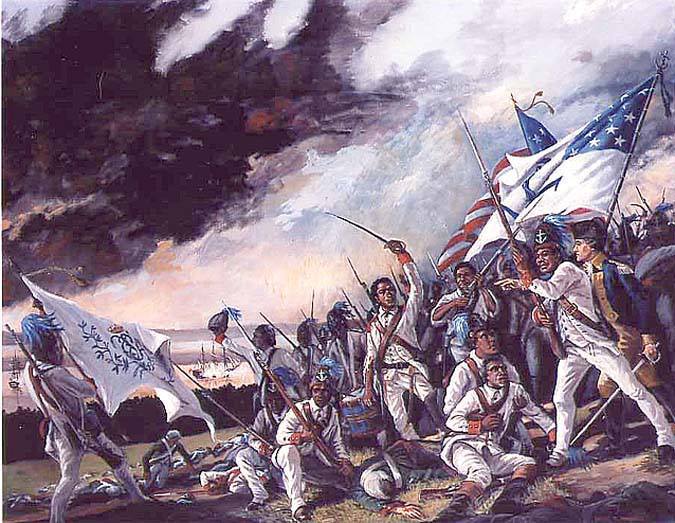 Left: "1st Rhode Island Regiment at
the Battle of Bloody Run Brook" by David R. Wagner, 1975. Click to enlarge.
Left: "1st Rhode Island Regiment at
the Battle of Bloody Run Brook" by David R. Wagner, 1975. Click to enlarge.