Gaspee Virtual
Archives Virtual
Archives |
| A History of the
Destruction of His Britannic Majesty's Schooner Gaspee...
by Bartlett |
| A NOTE ON THE
TEXT Copyright laws
must've been lame in 1861 when John Bartlett pretty much plagiarized
the work of Judge Staples' Documentary History of the Destruction of
the Gaspee, written only 16 years earlier. But Bartlett's
text is exceedingly hard to find in the year 2004, so we present it
here to aid in scholarly citations. To be honest, Staples,
particularly the 1990 republication by the RI Historical Publications
Society, is a more honest read. John Russell Bartlett (1805-1880)
was a historian most noted for publishing the multi-volume Records of the Colony of Rhode Island and
Providence Plantations between 1856 and 1865. He married
the daughter of the prominent General Christopher Rhodes, and lived in
Pawtuxet Village. It is no wonder then that he had a particular
fondness for the retelling of the Gaspee Affair. The following text
of The Destruction
of the Gaspee is reprinted from the edition published in Providence
by A. Crawford Greene in 1861. Rather than rescan and OCR the
entire
text, we used as a starting point, the 1991 republication of
Staples, Documentary History of the
Destruction of the Gaspee,
presented also at this web site. Paragraph structure and page
numbers were altered to match that found in Bartlett's presentation.
His relatively few original comments were either typed in directly, or
scanned in to the text at the appropriate places, all of which are
presented in <Arial
bold font>, and his footnotes are presented in <Bold
Times font>. Orphaned
text has
been completed into the page of origin. Otherwise, the
texts
follow their original printed sources as closely as the present format
allows. Antique words and
phraseology
were maintained as best as possible, but will come up as errors in
grammar
checks and spell checks or modern word processing programs, so be
advised.
It is also to be noted that the spellings of some words used in
Staples'
account are consistently misspelled by year 2004 standards, but which
were
presumably correctly spelt in 1773, e.g., 'despatched' and 'enquiry.'
Please
understand that neither myself or the Gaspee Days Committee can take
any
responsibility for errors of omission or commission in converting the
text
into HTML format. And further, this
despondant saeth not. Webmaster, Gaspee Virtual Archives, August, 2004. webmaster@gaspee.org |
 |
| 1.
A History by Providence: 2.
The Destruction of the GaspeeA History by Providence: 3. 4.
One hundred and twenty-five copies printed for
private
distribution.5.
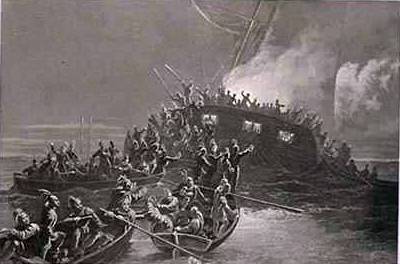
THE DESTRUCTION OF THE GASPEE. [THE proceedings of the General Assembly, relative to the destruction of the British schooner Gaspee, in the waters of Narragansett Bay, on the night of the 9th June, 1772, will be found in the records of the August session of that year. What followed, connected with this important event in the colonial annals of Rhode Island, extends through this, and a part of the following year. In presenting this history to the public, the editor, has brought the whole of the proceedings together, including the events which preceded the destruction of that vessel. This will present a continuous account of the affair, with the accompanying documents, from the time it occurred, to the report of the royal commission of inquiry on the same. The correspondence and most of the documents herewith printed, are preserved in the original, among the archives of the State, and are chronologically arranged and bound in one volume. In 1846, the Hon. William R. Staples caused these documents to be printed in the columns of the Providence Journal, with preliminary observations. He also interspersed the various documents with his own remarks, in order to present a plain and continuous "Documentary History" of the destruction of the Gaspee. This was afterwards printed in a pamphlet form; but has long been out of print. To these various documents, the present secretary of state, and editor of the Colonial Records, has been enabled to add several letters and documents of great interest which were not previously among the State archives, and which had never been printed. For several of these, he is indebted to the kindness of his friend, the Hon. George Bancroft, who procured copies of the originals on file in Her Majesty's state paper office, London. The others are from a variety of sources, including that great depository of historical documents. Copies of these several papers, have now been procured, and deposited in their proper places among the "Gaspee document," referred to. Among the most important of these new documents, are letters from Admiral Montagu to the Earl of Hillsborough; letters from Chief Justice Horsmanden, of New York, one of the royal commissioners of inquiry into the Gaspee affair, to the Earl of Dartmouth, giving an account of the proceedings of the court; and the official report of inquiry to the King, about the burning of the Gaspee.]—J. R. B. 6. The records of the proceedings and the correspondence of the preceding years, show that an illicit trade had long been carried on, not only in Rhode Island, but in the other English colonies. They show, too, that efforts had been repeatedly made by the commissioners of customs, to put a stop to this practice, by placing armed vessels in Narragansett Bay, and at other places along the coast, from Casco Bay to Cape Henlopen, in 1764. Serious riots, too, had, in several instances occurred, in consequence of the vigilance of the custom house officers, in their endeavors to check this illicit trade. The vessel assigned to this station, in 1764, by the King's authority, was the schooner St. John, Lieut. Hill, commander. This vessel seized the cargo of a brig, which had discharged near Howland's Ferry, and following her at sea, made a prize of her, and brought her to Newport. Other difficulties, which grew out of her presence, at Newport, led to the fitting out of an armed sloop, with the intention of destroying her, which was only prevented by the presence of the "Squirrel" man of war, in that harbor. Nevertheless, the people on board the sloop landed on Goat Island, seized the battery, and discharged its guns at the large ship. During the same year, another event took place in the har-bor of Newport, which tended greatly to exasperate the peo-ple. The Maidstone, a vessel belonging to the British navy, lay here, several months, and gave great dissatisfaction, by im-pressing seamen from vessels entering the harbor, as well as in taking them from the boats and small craft in the bay, Other ships of the royal navy, which visited Newport, also had difficulties with the people there, all of which tended to arouse them, and lead to some measures of retaliation. The climax was reached, when a brig from Africa, entering the port, was boarded by the officers from the Maidstone, and her entire crew pressed into the naval service. The same night, a mob of about five hundred men and boys, exasperated by the affair, seized one of the boats belonging to the Maidstone, which lay at the wharf, pulled her on shore, and after dragging her through the streets to the Common, in front of the court house, burnt her, amid the shouts of an immense crowd, which the occasion had brought together. 7. The affair was so suddenly concocted and carried into effect, that the authorities had no time to interfere. The next important event in order, in resisting the authority of the government in its efforts to suppress illicit trade, was the affair of the armed sloop Liberty, Capt. Reid, which the commissioners of the customs had sent to Newport, in 1769. This officer had exhibited an extraordinary zeal in executing the orders he had received, and had greatly annoyed vessels entering our ports. On the 17th July, while cruising in Long Island Sound, he took a brig and a sloop, belonging to Connecticut, which he suspected had been engaged in illicit trade, and brought them to Newport. The commander of the brig, Capt. Packwood, it appeared, had duly reported his cargo at the custom, house, before sailing, and no proof was exhibited that he had made any attempt to evade the revenue. On the 19th, as no charges had been made, or prosecution entered against the brig, Packwood went on board the Liberty. The captain be-ing absent, some difficulty took place, which led to the firing of several musket balls at Capt. Packwood's boat on her re-turn to the shore. Obtaining no redress for this outrage, the people of Newport boarded the obnoxious vessel, cut her cables, and suffered her to drift on shore, near Long Wharf. They then cut away her masts, threw her armament overboard, when, with the first high tide, she drifted over to Goat Island. The first night she lay here, a party from Newport, went over and burnt her. His Majesty's armed schooner, the Gaspee, of eight guns, Lieut. Dudingston, accompanied by the Beaver, made their ap-pearance in the waters of Narragansett Bay, in March, 1772, on duties similar to those of the "St. John" and 'Liberty," to which allusion has been made, viz.: to prevent breaches of the revenue laws, and to stop the illicit trader so long and so success fully carried on in the colony. 8. The commander of the Gaspee was quite as exacting as Capt. Reid of the Liberty had been. He stopped all vessels, including small market boats, without showing his authority for so doing; and even sent the property he had illegally seized, to Boston, for trial, contrary to an act of Parliament, which required such trials to be held in the colonies where the seizures were made. In these acts, Dudingston had clearly transcended his powers. Shortly after the Gaspee had commenced her illegal proceedings, the complaints from the people of Providence were so numerous to the Deputy Governor, Darius Sessions, that he submitted the question to Chief Justice Hopkins, who did not hesitate to give his opinion, "that no commander of any vessel has a right to use any au-thority in the body of the colony, without previously applying to the Governor, and showing his warrant for so doing; and also being sworn to a due exercise of his office." Upon re-ceiving this opinion, the Deputy Governor, who then resided in Providence, addressed the following letter to Governor Joseph Wanton, at Newport: The Deputy
Governor to the Governor of Rhode Island
PROVIDENCE,
March
21, 1772.
SIR:—The inhabitants of
this
town have, of late, been much disquieted
in
their minds, by repeated advices being brought of a schooner which for
some time past hath cruised in the Narragansett Bay and much disturbed
our Navigation. She suffers no vessel to pass, not even packet boats,
or
others of an inferior kind, without a strict examination, and where any
sort of unwillingness is discovered, they are compelled to submit, by
an
armed force. Who he is and by what authority he assumes such a conduct,
it is thought needs some inquiry, and I am requested, by a number of
gentlemen
of this town, on their behalf, to acquaint your Honor therewith, and
that
you would take the matter into consideration and, if the commander of
that
schooner, has not as yet made proper application and been duly
authorized
in his proceedings, that some proper measures be taken to bring him to
account.
It is suspected he has no
legal
authority to justify his conduct,
and
his commission, if he has any, is some antiquated paper, more of a
fiction
than any thing else, and this seems to be confirmed by Mr. Thomas
Greene,
who says he saw it, and believes it to be no other than the commission
the famous Reid had, who lost his sloop at Newport, or something else
of
no validity. 9. In consequence of the above mentioned application, I have consulted with the Chief Justice Hopkins thereon, who is of opinion, that no commander of any vessel has any right to use any authority in the body of the colony without previously applying to the Governor and showing his warrant for so doing and also being sworn to a due exercise of his office—and this he informs me has been the common custom in this Colony. I am, sir, &c, &c, DARIUS
SESSIONS.
To GOV. WANTON.
The letter led
to
the following correspondence between the
Governor
and the commanding officer of the schooner: The
Governor of Rhode Island to the Commander of the Gaspee
NEWPORT,
RHODE
ISLAND.
March 22, 1772
SIR:—A considerable number
of
the inhabitants of this colony have
complained
to me of your having, in a most illegal and unwarrantable manner,
interrupted
their trade, by searching and detaining every little packet boat plying
between the several towns.
As I know not by what authority you assume this power, I have sent
off
the high sheriff, to inform you of the complaint exhibited against you,
and expect that you do, without delay, produce me your commission and
instructions,
if any you have, which was your duty to have done when you first came
within
the jurisdiction of this colony.
I am your humble servant, J. WANTON.
To the commanding officer
of a
schooner near Brenton's Point
Lieut. Dudingston to the
Governor
of Rhode Island GASPEE,
Rhode
Island, March 23, 1772.
SIR:—Last night, I
received your
letter informing me that a "number of
the inhabitants of this colony had complained" to you of my having "in
a most illegal and unwarrantable manner interrupted their trade, by
searching and detaining every little packet boat,
plying between the several towns."
In answer to which, I have done nothing but what was my duty, and their complaint can only be founded on their ignorance of that. When I waited on you, on my arrival, I acquainted you of my being sent to this government to assist the revenue. I had my commission to show you if required, as it was ever understood by all his Majesty's governors I have had the honor to wait on, that every officer commanding one of his Majesty's vessels was properly authorized and never did produce it, unasked for. The officer I send is equally qualified, and has been in the boats in boarding most of the vessels, and can give any information relative to my proceeding. Sir, your humble servant, W.
DUDINGSTON.
To
Governor
Wanton
10.
The
Governor of Rhode Island to Lieut. Dudingston
NEWPORT,
RHODE
ISLAND, MARCH 23, 1772
SIR:—Yours of this day I
have
received, which does not give me that
satisfaction
I had a right to expect; neither was the bearer of the letter qualified
to give me any authentic information respecting the legality of that
authority
you have presumed to exercise within this colony. I expect that you do,
without delay, comply with my request of yesterday; and you may be
assured,
that my utmost exertions shall not be wanting to protect your person
from
any insult or outrage, on coming ashore.
I am your humble servant, J. WANTON.
To Mr. W. Dudingston, of
the
Schooner Gaspee.
With this, the correspondence between the Governor Wanton and Lieut. Dudingston ended. The Lieutenant's sense of propriety was evidently shocked by the letters from Governor Wanton, and of his peremptory demand to exhibit to him his commission and instructions. He seems to have believed that the authority from which his commission emanated, was paramount to that of the colonial governor. He therefore enclosed the letters of Governor Wanton, together with his own, to Admiral Montagu, at Boston, who was then in command of His Majesty's fleet on this station. The Admiral plainly espoused the side of Dudingston, and feeling his own dignity wounded at the demand of the Governor on his lieutenant, addressed the insolent letter, which follows, to Gov. Wanton: Admiral
Montagu to
the Governor of Rhode Island
BOSTON, 8th April, 1772
SIR:—Lieutenant Dudingston,
commander of his Majesty's armed schooner,
and
a part of the squadron under my command, has sent me two letters he
received
from you of such a nature I am at a loss what answer to give them, and
ashamed to find they come from one of his Majesty's governors. He
informs
me that he waited upon you and showed you the admiralty and my orders
for
his proceedings, which, agreeable to his instructions, he is to do,
that
you may be acquainted that he is on that station to protect your
province
from pirates and to give the trade all the assistance he can, and to
endeavor,
as much as lays in his power, to protect the revenue officer, and to
prevent
(if possible) the illicit trade that is carrying on at Rhode Island. He,
sir, has done his duty and behaved like an
officer,
and it is
your
duty as a governor, to give him your assistance, and not endeavor to
distress
the King's officers for strictly complying with my orders.
11. I shall give them directions, that, in case they receive any molestation in the execution of their duty, they shall send every man so taken in molesting them, to me. I am also informed, the people of Newport talk of fitting out an armed vessel to rescue any vessel the King's schooner may take carrying on an illicit trade. Let them be cautious what they do; for as sure as they attempt it, and any of them are taken, I will hang them as pirates. I shall report your two insolent letters to my officer, to his Majesty's secretaries of state, and leave them to determine what right you have to demand a sight of all orders I shall give to all officers of my squadron, and I would advise you not to send your sheriff on board the King's ship again, on such ridiculous errands. The captain and lieutenants have all my orders to give you assistance whenever you demand it, but further you have no business with them, and, be assured, it is not their duty to show you any part of my orders or instructions to them. I am, sir, &c, &c J. MONTAGU.
To Governor Wanton
This produced the following dignified and spirited answer: The
Governor of Rhode Island to Admiral Montagu
RHODE ISLAND, May 8, 1772.
SIR:—Your letter dated
April the
8th at Boston, I have received.
Lieutenant
Dudingston has done well in transmitting my letters to you, which I
sent
him; but I am sorry to be informed there is any thing contained in them
that should be construed as a design of giving offence, when no such
thing
was intended. But Mr. Dudingston has not behaved so well in asserting
to
you "he waited on me and showed me the admiralty and your orders for
his
proceedings which agreeable to his instruction he is to do," but in
that
he has altogether misinformed you, for he, at no time, ever showed me
any
orders from the admiralty or from you, and positively denied that he
derived
any authority either from you or the commissioners; therefore, it was
altogether
out of my power to know, whether he came hither to protect us from
pirates,
or was a pirate himself. —You say "he has done his duty and behaved
like
an officer." In this I apprehend you must be mistaken, for I can never
believe it is the duty of any officer, to give false information to his
superiors. As to your attempt to point out what was my duty as
Governor,
please to be informed, that I do not receive instructions for the
administration
of my government, from the King's admiral stationed in America.
You seem to assert that I have endeavored to distress the King's officer, for strictly complying with your orders. In this you are altogether mistaken, for I have at all times heretofore, and shall constantly for time to come, afford them all the aid and assistance in my power in the execution of their office. The information you have received "that the people of Newport talked of fitting out an armed vessel to rescue any vessel the King's schooner might take carrying on an illicit trade," you may be assured is without foundation, and a scandalous imposition, for upon inquiring into this matter, I cannot find that any such design was ever made, or so much as talked of, and, therefore, I hope you will not hang any of his Majesty's subjects belonging to his colony upon such false information. 12. I am greatly obliged for
the
promise of transmitting my letters to the secretary of state. I am,
however,
a little shocked at your impolite expression made use of upon that
occasion;
in return for this good office, I shall also transmit your letter to
the secretary of state, and leave to the King and his ministers to
determine
on which side the charge of insolence lies.
As to your advice not to send the sheriff on board any of your squadron, please to know, that I will send the sheriff of this colony at any time, and to any place, within the body of it, as I shall think fit. In the last paragraph of your letter you are pleased flatly to contradict what you wrote in the beginning; for there you assert that Dudingston, by his instructions, was directed to show me the admiralty and your orders to him, and here you assert, that I have no business with them, and assure me that it is not his duty to show me them or any part thereof. I am, sir, &c, &c J. WANTON. The Governor laid the proceeding letter from Admiral Montagu before the General Assembly, at their May session 1772, and the following resolution passed that body in relation to the answer sent to the Admiral. "Resolved, That His Honor the Governor be requested to transmit a copy of the written letter to Admiral Montagu, and likewise , that his Honor, the Governor, be requested to transmit to the secretary of state, a narration, containing the proceedings referred to in said letter, together with a copy of the Admiral's letter, as soon as may be, and that he present a copy thereof to this Assembly at the next session of the same." The letter of the Governor led to some further correspondence between the admiral and the lieutenant, of which only the following letter is found among the archives: Lieut.
Dudingston to Admiral Montagu. Schooner
Gaspee, Rhode Island
May 22, 1772 SIR:—I have received your
letters
of the 14th and 18th inst and copy
of commissioners to you. By theirs, I see plainly, I cannot look to
them
to be supported for sending the sloop and rum to Boston,
notwithstanding
I was assured by their officers at this port, no seizure could be safe
with them. There was only the alternative to send her or remain in this
harbor and guard twelve hogsheads of rum, a bait, the inhabitants of
this
government would willingly put in my way, if that could fix the
schooner. 13. I was not, at the time,
ignorant
of the statute to the contrary, but
never
doubted if the sloop got safe I should be supported by them, as I
informed
the board. The owner of the rum resided
in
Coventry, which is but
little
further from Boston than Newport, of course could, at as little
expense,
defend his property at the one as the other. As I find the exigencies
not
considered, but law referred to by them, for the future shall take care
not to act repugnant to it, let what may be the consequence. If I
should
have any doubt about that, will take the opinion recommended to their
officers
relative to the officers in the Navy being arrested here by the
Attorney
General. I shall also be on my guard not to put it in their power to
arrest
me or any officer under my command in this government. What passed
between
the governor and me was, near as I can recollect, what follows. The
morning
after my arrival from Boston was when I first saw him. Lieut D.—Sir, I command his majesty's schooner Gaspee, and am ordered into this government by Admiral Montagu, to assist the revenue. Governor—Is it the schooner Capt. Allen commanded? (meaning the Lieutenant I superseded.) Lieut..—Yes. Governor—We have had many different schooners here lately, (mentioning the Sultana, St. John and Halifax.) Lieut.—Yes; and you may remember me here about two years ago when the Colonels Dalrymple and Robinson came with me. (I am not sure whether he said he did or not.) Governor—What vessel was that which seized the Packet? I told him whom she was commanded by and belonged to, and my being there at the time, and said, it would not have happened had the officer come near the Gaspee, which was his duty, with more on the subject too trivial for you to hear. He then related the conduct of the collector and Mr. Reid, late commander of the custom house sloop Liberty, and said it was in their power to have saved her before she had received much damage, and said he would not mind what they represented concerning him, if they had told facts. I said I had heard it otherwise mentioned, but hoped I should meet with no difficulty in the execution of my duty. Governor—You may depend on
my
support and assistance. I then observed, it was not clear to me, if I made a seizure it would be safe. Governor—I will do all in my power. I then instanced what had been the fate of one made by the officers of the port a little before, and added, I did not think if I made one I should put it to the trial. Governor—I suppose you will be much here. I shall always be glad to see you. Lieut. D.—I shall be where I
find
I can best execute the service. I was much obliged to him. Governor—I hope, Captain, we shall have a good understanding. I said it was my wish, and
should give him as little trouble as
possible.
Much was said about his government and police, but never did he ask me
to
show my orders, or even mention them. The weather kept me some days in
the harbor, and I was in company with some of his friends, but never
heard
my authority questioned, till I sent the sloop to Boston, on my return
here, at which time I gave him my reason in a letter, a copy of which I
enclose to you, for not showing my orders, as he, till then, had never
required me to do so, at which time I sent them by an officer, which I
informed you of.
14. I must now beg leave to
observe,
if he had asked me to
show my orders, is it possible I should behave so much unlike an
officer
and gentleman in telling a falsehood, by doing which I must be ruined
as
an officer and in reputation forever?
The fallacy is easily seen when it is considered, the only thing
that
makes the schooner respected, is said to be denied by me. Had such an
assertion
come from a private character, I should hope for reparation for an
attempt
to wound my reputation as an officer. In my present situation I have
only
to hope my person will be respected as an officer as much as any
Governor,
who can make it appear by no better evidence than an old woman and
clerk
in the naval office, and not in the station of a gentleman, and I do
not
think either would be base enough to witness so great a falsehood. As
to
his letter, it cannot be looked upon as his, but the Assembly's, where
it was put to the vote to answer your letter or not. They were all for
the answer, the Governor alone, for sending it to Lord Hillsborough. Mr. Greene is one of the house, the owner of the rum. I could expect no quarter from people of that stamp. On the 20th the sloop was condemned. I have taken the liberty to enclose my letter to the Commissioners for your perusal, open, as it was the intention of the people here to have the sloop sold in the manner they have been used to, which always falls into the old owners' hands without opposition. I hope soon to have the board's answer to determine her destination. I am, sir, &c, &c, W. DUDINGSTON
To Admiral MONTAGU
At the next
session
of
the Assembly, which was in August following, and to which reference is
made in Colonial Records, Vol. VII, p. 51, Governor Wanton presented a
copy
of his letter to the secretary of state, which was as follows:
The Governor of Rhode Island to the Earl of Hillsborough.
NEWPORT,
Rhode
Island, May 20, 1772.
MY LORD:—In conformity to
a vote
of the General Assembly of this
colony,
I herewith transmit Your Lordship a copy of a letter I received from
Admiral
Montagu and the answer: They have also requested me to transmit to your
Lordship a narrative of all the proceedings referred to in said letter.
As Admiral Montagu has endeavored to fix a stigma on my character and administration as Governor of this Colony, by charging me with attempting to distress the King's officers from strictly complying with his orders, Your Lordship will indulge me with giving a short account of my proceedings, by which the ungenerous accusation of Admiral Montagu will, I flatter myself, appear not to have the least foundation in truth. On the 21st of March last, a number of the inhabitants of this colony, gentlemen of established character, and whose loyalty to their sovereign is not to be questioned, exhibited to me a complaint in writing, that a certain schooner was cruising in the Narragansett river, boarding every vessel and boat that passed, and otherwise interrupting them in the pursuit of their lawful business; and not knowing by what authority the persons belonging to said schooner exercised that power within the body of the colony, requested me to make such enquiry concerning the same as was consistent with law. 15 It, therefore, became my
indispensable duty, in order to satisfy the
complaints, to demand of the commanding officer of said schooner, the
reason
of his thus acting, and whether he was vested with such power as would
justify his proceedings, which produced my letter to him of the 22d of
March. It was answered by Wm. Dudingston, of the schooner Gaspee, but,
as he did not give me that satisfaction I conceived I had an
indisputable
right to expect, I wrote another letter, whereupon he sent me by one of
his officers, an order from the Lords of the Admiralty, for his
commanding
the schooner Gaspee; also their letter to the commissioners at Boston
requesting
that board to give him a deputation in the customs, both which I
returned
to the officer in the same hour he brought them, without attempting in
the least to distress or oppose him in the execution of his duty. This, my Lord, is a true state of facts, and, I believe, your Lordship is convinced that, in my proceedings, I have done nothing but what was my duty, and that Admiral Montagu's accusation is as groundless as it is illiberal. When I wrote my first
letter, I do
upon honour declare, that I did
not
know whether the schooner complained of was the Gaspee or not, and even
if I did, in my opinion I am justifiable, as I was entirely
unacquainted
with Mr. Dudingston's authority, either as an officer in the revenue or
navy; and, I do not believe, he had any right to officiate as a custom
house officer within the body of this colony, before he had
communicated
to me, or some proper authority, his commission for so doing. I must
not
omit mentioning, that the information which Admiral Montagu says he has
received that the people of Newport talk of fitting out an armed vessel
to rescue any seizures which may be made by the King's vessels, is,
Your
Lordship may be assured, a malicious representation, calculated, by the
enemies of our happy constitution, to injure the colony, and bring upon
the inhabitants his Majesty's displeasure. I acknowledge it a singular happiness, that this affair is brought before Your Lordship, and that your candor and inflexible integrity will fix the charge of insolence where it really belongs. I submit the dispute, with pleasure, from a thorough conviction that Your Lordship's opinion thereupon will be consonant to the strictest equity. It is now my turn to
complain of
Wm. Dudingston's illegal
proceedings,
in carrying a quantity of rum he had seized on board a small boat,
lying
within the county of Kent, in this colony, to Boston, for trial,
notwithstanding
by the 8th of his present Majesty, it is expressly declared, that all
forfeitures
of this kind shall be tried in that colony where the offence is
committed. To recite every particular of his unwarrantable proceedings, would, My Lord, be tedious. Let it then suffice, that since the Gaspee and Beaver have been stationed in this colony, the inhabitants have been insulted without any just cause, with the most abusive and contumelious language, and I am sorry that I have reason to say, that the principal officers belonging to said vessels have exercised that power with which they are vested, in a wanton and arbitrary manner, to the very great injury and disturbance of the colony. 15. I have, my Lord, constantly afforded the King's officers all the assistance in my power in the legal discharge of their trust; if any of them through prejudice, ignorance of their duty or youthful indiscretion, insult the colony, it is my duty, as his Majesty's governor, to remonstrate against it. I am, &c, &c J. WANTON.
To the Right Honorable
Earl of
Hillsborough, one of His Majesty's
principal secretaries of state, Whitehall.
The foregoing
letters present an account of the events which preceded the memorable
night of the 9th of June, when the Gaspee was destroyed. That
Dudingston did not act wisely, to say the least, in exerting the
authority he did, without first exhibiting his commission, is evident.
But it is certain, that in sending some of the property seized by him,
within the jurisdiction of the county of Kent, in Rhode Island, to
Boston, there to be adjudicated upon by the court of vice admiralty, he
was clearly in the wrong; as an act of Parliament expressly declares
that such seizures shall bo adjudicated in the colony where the seizure
is made. The goods here referred to, consisted of twelve
hogsheads of Narrative of the Capture
and Burning of the British
Schooner Gaspee.
"In
the year 1772, the British government had stationed at Newport,
Rhode Island, the schooner called the Gaspee, of eight guns,
commanded
by Wm. Dudingston, a Lieutenant in the British Navy, for the purpose of
preventing the clandestine landing of articles, subject to the payment
of duty. 17. The captain of this schooner made it his practice to stop and
board all vessels entering or leaving the ports of Rhode Island, or
leaving
Newport for Providence. Lindsey was standing easterly, with the tide on ebb
about
two hours, when he hove about, at the end of Namquit Point, and stood
to
the westward, and Dudingston in close chase, changed his course and ran
on the Point, near its end, and grounded. Lindsey continued on his
course
up the river, and arrived at Providence about sunset, when he
immediately
informed Mr. John Brown, one of our first and most respectable
merchants,
of the situation of the Gaspee. He immediately concluded that she would
remain immovable until after midnight, and that now an opportunity
offered
of putting an end to the trouble and vexation she daily caused. Mr.
Brown
immediately resolved on her destruction, and he forthwith directed one
of his trusty shipmasters to collect eight of the largest long-boats in
the harbor, with five oars to each, to have the oars and row-locks well
muffled, to prevent noise, and to place them at Fenner's wharf,
directly
opposite to the dwelling of Mr. James Sabin, who kept a house of board
and entertainment for gentlemen, being the same house purchased a few
years
after by the late Welcome Arnold, and is now owned by and is the
residence
of Colonel Richard J. Arnold, his son* *"This
house, then unfinished, was
occupied as a inn. It was soon afterwards purchased and completed
by Welcome Arnold, who resided there, till his death in 1798. It
then became the residence of his eldest son, Samuel G. Arnold, father
of the writer [the Hon. Samuel G. Arnold], and subsequently of his
youngest son, Richard J. Arnold, the present owner, who has altered and
enlarged it materially, within a few years. It is now the winter
residence of the author of this history. The house is No. 124 on
the east side of South Main Street, on the north-east corner of
Planet Street."—Note
to Arnold's Hist. of Rhode Island, Vol. II, p. 312.
18. About the time of the shutting up of the shops soon after sunset, a man passed along the main street beating a drum and informing the inhabitants of the fact, that the Gaspee was aground on Namquit Point, and would not float off until 3 o'clock the next morning, and inviting those persons who felt a disposition to go and destroy that troublesome vessel, to repair in the evening to Mr. James Sabin's house. About 9 o'clock, I took my father's gun and my powder horn and bullets and went to Mr. Sabin's, and found the southeast room full of people, where I loaded my gun, and all remained there till about 10 o'clock, some casting bullets in the kitchen, and others making arrangements for departure, when orders were given to cross the street to Fenner's wharf and embark; which soon took place, and a sea captain acted as steersman of each boat, of whom I recollect Capt. Abraham Whipple, Capt. John B. Hopkins, (with whom I embarked,) and Capt. Benjamin Dunn. A line from right to left was soon formed, with Capt. Whipple on the right and Capt. Hopkins on the right of the left wing. The party thus proceeded till within about sixty yards of the
Gaspee,
when a sentinel hailed, "Who comes there"? No answer. He hailed again
and
no answer. In about a minute Duddingston mounted the starboard gunwale
in his shirt and hailed, "Who comes there?" No answer.
He hailed again, when Capt. Whipple answered as follows: "I am the
sheriff
of the county of Kent, G—d d—n you. I have got a warrant to apprehend
you,
G—d d—n you; so surrender, G—d d—n you.'' "This
brief sketch may find an excuse in the rich revolutionary
associations that surround it. The year before his death, Col. Ephraim
Bowen, the last survivor of the Gaspee expedition, wrote an account of
the affair, which was engrossed by his daughter, and now hangs in the
dining room of the old mansion; the identical room in which the plot
was laid."—Note to Arnold's Hist. of
Rhode Island, Vol. II, p. 312.
19 I took my seat on the main
thwart,
near the larboard row-lock, with my gun by my right side, facing
forwards. As soon as Dudingston began to hail, Joseph Bucklin, who was
standing
on
the main thwart by my right side, said to me, "Ephe, reach me your gun
and I can kill that fellow.'' I reached it to him accordingly, when,
during
Capt. Whipple's replying, Bucklin fired and Dudingston fell, and
Bucklin
exclaimed, " I have killed the rascal." In less than a minute after Capt. Whipple's answer, the boats were alongside of the Gaspee, and boarded without opposition. The men on deck retreated below as Dudingston entered the cabin. As it was discovered that he was wounded, John Mawney, who had
for
two
or three years been studying physic and surgery, was ordered to go into
the cabin and dress Dudingston's wound, and I was directed to assist
him.
On examination, it was found the ball took effect about five inches
directly
below the navel. Dudingston called for Mr. Dickinson to produce
bandages
and other necessaries for the dressing of the wound, and when finished,
orders were given to the schooner's company to collect their clothing
and
every thing belonging to them and put them into their boats, as all of
them were to be sent on shore. All were soon collected and put on board
of the boats, including one of our boats. They departed and landed
Dudingston
at the old Still-house Wharf, at Pawtuxet, and put the chief into the
house
of Joseph Rhodes. Soon after, all the party were ordered to depart,
leaving
one boat for the leaders of the expedition, who soon set the vessel on
fire, which consumed her to the waters' edge. The names of the most conspicuous actors are as follows, viz: Mr. John Brown1, Captains Abraham Whipple2, John B. Hopkins3, Benjamin Dunn, and five others, whose names I have forgotten, and John Mawney4, Benjamin Page5, Joseph Bucklin6, and Turpin Smith7, my youthful companions, all of whom are dead, I believe, every man of the party, excepting myself, and my age is eighty-six years this 29th day of August, 1839. EPHRAIM BOWEN*.
20 ____________________________________ 1JOHN BROWN, and his brother
JOSEPH BROWN, were (as Admiral Montagu observes in his letter to
Governor Wanton,) among the most prominent citizens of Providence. This
family, as is well known to the people of Rhode Island, have ever been
among its most distinguished citizens.
The first of them, Chad Brown, was one of the five associates of Roger Williams, who were the earliest founders of the State. John Brown, at the period referred to, was the leading merchant in the colony. He was also distinguished as an earnest patron of literature and science; being among the founders of Brown University, and otherwise contributing liberally for the encouragement of science. His brother Moses, who died Sept. 6, 1836, in his 99th year, was a distinguished philanthropist and encourager of education. Obadiah, his cousin, was the founder of the Friends' Boarding School. The descendants of these brothers, have been equally distinguished in commerce, navigation and manufacture, as well as liberal benefactors of our literary and charitable institutions. 2ABRAHAM WHIPPLE was captain of a merchantman, in the West India trade. During the French war, he commanded the "Game Cock," a celebrated privateer, which, in one cruise took twenty-three prizes. His shrewdness and bravery led to his selection as captain of the party which destroyed the Gaspee. On the breaking out of the revolutionary war, he became a commander in the American navy, and rendered his country most important service. 3John B. HOPKINS, was a son of Commodore Esek Hopkins, a distinguished officer of the revolution and nephew of Gov. Stephen Hopkins, one of the signers of the declaration of Independence. He commanded the ship Cabot, one of the fleet that sailed from Rhode Island, February 17, 1776. In an action that took place on this cruise, he was severely wounded. 4 JOHN MAWNEY, was a descendant of one of the Huguenot families, that came to this country about the year 1700. He was educated to the profession of medicine; though, having inherited an ample estate, be never practiced it to a very great extent. He was at one time, a colonel in the Rhode Island militia, and afterwards sheriff of the county of Providence. He was distinguished for his classical attainments, and to the close of his long life, read with unabated interest, the Greek and Latin poets. He suffered greatly in the public esteem, on account of his bold and unblushing irreverence and infidelity. It is believed that there are none of his descendants now living; it is certain that there are none in the male line. He died at a great age, on his estate, in that part of Cranston, now known as Elmwood 5BENJAMIN PAGE, was a prominent ship master, and for many years commander of a ship in the East India trade. 6JOSEPH BUCKLIN, was well known in Providence and kept a prominent restaurant, or place of resort, in South Main Street, where gentlemen resorted for their suppers.. Here, too, they assembled, to discuss politics, and where, possibly, the expedition which destroyed the Gaspee, was discussed, as well as at Mr. Sabin's house, which was near it. 7TURPIN SMITH, after the revolution, became a prominent shipmaster; in which pursuit, he accumulated a handsome property. After his retirement from maritime life, he lived in Providence, greatly respected and beloved, discharging faithfully all the duties of a good citizen. He attained to more than four score years, and left to his posterity the rich inheritance of an unspotted name. __________________________ Extract from the Providence Journal, relative to the Gaspee affair, in the celebration of the 4th of July, 1826, the fiftieth anniversary. In speaking of the parties in the procession, the account says: "After these, the four surviving captors of the King's armed schooner Gaspee, rode in an elegant barouche, procured by Mr. Blake, of the Franklin House, expressly for this occasion. Mr. Blake, himself, appeared on the box, and managed with great dexterity, the four spirited horses attached to the carriage. It was a matter of most interesting association and recollection, to witness these four surviving lads, who burnt the Gaspee (as the orator so happily termed them) at the end or fifty-four years, riding in a splendid equipage, and receiving the award of a republican triumph, for a deed, the commission of which, at that time, had well nigh caused them to ride in a cart to Execution Dock, or to be drawn on a hurdle to Tyburn, for high treason; an event they anticipated as vastly more likely, than that in 1826, the jubilee of American freedom, they should become the time honored objects of the greatest interest to an immense concourse of citizens, thronging the streets, and crowding to the altar of freedom, to offer up the sacrifices and thanksgivings of a great, prosperous and free people: These four veterans, Col. Ephraim Bowen, Capt. Benjamin Page, Col. John Mawney, and Capt. Turpin Smith, are among our most respected citizens, and on this occasion, the spirit that first animated them, in 1772, seemed to kindle anew in their still vigorous frames: We believe, from the present ages of these veterans, they were all not over twenty years of age, at the time of the attack on the Gaspee." *The
compiler of the present history of the
Gaspee affair, was well acquainted with the venerable Col. Bowen, and
often rode in his chaise with him, between Providence and his
residence, in Pawtuxet. On these occasions the Colonel liked to give
his revolutionary reminiscences; among which, his connection with the
destruction of the Gaspee, was prominent. The writer also remembers
John Mawney and Turpin Smith, who, with Col. Bowen, always had a
prominent place in the proceedings connected with the 4th of July
celebrations Providence.—
J. R. B. 21. Colonel Bowen is in error as to the day on which the Gaspee was destroyed. He gives it as the 10th , whereas, it is certain that it was on the night of the 9th of June. Capt. Lindsey's sloop, called the Hannah, according to the Providence Gazette, of June 13, arrived at Newport on Monday the 8th, from New York, where she reported her cargo at the custom house; and on the following day, proceeded up the bay, to Providence, chased by the Gaspee. The attack was planned and carried into execution on the night of the 9th, by the burning of the vessel; but as the destruction was not complete until the morning of the 10th, either day is applicable to the event. The proclamation of Governor Wanton, in relation to the affair, which is dated on the 12th, says the vessel was destroyed on " the 9th instant, in the night." Col. Bowen is also in error, as to the name of the captain, which was Benjamin, and not Thomas Lindsey.* Mr.
John Mawney, who was one of the party conspicuous in the affair,
published in the Providence American
and Gazette, in the year 1826, a statement, in which some
additional facts are given. 22 After hearing the drum beat, he repaired to Mr. Sabin's, the place of rendezvous, where he learned the object of the meeting; and on being urged by some of his acquaintances, was induced to accompany them, as surgeon. Statement
of Dr. John Mawney. "To this," he says, "I readily consented, and went to Corlis'
wharf
with Capt. Joseph Tillinghast, who commanded the barge, it being the
last
boat that put off, and in going down we stopped at Capt. Cooke's wharf,
where we took in staves and paving stones, which done followed our
commander
and came up with them a considerable distance down the river, after
which
we rowed along pretty rapidly till we came in sight of the schooner,
when
Capt. (the late Commodore Whipple,) ordered us to form a line, which
was
instantly complied with, after which we rowed gently along, till we had
got near the schooner, when we were hailed from on board with the
words,
'Who comes there?" Capt. Whipple replied, 'I want to come on board." The
reply was, "Stand off, you can't come on board." On which Capt. Whipple
roared out, "I am the sheriff of the county of Kent, I am come for the
commander of this vessel, and have him I will, dead or alive; men,
spring
to your oars;" when we were in an instant on her bows. I was then sitting with Capt. Tillinghast in the stern of the barge, and sprang immediately forward, and seeing a rope hang down her bows, seized it to help myself in. The rope slipping, I fell almost to my waist in the water, but being active and nimble, I recovered, and was the first of our crew on deck, when Simeon H. Olney handed me a stave, with which, seeing one that I took to be of the crew of the schooner, floundering below the windlass, I was in the attitude of leveling a stroke, when he cried out, "John, don't strike." 23 Being very intimately acquainted with Capt. Samuel Dunn, I
knew
his voice, left him, and sprung back of the windlass, where there was
commotion
and noise, but which soon subsided, the crew jumping down the hold, I
immediately
following, when I ordered them to bring cords to tie their hands, and
told
them they should not be hurt but be sent on shore. They brought some
tarred
strings, with which I tied the hands of two behind, when John Brown,
Esq.,
called to me saying, I was wanted immediately on deck, where I was
instantly
helped. When I asked Mr. Brown what is the matter, he replied, "Don't
call
names, but go immediately into the cabin, there is one wounded, and
will
bleed to death." I hastened into the cabin and found Lieut. Dudingston
in a sitting posture, gently reclining to the left, bleeding profusely,
with a thin, white, woolen blanket, loose about him, which I threw
aside
and discovered the effect of a musket ball in his left groin, and
thinking
the femoral artery was cut, threw open my waistcoat and taking my shirt
by the collar, tore it to my waistband, when Mr. Dudingston said,
"Pray,
sir, don't tear your clothes, there is linen in that trunk," upon which
I requested Joseph Bucklin to break open the trunk and tear linen and
scrape
lint, which he immediately attempted, but finding the linen new and
strong,
could not make the lint. I then directed him to place his hands as I had mine, which
was, the
ball of my left hand on the orifice of the wound, and giving him the
word
to slip his hand under mine and to press hard to prevent the effusion
of
blood; which being done, I went to the linen and attempted to scrape it
into lint, but found I could not effect it. As daylight was fast coming
on and our time short, I then tore the linen into strips for compresses
and the necessary bandages, which was done by knotting them into long
strips,
placed the compresses five or six deep, and with the ligatures, by the
lieutenant 24 All being prepared, I told Bucklin to raise his hands, when I
instantly
placed the compresses on the orifice, and placing the bandage round the
thigh over the wound and crossing it above, drew tight, so that the
effusion
of blood was stopped. During the operation, I was several times called
upon at the door, but now was ready. When the door was opened many
rushed
in and attacked the bottles. I having boots on, stamped on them, and
requested
others to assist, which was readily done. During this, Mr. Dudingston
was
carried out of the room, and I never saw him after, notwithstanding I
had
several invitations, through Dr. Henry Sterling. When I came on deck I
saw Capt. Tillinghast, and some others. We got into the boat and rowed
up the river a certain distance and went by land to town, when Capt.
Tillinghast,
who was then living with me, after taking breakfast, went on the hill
to
view the smoking ruins of the vessel, which was all in flames soon
after
we left it."* JOHN MAWNEY
This statement
of Dr. Mawney, differs somewhat from that of Col. Bowen, though in
nothing that is material. It is quite natural that among so many
men, incidents might take place which all did not observe.
The attention of Dr. Mawney was particularly directed to
the
wounded officer, though, it would appear that he had been ready to
inflict,
as
to cure wounds. "From a subsequent statement of Dr. Mawney, it appears that Lieut. Dudingston was not wanting in gratitude to his surgeon. After his wound was dressed, he offered Dr. Mawney a gold stock buckle as a testimonial of his gratitude. _______________________*The Providence
Gazette. of June 13, 1772,
after giving the account of the
burning of the Gaspee, adds the following:
"We hear that one Daggett, belonging to the Vineyard, who had served the aforementioned schooner, as a pilot, but at the time of her being destroyed, was on board the Beaver sloop of war, on going ashore a few days since, at Narragansett, to a sheep-shearing, was seized by the company, who cut off his hair, and performed to him the operation of shearing, in such a manner, that his ears and nose were in imminent danger." 25 This was
refused,
but a silver one was afterward
offered
and accepted, and worn by Dr. Mawney but a little while before his
death."* Deputy
Governor Sessions to the Governor of Rhode Island
PROVIDENCE, June 11, 1772.
SIR:—A very disagreeable
affair
has lately happened within this part of
the colony. Last Tuesday night, as his Majesty's schooner the Gaspee
lay
aground on the point of land called Namquit, a little below Pawtuxet,
she
was boarded in a hostile manner, by a number of persons unknown, who,
in
the attack, dangerously wounded the commander, William Dudingston, by
firing
a pistol or musket ball through his arm, from whence it passed and
entered
near his groin, and is now lodged in some part of his body.
As soon as they had secured the possession of the vessel, they took out the captain with all the people, the greater part being first pinioned, put them into boats, and put them ashore on the main land near Pawtuxet; after which they put fire to the schooner, which soon reduced her to ashes, down to the water's edge. Upon my receiving the news, I immediately set out for Pawtuxet, attended by some gentlemen from this town, went directly to Capt. Dudingston, told him if he needed any money, surgeons, or a removal of his person to a place more convenient, I would give him all the assistance in my power. He replied, he wanted no favors with respect to himself, but only desired some care might be taken of his people, that they might be collected together, and sent either to Boston to the Admiral, or else to the Beaver at Newport, which I promised I would take care to do. I then informed him, that the design of my visit, at that time, was not only to afford him any relief his circumstances might require, but also to gain a declaration from his own mouth respecting the attack that had been made on his person and the vessel he commanded, that the perpetrators might be brought to justice. He answered, he would give me no account of the matter; first, because of his indisposition of body, and secondly, because it was his duty to forbear any thing of the nature till he had done it to his commanding officer, at a court martial, to which, if he lived, he must be called, but if he died, he desired it might all die with him. 26 I
then asked him if he was willing I should examine any of his officers
and
people.
He said he was willing. I then proceeded to examine a number of them, they all agreeing nearly to the same thing, and herewith convey to your honor, copies of the most material of their declarations. The dangerous tendency of this transaction is too obvious to pass it over with the least appearance of neglect, and, therefore, doubt not your honor will give it due attention, and prosecute such measures as wisdom and prudence shall dictate. It is the prevailing opinion of the gentlemen in this quarter, that a proclamation, with a large reward, be issued for the apprehending the persons who have thus offended. You will please consult the gentlemen your way, and in the meantime, I will endeavor to collect the sentiments of the members of the Assembly, and other principal gentlemen by name and send the same to your honor as soon as may be. I am, &c, &c., DARIUS
SESSIONS.
To
Governor
Wanton
Affidavit
of Bartholomew Cheever. The examination of
Bartholomew
Cheever, seaman, lately belonging to
his Majesty's schooner, the Gaspee, taken by Darius Sessions, deputy
governor
of the colony of Rhode Island, &c., is as followeth, viz: That the
said schooner being bound from Newport up to Providence, to take on
board
some of his Majesty's seamen that were expected from Boston, did, on
the
9th of this instant, at about three o'clock in the afternoon of said
day,
run aground on a point of land, about six miles below the town of
Providence,
where she, the said schooner, lay until twelve o'clock at night, at
which
time he, the said Cheever, was called upon deck to take the watch;
about
three-quarters of an hour afterwards, the schooner yet being aground,
he
observed some long boats, about six or seven in number, full of men,
drawing
near to the schooner, upon which he informed the commander, Capt.
Dudingston,
who immediately came on deck, and ordered him to hail them and bid them
stand off on their peril, to which they answered, "Damn you, we have
you." The captain then ordered him
to
call all hands on deck, which he
did;
but
before many of them got up, the boats were alongside and the crews
getting
on board; and as they were entering the schooner, he saw the flash and
heard the report of a musket, and heard the captain cry out, he was a
dead
man. We were then ordered into the hold, and taken out separately and put into the boats alongside, the most of us being pinioned, and then put on shore on the main land, where we had not been long before we saw the schooner on fire, where she continued burning till the fire reached the water's edge. Question—Did you, or do you know, or do you remember ever to have seen before any of those persons that boarded the schooner at that time? Answer—No. his
mark
BARTHOLOMEW [X] CHEEVER. Colony of RHODE ISLAND, &C. Warwick, June 10, 1772. The above named
Bartholomew
Cheever was solemnly sworn to the truth of
the foregoing declaration, to the which he has subscribed as above,
before
DARIUS
SESSIONS,
Deputy Governor. 27 Affidavits of John Johnson and William J. Caple. The examination of John
Johnson,
boatswain of his Majesty's schooner
Gaspee,
commanded by William Dudingston, together with the examination of
William
Caple, a seaman on board said schooner, taken this tenth day of June,
in
the twelfth year of his Majesty's reign, A. D. 1772, before the Hon.
Darius
Sessions, deputy governor; severally say:
That on the ninth of June, being bound with said schooner to the town of Providence, in order to take on board some of his Majesty's seamen, which was expected from Boston, in order to replace them on board his Majesty's ship to which they belonged, about three o'clock in the afternoon of said day the schooner grounded on a point in the Narragansett Bay, about six miles southward of the town of Providence; and about the middle of the night following, the schooner still being on ground, there being but one hand on deck, he discovered seven or eight long boats, with a number of persons aboard them, on which the person on deck informed the commander, William Dudingston, who hailed the boats and ordered them to keep off; but the persons on board said boats not regarding the commander's orders, came near in order to board said schooner, on which the captain or commander called all hands; but before we was on deck, we heard two small arms or pistols fired; and when coming on deck, the schooner was boarded, and being in the hatchway, said Johnson received several blows with a stick, and as soon as we was on deck, we was bound, and all the rest of the seamen bound likewise, and put on board their boat, and landed on the west side of said Bay, together with captain or commander, who was much wounded. Question—Have you any knowledge of the persons that boarded the schooner? Answer—No. his
mark.
JOHN [X] JOHNSON. his mark. WM. J. {X} CAPLE. Colony of RHODE ISLAND, &c., Warwick, June 10, 1772. The within John Johnson
and
William J. Caple made solemn oath to the
truth of
the within, or foregoing declaration, to which they have subscribed,
before --
DARIUS
SESSIONS,
Deputy Governor. 28 On the following day, June 12, Governor Sessions addressed another letter to Gov. Wanton. The bearer of which, probably brought the proclamation of Governor Wanton, which follows: Deputy
Governor Sessions to the Governor of Rhode Island.
PROVIDENCE, June 12, 1772.
SIR:—Since I wrote you yesterday, by Hacker, I have
received the
advice
of all the civil authority in this town, as well as an application in
writing,
signed by a great number of the most reputable inhabitants, who are
unanimously
of opinion, and earnestly desire that your honor forthwith issue a
proclamation
with a proper reward, for the apprehending and bringing to justice any
and every person that was concerned in destroying the schooner Gaspee,
or in assaulting and wounding William Dudingston, the commander of said
schooner; and, if your honor find it expedient to put forth such
proclamation,
it is requested that a copy thereof may be sent by the bearer, who goes
express, and has orders to wait until it is determined whether a
proclamation
be issued or not; and if it be, to bring it back with him timely, that
it may be inserted in our newspaper to-morrow. Some exceptions are taken at the Gaspee's being called his Majesty's schooner, as it is thought by some she, in fact, really was not, and consequently did not deserve that appellation. If the evidence we have in that respect be sufficient to denominate her a King's vessel, she ought to be called so, if not, then only without any compliment, the schooner Gaspee, which is submitted to your honor's better knowledge and discretion by— Your honor's most humble servant, DARIUS
SESSIONS.
P.S.—Dr.
Sterling, who attends Capt. Dudingston, informed us yesterday
that he was in a fair way to recover of his wounds.
To Governor WANTON, To The Hon. JOSEPH WANTON, Esq., at Newport. Proclamation
of the Governor of Rhode Island, relative to the Destruction of the
Gaspee.
[L. S.] By the Honorable
Joseph
Wanton, Esquire, Governor, Captain
General
and Commander-in-chief of and over the English Colony of Rhode Island
and
Providence Plantations in New England in America—
A PROCLAMATION. Whereas, on Tuesday, the 9th
inst., in the night, a number of people
unknown, boarded his Majesty's armed schooner the Gaspee, as she lay
aground
on a point of land called Namquit, a little to the southward of
Pawtuxet,
in the colony aforesaid, who dangerously wounded William Dudingston,
the
commander, and by force took him with all his people, put them into
boats,
and landed them near Pawtuxet, and afterward set fire to the said
schooner,
whereby she was totally destroyed. I have, therefore, thought
fit, by
and
with the advice of such of his Majesty's council as could be seasonably
convened to issue this proclamation, strictly charging and commanding
all
his majesty's officers within the said colony, both civil and military,
to exert themselves with the utmost vigilance to discover and apprehend
the persons guilty of the aforesaid atrocious crime, that they may be
brought
to condign punishment. And I do hereby offer a reward of one hundred pounds sterling money of Great Britain to any person or persons who shall discover the perpetrators of the said villainy, to be paid immediately upon the conviction of any one or more of them. And the several sheriffs in the said colony are hereby required forthwith to cause this proclamation to be posted up in the most public places in each of the towns in their respective countries. Given under my hand and seal at arms at Newport this 12th day of June, in the twelfth year of the reign of his Most Sacred Majesty George the Third, by the Grace of God, King of Great Britain and so forth, Anno Dom. 1772. J. WANTON.
By his Honor's command:
HENRY WARD, Secretary.God save the King. 30. Notwithstanding the wound of Lieutenant Dudingston, he probably on the morning of the 10th of June, dispatched a messenger to Admiral Montagu, with the news of the loss of his vessel. The messenger was doubtless, William Dickinson, a midshipman, as the following letter, dated the 11th, was received by Governor Wanton from the Admiral, endorsing the deposition of Dickinson. Admiral
Montagu to the Governor of Rhode Island
BOSTON, 11th June, 1772.
SIR:—Enclosed I transmit your Excellency a deposition
taken
before me
of
the piratical proceedings of the people of Providence in Rhode Island
government,
by attacking his Majesty's schooner with an armed force, wounding her
commander
in a dangerous manner, and then setting her on fire. I am to request your Excellency will use such methods as you shall think proper for apprehending and bringing the offenders to justice. I am now despatching a sloop to England with the account I enclose to you, and am &c, &c J.
MONTAGU.
His
Excellency
GOV. WANTON.
The deposition enclosed was that of William Dickinson, which was as follows: Deposition
of William Dickinson. William Dickinson,
midshipman of
his Majesty's schooner Gaspee,
sayeth: That the said schooner was
at
single anchor about three leagues
below
Providence,
in Rhode Island government, 10th of June, 1772, and about half past
twelve
o'clock in the night or morning, the watch gave the alarm that a number
of boats were coming down the river, and very near us, (being an
exceeding
dark night,) we hailed them, and ordered them to keep off. They
instantly
gave us three cheers, on which we fired at them with muskets, which
they
immediately returned with half a dozen muskets, (or thereabouts.) We
then
fired our pistols, on which they boarded us upon the starboard bow, and
fired a number of small arms. Immediately Lieutenant Dudingston (her
commander)
cried out, "Good God, I am done for." He was wounded in his groin and
arm. While we were disputing
forward,
relative to their boarding us,
three
other boats boarded us upon the quarter. In the three boats which
boarded
us upon the quarter, there were thirty or forty men, at least, and in
the
whole, I suppose, about 150 in number, on which we thought proper (the
Lieutenant being wounded) to surrender.
31 When they had got possession
of
the schooner they used the people very ill, by pinioning of them, and
throwing
them into their boats, and refused the Lieutenant and officers any
necessaries
but what they had on, and not even suffered the commanding officer to
have
his papers, and robbed his servant of several silver spoons, and
throwed
his linen and apparel overboard. We were then sent ashore,
in two
different
boats, the Lieutenant and part of the men in one boat, and myself with
the rest of the people in the other boat, at the distance of about two
miles asunder, as we found at daylight. I remained on the beach, and
about
half-past three o'clock saw the schooner on fire, and about half-past
four
I saw three boats put off from her, full of men, and rowed up towards
Providence,
and an hour after another boat came by her and landed her men at
Pawtuxet.
Question.—How long
had you
been lying in Providence River? 32 Q.—Did they suffer
the
lieutenant to put on any clothes after
he was wounded? And I further declare, that
when
Lieutenant Dudingston came on deck,
I saw him go and stand by the starboard foreshrouds, in his shirt, with
a pistol in one hand and a hanger in the other. After he was wounded he
got aft and sat down by the cabin companion way, when the two
ringleaders,
with a number following them, came to him and said, "Now you piratical
rascal, we have got you. Damn you, we will hang you all by the laws of
Great Britain. Damn you, what made you fire when we answered you that
the
head sheriff was in the boat." The Captain (N.B. The head
sheriff
and captain are fictitious names
that the two ringleaders went by) said, "Stand aside and let me
despatch
the piratical dog." He then lifted a handspike
over
Mr. Dudingston's
head,
who asked "if they would give no quarters." They answered, "No." He
then
desired they would let me bind up his wounds, for he was shot, and
showed
them the wound in his left arm. They then said, "Damn your
blood,
you
are
shot by your own people." He was then taken down into
the
cabin by some
of the mob. They then pinioned me and put me into the boat, where I
remained
for half an hour, when one of the mob called to their people in the
boat
to loose me for the Lieutenant wanted me. I went down in the cabin to
him.
He was laid on the after lockers, and one of the mob washing and
binding
up his wounds. The mob then got him on deck and put him in a boat and
put
off. Soon after, I was ordered into the boat again, and put off. In going on shore I saw a negro with the Lieutenant's hanger; being asked by another how he got it, he said he took it from the Captain. Being down in the cabin with
Lieutenant Dudingston, the ringleaders
and some of the principal of the mob demanded his papers and orders for
his proceeding in such piratical manner. I then showed them the
commission
from the Lords of the Admiralty, with all his orders and instructions
that
he had received from the Admiral, which they took and carried away. In going ashore one of the mob that rowed the boat said, that he and several more would not have been there, but that they were taken out of a house by force and compelled to go; that they beat a drum round the town of Providence in the evening to raise a mob. W. DICKINSON.
Suffolk, sc. BOSTON, June 11, 1772. The above named William
Dickinson personally appearing, maketh solemn
oath
to the truth of the foregoing deposition, as wrote upon this and the
six
preceding pages, which is taken at the request of the Honorable John
Montagu,
Esq.
Before me, EDMUND
QUINCY.
33 The
Governor of Rhode Island to Admiral Montagu, in reply.
NEWPORT, June 12, 1772.
SIR:—I have this moment received your honor's letter of
yesterday upon
the destruction of his Majesty's schooner Gaspee. Upon the first information of this unhappy affair, which gives me, and every friend to government, the highest concern, I called together all the members of the General Assembly that I could conveniently, who unanimously advised me to publish the proclamation of which I enclose you a copy. I have not, as yet, been able to collect all the circumstances of this daring insult upon authority, so as to give you a perfect idea of it, but by the evidence of three of the people of the Gaspee, taken before his honor the deputy governor, copies of which I transmit, you will perceive that there is a material difference between them and the account given by William Dickinson. You may rely upon the utmost
and
continued exertions of the officers
of this Colony to detect and bring to justice the perpetrators of this
violent outrage. I have the pleasure to inform you that Lieutenant Dudingston is in a fair way of recovery. I am, sir, &c, &c J. WANTON.
To His Honor Admiral
MONTAGU.
On the 12th,
Lieutenant
Dudingston had so far recovered as to be able to write
a letter to Admiral
Montagu, wherein he presented his version of the destruction of
the vessel. This differs but little from those of Col. Bowen and
Dr. Mawney. as to the attack on the boats, his being wounded and the
surrender of his vessel to an overpowering force. It is natural, that in stating the case to Admiral Montagu, Dudingston would represent the circumstances as favorable to himself and crew aa possible. 34 Lieut.
Dudingston to Admiral Montagu.
PAWTUXET,
12th
June, 1772.
SIR:—On Wednesday morning,
about
one o'clock, as his Majesty's schooner
was lying upon a spite of sand called Nancutt, the centinels discovered
a number of boats coming down the River towards us.
As soon as I was acquainted with it, I came upon deck and hailed the boats, forbidding them to come near the schooner, or I should order them to be fired upon. They made answer, they had the sheriff with them, and must come on board. I told them, the sheriff could not be admitted on board at that time of night, on which they set up a hallow and rowed as fast as they could towards the vessel's bows. I was then using every means in my power to get the guns to bear upon them, which I could not effect, as they came right ahead of the vessel, she being aground. I then ordered the men to come forward with their small arms and prevent them from boarding. As I was standing myself to oppose them, and making a stroke with my sword at the man who was attempting to come up, at that instant I found myself disabled in my left arm, and shot through the groin. I then stepped from the gunwale with an intention to order them to retire to close quarters, but soon saw that most of them were knocked down, and myself twice, (after telling them I was mortally wounded.) They damned me, and said I was not wounded;—if I was, my own people had done it. As loss of blood made me drop down upon deck, they ordered me to beg my life, and commanded the people to surrender. As I saw there was no possibility of defending the vessel against such numbers, who were in every respect armed and commanded with regularity by one who personated the sheriff, I thought it best for the people's preservation, to propose to them that I would order them to surrender if they assured me they should not be hurt, which they did. I then called out, which was immediately echoed by the people round me, that I had given them orders to surrender. They hurried all the people below and ordered them up one by one and tied their hands behind their backs, then ordered them into different boats. I then begged they would either despatch me or suffer my wounds to be dressed; upon that they allowed my servant to be unbound to get me things for dressing, and carried me below. But what was my surprise when I came down in the cabin, two surgeons were ordered down from the deck to dress me, who were furnished with drops and began to scrape lint for that purpose. During this time I had an opportunity of observing the persons of about a dozen, who were in the cabin. They appeared to me to be merchants and masters of vessels, who were at my bureau reading and examining my papers. They promised to let me have the schooner's books and my clothes; instead of which, as they were handing me up to go in the boat they threw them overboard, or into some of the boats. I was soon afterwards thrust into a boat, almost naked. During the time they were rowing me on shore, I had an opportunity of observing the boat, which appeared to me to be a very large long-boat. I saw by the man who steered her a cutlass lying by him, and directing the men to have their arms ready. As soon as they put off, the Sheriff gave them orders to land me on some neck, and the boat to come off immediately, and told me if I did not consent to pay the value of the rum I must not expect to have any thing belonging to me saved. 35 I made answer, whatever
reparation law would give, I was ready
and
willing; as to my things they might do with them as they pleased. They
were accordingly going to land me on this neck, which I told them they
had better throw me overboard. One man, who had a little more humanity
than any of the rest, said they had better land me at the Point of
Pawtuxet.
As I was unable to stand, they unbound five of the men and gave them a
blanket to carry me up. When I was halfway on shore I heard some of the
schooner's guns go off, and heard the people say she was on fire.
I had not been carried far when the people exclaim'd, I was on an Island; and they saw no house—on which they laid me down and went in quest of one. Soon after they came to acquaint me they saw one, which I was carried to; a man was immediately despatched to Providence for a surgeon. A little after the people joined me with the midshipman; all of whom that I could persuade are sent on board his Majesty's sloop Beaver. The schooner is utterly destroyed, and every thing appertaining to her, me, and the schooner's company. If I live, I am not without hope of being able to convict some of the principal people that were with them. The pain with the loss of blood rendered me incapable of informing you before of the particulars. There are none of the people any ways wounded, but bruised with handspikes. I am, sir, &c, &c,. W. DUDINGSTON.
To Admiral MontaguIn the above letter, Dudingston says, that in taking him ashore. they told him, if he "did not consent to pay the value of the rum" he had seized, "he must not expect to have any thing saved belonging" to him; to which, he made answer, that he was ready to make "any reparation the law would give." It appears, by the following letter, from the collector of customs, at Providence, that the owners of the goods referred to, lost no time in laying their hands on his person. William Checkley, to the Commissioner of Customs. [Providence],
12th June, 1772.
Honorable
Gentlemen:—Hearing this
morning, that the high sheriff was
gone
to arrest Capt. Dudingston, on the suit of Jacob Greene and others, for
goods which Capt. Dudingston lately seized in the river, and carried to
Boston, I went down immediately, and found the sheriff had just before
arrested him; a copy of the writ I herewith enclose to Your Honors.
I offered to be security for him; but Capt. Dudingston told me he should not ask any person to be security, as he did not expect to live long, and the sheriff might do as he pleased. The surgeons told me he was too ill to be moved; and as I expect the sheriff will use great severity with him, I humbly request Your Honors to give me such direction in the matter as to you shall seem necessary.* I am, &c., &c., WILLIAM CHECKLEY.
To the Honorable His
Majesty's
Commissioners of Customs.
The only thing that surprised the admiral in the statement of the lieutenant, was, that of his finding two surgeons in the cabin of the Gaspee, when he was taken down wounded , whence he doubtless inferred, that the attacking party expected to shed blood, and that it was a previously contrived plot. Admiral
Montagu to the Governor of Rhode Island.
BOSTON, 15th June, 1772.
SIR:—By return of express I
am
favored with your Excellency's letter,
and
am much obliged for the part you have taken in endeavoring to find out
and bring to justice, those rebellious, lawless, and piratical people
who
were concerned in wounding the King's Lieutenant and burning his
schooner.
It will not bear a dispute but that they belonged to Providence, as they were heard by four or five gentlemen that were in the town, and are now here, beating the drum to arms to raise a body of people to destroy the King's schooner. I have persued the depositions which your Excellency enclosed, and although they differ in words, yet the matter is much to the same purpose. I have, since I received
yours,
received one from Lieutenant
Dudingston,
whose account nearly agrees with the other, with this addition only:
that
when he was carried down to his cabin, after he was wounded, he, to his
great surprise found two surgeons that came off from the shore in the
boats,
ready to dress his wounds, with drops and scraping of lint, and at
least
a dozen of these people who were in the cabin, which were at his bureau
reading and examining his papers, appeared to him to be merchants and
masters
of vessels. It gives me pleasure to hear the Lieutenant is in a fair way of recovery. I am , sir, &c, &c. J. MONTAGU.
To His Excellency GOV.
WANTON.
37 Admiral Montagu lost no time transmitting to His Majesty's secretary of state, the Earl of Hillsborough, an account of this affair. His letter is dated on the very day of Governor Wanton's first letter to him, and his account of it was given from the version as presented to him by Lieutenant Dudingston, or some one else from the Gaspee, on the day she was destroyed. His account is very brief. The deposition referred to, is doubtless that of William Dickinson, a midshipman of the Gaspee, a copy of which, was transmitted by the admiral to Governor Wanton, in his letter to him, of the 11th June. Admiral Montagu to Lord
Hillsborough.
Boston, in
New
England,
12th June 1772. My Lord: —I was in hopes I
should not have had occasion to trouble Your
Lordship with any public letters, while I have the honor to command on
the continent; but the lawless and piratical people of Rhode Island
obliges
me to write to you.
By the enclosed deposition,
Your
Lordship will see that this nest of
daring smugglers have wounded in a most dangerous manner Lieut.
Dudingston,
and burnt the King's schooner Gaspee, under his command, for no other
cause,
except his being dilligent in the discharge of his duty, by giving
every
proper assistance to the fair trader, and using every endeavor to
suppress
the illicit trade that is carried on to a great degree, in that
province,
and which can never be checked unless there are more men-of-war
stationed
there, to keep the inhabitants in order. I beg leave to refer Your Lordship to the enclosed deposition, for the particulars, and wait Your Lordship's instructions for what is to be done. Permit me to add, that the lieutenant that is wounded, is a sober, dilligent, good officer; and has most strictly done his duty since I have had the honor of commanding here, frequently at the hazard of his life, in assisting the revenue. Should he survive, which I have little hopes of, I beg leave to recommend him to Your Lordship's favor and protection. I have the honor, &c., &c., J. MONTAGU.
To the Right Honorable
Lord
Hillsborough.
P.S. Herewith I transmit to Your Lordship copies of letters which have passed between me, Lieutenant Dudingston and the Governor of Rhode Island, which I did not think necessary to trouble Your Lordship with.until this melancholy affair of the schooner happened. J.M.
38 The following is the official account of the destruction of the Gaspee, transmitted by Governor Wanton to the Earl of Hillsborough. NEWPORT,
Rhode
Island,
June 16, 1772. MY LORD: I had the honor
to
write your Lordship on the 20th inst. I am
now reduced to the necessity of addressing your Lordship upon a most
disagreeable
subject; the destruction of the schooner Gaspee, under the command of
Lieutenant
W. Dudingston, by persons unknown. The particulars relating to this
unwarrantable transaction, so far
as
I have been able to collect them, are as follows:
On the 9th inst., she run
aground
on a point of land called Namquit,
a little below Pawtuxet, on the Narragansett River, within this Colony.
About three quarters of an hour after 12 o'clock at night, there being
but one hand on deck, six or seven boats, full of men, were by him
discovered
drawing towards said schooner; and before many of her hands had time to
get upon deck, was boarded by the people in the boats, who, as soon as
they had secured the possession of the schooner, took out the captain
and
all the people and set them ashore on the main land. After which they
set
fire to the schooner. In the attack, Wm. Dudingston was wounded by a
ball
through his arm, from whence it passed and lodged in some part of his
body. Mr. Sessions, the deputy
governor
of this Colony, immediately upon
hearing
of this unhappy affair, went to Wm. Dudingston, and offered him all the
help and assistance in his power, but Mr. Dudingston said he wanted no
favors for himself. The deputy governor then told him that he came not
only to offer him any relief his distressed circumstances might
require,
but also to gain a declaration from his own mouth respecting the
destruction
of the schooner under his command, that proper and rigorous measures
might
be taken to discover and bring the perpetrators to justice. Mr.
Dudingston
answered, he would give him no account because of his indisposition,
and
also, because it was his duty to forbear any thing of that kind, till
he
had done it to his commanding officer, at a court martial, to which, if
he lived, he must be called, but if he died, he desired it might all
die
with him. The deputy governor, with the consent of Mr. Dudingston, then proceeded to examine a number of his men, and on the 11th transmitted copies of the most material of the examinations to me; upon the receipt whereof, I immediately convened such of his Majesty's council and the house of deputies as could be seasonably notified, and laid before them the proceedings of the deputy governor, which they highly approved of, and unanimously recommended my issuing a proclamation, with a reward of £100 sterling for the discovery of any of the persons concerned in this violent insult upon government, which I cheerfully complied with, and sent them into the several towns in this Colony. 39 This transaction gives me the utmost uneasiness, and your Lordship may be assured, that the utmost vigilance of the civil authority will not be wanting to bring the perpetrators to exemplary and condign punishment; and injustice to the inhabitants of the Colony, I must not omit mentioning, that the conduct of those who committed this outrage is, by them, universally condemned. I wish, my Lord, those
officers
who have lately been sent into this
Colony, under a pretence of assisting trade, had conducted with that
temper,
prudence and discretion which persons entrusted with the execution of
the
laws ought, upon every occasion, to manifest. In my last, I informed your
Lordship, that the inhabitants had been
insulted without any just cause, and I am extremely sorry that I have
still
reason to say, that the trade of this Colony is interrupted in a most
unprecedented
and oppressive manner, without contributing, in the least, to the
service
of the revenue. Inward bound vessels have been detained several days
without
the least colorable pretext, and then delivered up. One from South
Kingstown,
for having on board a small quantity of tobacco of the growth of this
Colony,
which the owner was transporting to Newport for a market; another for
having
only three or four dozen wine laid in by the Captain for sea stores.
The
small freight boats plying between the several towns with the produce
of
the Colony, are, by the severity of these officers, subjected to great
inconvenience, which very sensibly affects the whole Colony,
particularly
the town of Newport, its metropolis, whose inhabitants are principally
supplied with the necessaries of life by water, and the obstructions
they
now experience have contributed not a little to enhance the price of
fuel
and provisions, to the great disadvantage of the town; and in my humble
opinion, if such measures are permitted to be pursued, the Colony will
ere long be involved in the deepest calamity. These, my Lord, are serious and important truths; and as your Lordship, from your thorough knowledge of the Colony, must be perfectly acquainted with the nature and extent of our trade, the profits of which ultimately centering in Great Britain, for the purchase of her manufactures, I have no room to doubt of your Lordship's interposition in behalf of this Colony, that all cause of complaint against any of the King's officers stationed here may be removed, and the inhabitants treated with that respect which is due to the subjects of his Britannic Majesty. As a proof, my Lord, that the trade of this Colony stands upon as fair and legal a footing as the trade of any part of his Majesty's dominions, out of two hundred sail of vessels which have entered this port since the first day of March last, only two in that number have been prosecuted and condemned for breach of acts of trade, one of which belongs to the Massachusetts Bay, notwithstanding they have been searched and rummaged with the greatest severity. These two vessels, although seized and condemned here, were sent by Capt. Linzee, of the Beaver, and Lieutenant Dudingston, to Boston, for sale, in direct opposition to the orders of the court of Vice Admiralty within this Colony, and the marshal of said court prevented by force from libelling one of these vessels for payment of the mariners' wages. These, my Lord, are but a
few of
the many grievances which the
people
of this Colony have been for months past harassed and perplexed with;
but
as the General Assembly will be convened, I make no doubt they will
order
a more particular remonstrance to be made. In the meantime, permit me, my Lord, to implore your attention to the complaints of a much abused and injured people, whose loyalty and affection to their Sovereign claims your Lordship's countenance and patronage. I am, &c, &c J. WANTON.
To The Right Honorable the
Earl
of Hillsborough.
40 The following extract of a letter, relating to the Gaspee affair, is found with the correspondence of Admiral Montagu, in the state paper office. It does not appear to whom it was written. Charles Dudley, Esq., to__________
__________
Rhode
Island, 23d
July, 1772.
.....The
attack upon the Gaspee
was not the effect of sudden passion and
resentment, but of cool deliberation and fore-thought...... It had long
been
determined she should be destroyed.
The paragraph in the enclosed newspaper, under the Newport head, was the prelude to the diabolical scene...... The next public step, was a memorial or petition from the merchants in Providence; first laid before the superior court of judicature, then sitting in the town, and afterwards before the Governor, praying that the commander of "an armed vessel, then cruising in the bay, should be called upon by the civil authority, to know by what powers he was authorized to search ships and other vessels on the high seas;" though it was notorious that the armed vessel in question, sailed under British colors, and belonged to His Britannic Majesty. The piece from the paper,
Newport, February 24, speaks of "an armed
schooner, that had seized ten or twelve hogsheads of rum the first part
of last week; also, last Thursday, three hogsheads of molasses,
belonging
to a poor man. Some say, this piratical schooner belongs to King George
the Third; but we should think it a little below His Br-t-n-c Majesty,
to keep men-of-war employed in robbing some of his poorest subjects."
"There is
little
room
to
doubt," as Judge Staples observes, "but that Gov. Wanton and the
officers of the colony would have
been
satisfied that the authors of the mischief should remain undiscovered;
although their duty as officers, and their interests required them to
exhibit
a great zeal and loyalty on the occasion. On the other hand, Admiral Montagu and his brother officers in the Navy and Revenue, were sincere in their exertions to bring the perpetrators to condign punishment. This appears from the following letter, relative to the deposition of the negro Aaron, which is often referred to in the proceedings which follow. 41
Admiral
Montagu to the Governor of Rhode Island
BOSTON, 8th July, 1772.
SIR:—By express last night from Capt. Linzee, of his
Majesty's
sloop
Beaver,
I received the enclosed account; and, although it comes from a negro
man,
it carries with it the appearance of truth, as it agrees in many
circumstances
with Lieutenant Dudingston's letter, (to me,) and also with the
deposition
of the midshipman of the Gaspee; add to this, a man belonging to the
Gaspee,
swears to this negro's being in the boat that put him ashore, and
challenged
him as soon as he saw him on board the Beaver. These corroborating circumstances put it out of all doubt with me that he was actually concerned in taking and burning the King's schooner. And as he has impeached several others that were concerned in that piratical act, I am to beg your Excellency, will get the people mentioned in the enclosed account apprehended, that they may be examined before you, in the presence of Lieutenant Dudingston, who, I dare say, will remember the person of the surgeon that dressed his wounds, and may possibly recollect the persons of Potter and Brown, who appear to me to have been the ringleaders in destroying his Majesty's schooner. As this affair was transacted in your Excellency's government, I must totally rely on you to have these people secured and (if there is sufficient proof against them) brought to justice. I doubt not but that you will exert yourself as much as in your power, and I flatter myself, that, with your assistance, the King will have justice done him, and the offenders brought to punishment, which I hope will in future prevent the King's officers from being upon all occasions insulted, and check the lawless and piratical behavior of the people of Rhode Island. I am, sir, &c, &c, J. MONTAGU.
To His Excellency GOV.
WANTON.
P.S.—I shall be glad your
Excellency would inform me whether this
act
was committed on the high seas or in the body of the county; if, on the
former, I doubt not but, as one of the commissioners, you will use
every
proper method to get them apprehended, that they may be tried. If you
should
think it proper to take the negro's deposition on oath, I should be
glad
you would suffer a proper person to go on board the Swan to take it,
and
that you will favor me with a copy of it. Statement
of the Negro Aaron.
Aaron, a negro man, has
declared
that he rowed from Providence, the
evening
his Majesty's schooner Gaspee was burnt, towards Warren, where he met a
man called Potter, of Bristol, in a rowing boat, with eight men, armed
with pistols, guns, and clubs; the said Potter desired him to go with
him.
In consequence of Potter's desire, I rowed by his boat until I came within a quarter of a mile of the King's schooner, that was on shore on a spite of sand. I then got into Potter's boat by his desire; he told me with others, that he was to join other boats that was coming down from Providence, in order to burn the King's schooner that lay on shore. In about half an hour after, we joined seventeen boats from Providence, commanded, as they informed me, by John Brown. 42 Immediately after the
boats
joined company, we rowed
towards the schooner; before we came close to the schooner, they hailed
the boats, and forbid them coming on board; but notwithstanding the
officer
of the schooner forbidding the boats to come on board, we had orders to
row up to the schooner, which we did immediately, and boarded her.
I saw Brown fire a musket when in the boat under the bows; the captain of the schooner immediately fell from the place he was standing on; the surgeon that was ordered to dress the captain was a tall, thin man, called Weeks, of Warwick; very soon after we got on board the schooner, the men's hands belonging to the schooner was tied behind their backs, and put in boats and put on shore. I rowed the bow oar in the boat that the captain came on shore in; I think there was five people belonging to the schooner in the boat. The captain lay abaft all the oars; Potter, of Bristol, was in the boat, and John Brown, of Providence; Brown steered the boat on shore; I had on a red and white spotted handkerchief tied on my head, and two frocks on my body. A list of five men's names, that was concerned in destroying his Majesty's schooner Gaspee: John Brown and Joseph Brown, principal men of the town of Providence; Simeon Potter of Bristol; Doctor Weeks, of Warwick; _________ Richmond, of Providence. N.B. One of the Gaspee's men declared, as soon as he saw the negro, that he was the man that rowed the bow oar in the boat he went on shore in; and that he assisted the negro to row the oar. Admiral Montagu, at the same time, communicated the particulars which he had obtained from Aaron, to the Earl of Hillsborough. He also takes the occasion to add remarks relative to the character of the leading men supposed to have been implicated in the burning of the Gaspee, which are not at all flattering. Here follows his letter. Admiral Montagu to the Earl of Hillsborough. Boston, 11th
July,
1772.
My Lord:—Since I had the
honor
of writing to Your Lordship last, I have
received an express from Capt. Linzee, of His Majesty's sloop Beaver,
at
Rhode Island, informing me he had discovered and detained an indented
black
servant, who was in one of the boats that boarded the Gaspee schooner;
that one of the men now on board the Beaver (late of the Gaspee),
remembered
the man the moment he saw him.
Enclosed, I transmit to Your Lordship the said black man's deposition (on being examined), by which Your Lordship will be able to judge of the people concerned, and of the measures necessary to be taken. I beg leave to observe to Your Lordship, that I have inquired of many of the principal people of this place, who all knew Potter, of Bristol, mentioned in the enclosed deposition, and in general agree that he is a man of fortune, but of the most infamous character possible to describe; and has been guilty of almost every vice a pirate can be guilty of. The Browns, of Providence, are principal people of that place. 43 It appears to me, My Lord, that these people were the ringleaders in this piratical proceeding. I have therefore, written to Governor Wanton, of Rhode Island, and begged his utmost exertions may be used for the apprehension and bringing to justice the people mentioned in the said deposition, as principals in this proceeding; but the disposition of the people of that government in general, is such, that I cannot flatter myself with much success, unless some other method is taken for apprehending them. I have the honor to be, &c., &c., J. MONTAGU.
To the Right
Honorable the Earl of Hillsborough.
It does not appear that Governor Wanton adopted the course recommended by Admiral Montagu, to arrest the parties charged by the negro Aaron, with being concerned in the burning of the Gaspee. Whether he knew they were concerned in the affair, which is probable, and desired to screen them, or whether he disbelieved the statement of Aaron, and determined to make it so appear, the reader must judge. But it seems he lost no time in obtaining the following affidavits. Affidavits
going to disprove Aaron's statement.
Samuel Thurston, of the
island of
Prudence, in the township of
Portsmouth,
in the county of Newport, of lawful age, declareth and saith: That
Aaron,
mulatto lad of about 16 years of age, now on board his Majesty's ship
the
Swan, commanded by Capt. Ayscough, is an indented servant to Samuel
Tompkins,
of Prudence aforesaid, son-in-law to the said Samuel Thurston, which
Samuel
Tompkins hath lived in the same house with the declarant for many years
past, and have jointly managed a farm together; that he is fully
persuaded,
the said Aaron hath not been off from the said island for more than
twelve
months preceding the 2d day of July instant; in the night of which the
said Aaron stole their boat and went on board his Majesty's ship the
Beaver;
that particularly on the night after the ninth of June last, being the
same night that his Majesty's schooner the Gaspee was burnt, he is well
assured that the said Aaron remained in his house the whole of the
night,
he having seen him in the evening and early in the morning of the 10th
at his work. That at the time, there was
but
one boat at the end of
said
island, which was then so much out of repair that the said declarant
thinks
she could not swim, and then lay bottom upwards in order to be
refitted,
being the same boat the said Aaron stole after she was repaired. That he, the declarant, thinks it absolutely impossible, that the said Aaron should have been, that night, any where near the place where the said schooner was burnt; and that the said Aaron remained at home from the said ninth of June until the said 2nd day of July, and never, during that time, gave him the least information, suggestion or hint of having any knowledge of the business of the said schooner. SAM'L
THURSTON.
Colony of RHODE ISLAND, & c., Newport, July 10, 1772. Personally appeared Samuel
Thurston, (one of the people called
Quakers,)
and on his solemn affirmation, declared that the above written
declaration
is true, before--
J. WANTON,
Governor.
44
Samuel Tompkins, of the
island
of Prudence, in the township of
Portsmouth,
in the county of Newport, on oath declareth and saith,
That Aaron, a mulatto lad of about 16 years of age, now on board his Majesty's ship the Swan, commanded by Capt. Ayscough, is an indented servant to the deponent; that he is fully persuaded the said Aaron hath not been off from the said island more than once or twice for twelve months preceding the 2d day of July isnt., in the night of which, the said Aaron stole a boat belonging to the deponent and his father-in-law, Mr. Samuel Thurston, and went on board his Majesty's ship the Beaver. That particularly on the night after the 9 of June last, being the same night that his Majesty's schooner the Gaspee was burnt, he is well assured the said Aaron remained in his house the whole of the night, he having seen him about 9 o'clock that evening, with the rest of the servants in the family, about which time they retired to bed; and, also, very early in the morning of the 10th, the said Aaron, according to his usual custom, brought the cows into the yard to be milked That at the time there was but one boat at that end of the island, which was then so much out of repair that the deponent is confident she could not swim, and then lay bottom upwards, in order to be refitted, being the same boat the said Aaron stole after she was repaired. That he, the said deponent, thinks it absolutely impossible that the said Aaron should have been that night any where near the place where the schooner Gaspee was burnt; and that he, the said Aaron, remained at home from the said 9th of June until the said 2d day of July, and never, during that time, gave him the least information, suggestion, or hint of his having any the least knowledge of the destruction of the said schooner. SAM'L
TOMPKINS.
Colony of RHODE ISLAND, & c., Newport, July 11, 1772. Mr. Samuel Tompkins
personally
appeared and made solemn oath to the
truth
of the above deposition, by him subscribed, before--
J. WANTON,
Governor.
Somerset, a mulatto, and
Jack, a
negro, indented servants, living
with
Samuel Thurston and Samuel Tompkins, on the island of Prudence, in the
township of Portsmouth, in the county of Newport, of lawful age, on
oath
severally depose and say: That to their certain knowledge, Aaron, a mulatto lad, who is also an indented servant to the said Samuel Tompkins, and now, as they are informed, on board of a man-of-war, has not been off from said island for many months preceding the 2d day of July inst.; in the night of which the said Aaron stole a boat belonging to the said Samuel Thurston and Samuel Tompkins, and went on board a man-of-war. 45 That the said
Aaron
has slept with the deponents in the same bed for several years, and
particularly
on the night the schooner called the Gaspee was burnt the said Aaron
was
at home, at the dwelling house of the said Thurston and Tompkins, and
that
he, the said Aaron, lay in the same room and bed with the deponents the
whole of that night, having retired to bed together between nine and
ten
o'clock in the evening. And the deponents severally say that they have never had the least hint, or information, from the said Aaron of his having any knowledge of the burning of the said schooner Gaspee, and that they are well assured that he knows nothing of the transaction. And the deponents further say not. The mark of
[X]
SOMERSET.
The mark of [X] JACK. Colony of RHODE ISLAND, & c., Newport, July 11, 1772. In their proper persons
came and
appeared the above named Somerset and
Jack, and after being cautioned to tell the truth, and nothing but the
truth, made solemn oath to the above deposition to which they have made
their respective marks, before--
J. WANTON,
Governor.
About the same time, Capt. Linzee, of the Beaver, then lying in Newport, caused the following deposition to be taken: Deposition of Patrick Earle. The deposition of Patrick
Earle,
of lawful age, late belonging to
his
Majesty's armed schooner Gaspee, commanded by Lieutenant William
Dudingston,
but now to his Majesty's ship the Beaver, commanded by John Linzee,
Esq.
This deponent saith: That after a number of boats boarded the said schooner, as she lay aground, and the people's hands were tied, he, with several others, was put into the same boat that the captain was carried ashore in, and that he helped a negro man, called Aaron Briggs, to row the bow oar, which negro is now on board his Majesty's ship Beaver, who hath sworn that he did row ashore with the bow oar, and further saith not. The mark of
[X]
PATRICK EARLE.
Sworn in Newport 16th
July,
1772.
Before me, CHARLES
BARDIN.
Justice of the Peace. 46
The
statement, of the mulatto boy Aaron, taken on board the Beaver, seemed
hardly sufficient to warrant the arrest of the respectable parties,
which he had endeavored to implicate in the transaction, in question.
Governor Wanton, therefore, very properly desiring that he should be examined by the civil authority, conformably to law, addressed the following note to the captain of the Beaver. The Governor of Rhode
Island to Captain Linzee, of His Majesty's ship Beaver:
NEWPORT,
July
15th, 1772.
SIR:—Having received
information from the Honorable Admiral
Montagu,
that Aaron, a mulatto lad, on board his Majesty's ship the Beaver,
under
your command, has confessed that he was concerned in destroying his
Majesty's
schooner the Gaspee, as she lay aground on Namquit Point, in the county
of Kent, within this Colony; and as it is highly necessary that this
lad
should be examined by the civil authority concerning what he knows of
that
affair, I have directed the Sheriff to wait upon you and request that
you
would deliver Aaron into his custody, in order to be brought on shore,
that such proceedings may be had and done in this matter as are
agreeable
to law.
The King's Attorney General will attend the examination, and I should be glad if you, or any of your officers, would likewise attend. If you are of opinion that
it is
most for his Majesty's service to
return
Aaron on board your ship after he has been examined, instead of
committing
him to jail, you may be assured it shall be done. Mr. Brenton also waits on you, whose opinion on matters of law may be of service to you in this important affair. I am, sir, &c, &c J. WANTON.
To JOHN LINZEE, Esq.,
commanding
his Majesty's ship the Beaver.
Warrant to the
Sheriff of the County of Newport, for the Arrest Colony of Rhode Island.
[L. S.] GEORGE THE THIRD by the grace of God, King of Great Britain, France and Ireland, Defender of the Faith, &c. To the sheriff of the county of Newport, or his lawful deputy, greeting: Whereas, I have received information, that Aaron, a mulatto lad, otherwise called Aaron Bowler, alias Briggs, now on board His Majesty's ship, the Beaver, under the command of Captain John Linzee, in the harbor of Newport, aforesaid, with divers other malefactors, to me as yet unknown, did, in the night of the 9th of June last, unlawfully and riotously assemble and gather together to disturb the peace of our said lord the King; and being so assembled and gathered together, with force and arms, an attack did make upon His Majesty's schooner, the Gaspee, under the command of Lieutenant William Dudingston, as she lay aground on a point of land, called Namquit, within the township of Warwick, in the county of Kent, in the colony aforesaid; and him, the said William Dudingston, then and there, being in the peace of our said lord the King, did dangerously wound, and the said schooner then and there did wickedly, willfully and feloniously burn and destroy, against the peace of our said lord the King, his crown and dignity. 47 Therefore, in the name of our sovereign lord the King, I command and charge you, that immediately upon the receipt hereof, you repair on board His Majesty's ship Beaver, aforesaid, and make diligent search for the said Aaron; and if he be by you found, to bring him before me, or some other lawful authority within this colony, to be examined concerning the premises, that such other proceedings may be had and done, as to law and justice doth appertain. Hereof fail you not, as you will answer the contrary at your peril; and make true return of this warrant with your doings thereon. Given under my hand and seal, this 16th day of July, in the twelfth year of His Majesty's reign. Anno Domini 1772. METCALF
BOWLER,
Just. of Assize. Newport, July 17, 1772. By virtue of the within
warrant,
I waited upon John Linzee, Esq.,
within
mentioned, who refused to deliver up the within named Aaron, in
presence
of James Brenton, Esq.
ROBERT
LILLIBRIDGE, JR.,
D. Sheriff. This request
of
Governor Wanton, was treated by Capt. Linzee with great contempt, and
utterly disregarded him, as will appear by the Governor's letter to
Admiral Montagu. It appears,
from the
following
letter from Lieutenant Dudingston, to Admiral Montagu, that his fears
for
his personal safety were not wholly removed. Lieutenant
Dudingston to Admiral Montagu. Brenton's
Point, near
Newport, July, 1772 SIR:—This day I received
yours of
the 8th inst., and am hardly able
to give answer, from the painful situation I am in, nor is it possible
at present for me to be of the least use in respect to the negro. I
have
no doubt of his being in the boat with me, and it is what I expected,
that
the Governor would say he was an impostor; and I cannot help telling
you
that without I was able to retire to a ship, I should not exist one
night
on shore, if I was capable to make oath to one of the people mentioned.
I beg this may be private till I can be moved, as the copy of the former letter, being made public to the people by the Governor, puts me in great danger. I am, sir, &c, &c, W.
DUDINGSTON.
.
To Admiral MONTAGU.
48 Governor
Wanton
next communicated to Admiral Montagu the proceedings in relation to
Aaron; expresses his firm conviction that he was not present at the
burning of the Gaspee; and that, from his notoriously bad character,
his word should not be believed. He also makes known to the
Admiral his application to Capt. Linzee, for Aaron, and the contempt
with which he treated his request, it seems, was in accordance with the
advice of one of the judges of the supreme court. The
Governor of Rhode Island to Admiral Montagu.
NEWPORT, July 22,
1772.
SIR:—Your favor of the 8th inst. I have received, together
with
the
information given by one Aaron, a mulatto servant, relative to the
destruction
of the Gaspee; on receiving of which I pursued every measure in my
power
to investigate and find out the truth of the various assertions
comprised
in his declaration.For which end I caused to be examined on oath some of the family with whom this declarant lived as a servant, persons of credit and established character, who were separately examined, and whose testimony perfectly agreed in every circumstance on such examination, by which, and from the general bad character of the declarant, I was fully convinced that no regard could be had to this information; that the declarant could not be present at the time when this offence was committed, as it is fully proved that he was at home, on an island near seven miles from the place where the disaster happened. However, being very solicitous that every inquiry should be made that might reflect light on this unhappy affair, I had a conference with one of the Judges of the Superior Court, before whom this matter must finally come to be adjudged, who gave it as his opinion, that it was absolutely necessary that this declarant should be delivered up to the civil authority to be properly examined. He therefore issued his warrant to take Aaron into his custody. At
the
same time I wrote Capt. Linzee a letter requesting him to deliver him
to
the Sheriff, in order to his being examined, both which were treated by
Capt. Linzee with great contempt, and by him utterly disregarded. What
could be his motives or reasons for such his conduct, I am not able to
account for. It certainly is a great contempt of the civil authority of
this colony, who have the only power and jurisdiction to try all and
every
offence committed within the same, to refuse delivering up an offender,
who, by his own confession, hath acknowledged his guilt, and what is
sufficient
for his conviction, supposing what he hath declared to be true, and, if
otherwise, he ought to be proceeded against agreeably to law, and
punished
according to his offence.
49 I have transmitted to you the several depositions, by which I apprehend you will agree with me in opinion, that no dependence can be had on the declaration given by the informant, but must wholly be disregarded. Villainy of this kind is not new.— We have a recent instance of this sort at home. Britain and others conspiring in the most horrid manner to charge the officers of state with a crime that the whole world knew they could not possibly be guilty of. The schooner, when she was
destroyed, lay aground in a narrow river
near thirty miles from the main sea, and as all ports and havens are
infra
corpus comitatus, I am of opinion, that in this case, the Admiral hath
no jurisdiction. His Honor the Chief Justice has favored me with his
opinion
on this matter, which herewith I enclose. When Aaron is delivered into the hands of the civil authority, whatever is legal and necessary will undoubtedly be done. I have advised with the King's Attorney, whose opinion and advice coincides with what I have written on the subject of Aaron's declaration. I am your Honor's most obedient humble servant, J. WANTON.
To The Honorable Admiral
MONTAGU.
Admiral
Montagu in reply to the Governor of Rhode Island.
BOSTON, 1st
September, 1772.
SIR:—I received your
letter
dated 22d July, with three depositions
enclosed.
I deferred answering it till I had seen and examined Aaron, the black
indented
servant, who says he was in one of the boats that boarded and burnt the
Gaspee; and it is clear to me from many corroborating circumstances,
that
he is no imposter.
Sorry I am that no regard
can be
had to his information in your
opinion.
In my opinion, the depositions your Excellency sent me prove nothing
that
confutes any thing he has said. However, it is not in my
power to
do
more
than I have to bring the offenders to justice; the whole must rest with
you, who are upon the spot. I find the master of Aaron, the black, has
arrested Captain Linzee for the detention of his servant; therefore, as
Captain Linzee has done nothing but by my orders, I have bailed him,
and
will keep the fellow. I did intend sending him to you, had not his
master
taken this step. I shall not trouble your Excellency any more on the subject of the Gaspee, but leave the result of the whole conduct of his Majesty's good subjects at Rhode Island to him and his ministers, and am, sir, your most obedient and humble servant, J. MONTAGU.
Governor WANTON.
Here ended the proceedings of the colony and the English Admiral, in relation to this subject, previous to the action upon it by the British government. 50 From various references, it appears that
under date of the 4th of September, 1772, Lord Dartmouth addressed a
letter to Governor Wanton, transmitting the royal proclamation,
commission, instructions, etc.; which letter, unfortunately, is not
found in the files of the secretary's office; nor does it appear in the
compilation of Judge Staples.1 1Governor Wanton, in his letter to the Earl
of Dartmouth, dated December 24, 1772,
mentions this letter. 2In a subsequent
letter to Governor Wanton, which will be found in the order of its
date, the Earl of Dartmouth complains of the publication of his letter
of the 4th of September, in the common newspaper, parts of which, were
"secret and confidential, and addressed
personally" to himself. His Lordship fears, too, that this act "cannot be considered as entirely corresponding with the assurances given, of paying the strictest attention and deference to such orders" as he may transmit to the Governor. The following letters
from Governor Hutchinson, of Massachusetts, to a gentleman in Governor Hutchinson to Secretary Pownall. Boston, 29th
August, 1772.
Dear Sir:—I troubled you
with a
long letter the 21st July. Give me
leave
now only to add one or two things, which I then intended, but to avoid
being too tedious, omitted.
People in this province, both friends and enemies to government, are in great expectations from the late affair at Rhode Island, of the burning the King's schooner; and they consider the manner in which the news of it will be received in England, and the measures to be taken, as derisive. If it is passed over without a full inquiry and due resentment, our liberty people will think they may with impunity commit any acts of violence, be they ever so atrocious, and the friends to government will despond and give up all hopes of being able to withstand the faction.
51 The persons who were the
immediate
actors, are men of estate, and
property,
in the colony. A prosecution is impossible. If ever the government of
that
colony is to be reformed, this seems to be the time; and it would have
a happy effect in the colonies which adjoin to it. Several persons have
been advised by letters from their friends, that as the ministry are
united,
and opposition at an end, there will certainly be an inquiry into the
state
of America, the next session of Parliament. The denial of the supremacy
of Parliament, and the contempt with which its authority has been
treated
by the Lilliputian Assemblies of America, can never be justified or
excused
by any one member of either House of Parliament." Governor
Hutchinson to Samuel Hood, Esq.
"Boston,
2nd
September, 1772.
Dear
Sir:--Capt. Linzee can inform you
of the state of Rhode Island better than I can do; so daring an
insult, as burning the King's schooner, by people who are as well known
as any who were concerned in this last rebellion, and yet cannot be
prosecuted, will certainly rouse the British lion, which has been
asleep these four or five years.
Admiral Montagu says that Lord Sandwich will never leave pursuing the colony, until it is disfranchised. If it is passed over, the other colonies will follow the example." In
the "Massachusetts
Spy, or Thomas's Weekly Journal,"
published in Boston, on the 31st December, 1772, is the following,
which is doubtless the chief portion of the missing letter referred to. Extract of a Letter from Lord
Dartmouth to the Governor of Rhode
Island.
"The following may be depended upon, as a genuine extract of the letter from Lord Dartmouth, to the Governor of Rhode Island, dated Whitehall, September 4, 1772:" "The particulars of that atrocious proceeding (referring to the burning the Gaspee schooner), have, by the King's command, been examined and considered with the greatest attention; and although there are some circumstances attending it, in regard to the robbery and plunder of the vessel, which, separately considered, might bring it within the description of an act of piracy, yet, in the obvious view of the whole transaction, and taking all the circumstances together, the offence is, in the opinion of the law servants of the crown, who have been consulted upon that question, of a much deeper dye, and is considered in no other light, than as an act of high treason, viz.: levying war against the King. And, in order that you may have all proper advice and assistance, in a matter of so great importance, His Majesty has thought fit, with the advice of his Privy Council, to issue his royal commission, under the great seal of Great Britain, nominating yourself and the chief justices of New York, New Jersey, and the Massachusetts Bay, together with the judge of the vice admiralty court established at Boston, to be His Majesty's commissioners for inquiring into, and making report to His Majesty, of all the circumstances relative to the attacking, plundering and burning the Gaspee schooner. 52 The King trusts that all persons in the colony, will pay a due respect to his royal commission, and that the business of it will be carried on without molestation; at the same time, the nature of this offence, and the great number of persons who appear to have been concerned in it, makes every precaution necessary. His Majesty, has, therefore, for their further support in the execution of this duty, thought fit to direct me to signify his pleasure to Lieutenant General Gage, that he do hold himself in readiness to send troops into Rhode Island, whenever he shall be called upon by the commissioners for that purpose, in order to aid and assist the civil magistrate in the suppression of any riot or disturbance, and in the preservation of the public peace. I have only to add, upon that head, that His Majesty depends on the vigilance of the civil magistrates of the colony, to take the proper measures for the arresting and committing to custody, in order to their being brought to justice, such persons, as shall, upon proper information made before them, or before His Majesty's commissioners, appear to have been concerned in the plundering and destroying the Gaspee schooner. It is His Majesty's
intention, in
consequence of the advice of his
Privy
Council, that the persons concerned in the burning the Gaspee schooner,
and in the other violences which attended that daring insult, should be
brought to England, to be tried; and I am, therefore, to signify to you
His Majesty's pleasure, that such of the said offenders as may have
been,
or shall be, arrested and committed within the colony of Rhode Island,
be delivered to the care and custody of Rear Admiral Montagu, or the
commander
in chief of His Majesty's ships in North America, for the time being,
or
to such officers as he shall appoint to receive them; taking care that
you do give notice to the persons accused, in order that they may
procure
such witnesses on their behalf, as they shall judge necessary; which
witnesses,
together with all such as may be proper, to support the charge against
them, will be received and sent hither with the prisoners." At
the August session of the General Assembly, the subject of the
destruction of the Gaspee, was introduced by the following
communication from the Governor: Governor Wanton to the House of Deputies of Rhode Island. To the House of Deputies: Gentlemen:—The measures which have been pursued for discovering the persons who were concerned in destroying the King's armed schooner, the Gaspee, as she lay aground on a point of land, called Namquit, in this colony, will appear from the several papers which I have delivered to Mr. Speaker, in order to be laid before you, for your information. I have, in consequence of
that
unhappy transaction, addressed the
Right
Honorable the Earl of Hillsborough; a copy of which, and also what I
wrote
to the agent, upon the same occasion, I have delivered to Mr. Speaker. I thought it my duty,
during the
recess of the Assembly, to acquaint
the secretary of state with this affair, lest, by an entire silence, or
from misinformation, any impressions might be made prejudicial to the
colony.
53 I hope my proceedings will meet your approbation; and submit to your determination what is further necessary to be done, recommending the same to your serious and immediate consideration. I have the honor to be, &c., &c., Council
Chamber,
J. WANTON.
Newport, August 18th, 1772. At
the same session. Deputy Governor Sessions presented an account for
expenses incurred by him in collecting evidence relating to the
destruction of the Gaspee; for subsisting he crew, while at Pawtuxet,
and in sending them on board His Majesty's ship, the Beaver, which lay
in the bay below. Mr.
Samuel Aborn, of Pawtuxet, also presented a bill for securing the
stores, anchors, guns and other effects belonging to the burnt vessel;
all of which bills, were ordered to be
paid.
The following additional proceedings are from the records of the session: Proceedings of the General Assembly of Rhode Island, Whereas, His Honor the Governor, hath laid before this Assembly, a full and particular narrative of the measures he hath pursued, in consequence of the burning of His Majesty's schooner, the Gaspee; and of the steps he hath taken to discover the perpetrators of that atrocious piece of villainy; upon due consideration whereof,— It is voted and resolved, that the whole of His Honor's proceedings be approved; and that His Honor be, and he is hereby, requested to transmit a copy thereof, to the agent of the colony, in Great Britain;* and to pursue such further measures respecting the said affair, during the recess of the General Assembly, as shall appear necessary. And whereas, His Honor issued a proclamation, promising a
reward of
£100, sterling, to any person or persons who shall discover the
persons
guilty of the said crime;— *The
letter to the agent, in London, is not preserved on the files
in the secretary's office. It did not probably vary from the letter to
the Earl of Hillsborough, before given.
54 It is therefore further voted and resolved, that this Assembly will make provision for paying the above mentioned reward, in case any person or persons shall be entitled thereto. And it is further voted and resolved, that no copies of letters, or other proceedings, relating to the above mentioned affair, be delivered out by the secretary, to any person or persons, whomsoever. It is voted and resolved, that the letter from His Honor the
Governor,
to the Right Honorable the Earl of Hillsborough, of the 20th of May
last,
containing a narrative of the proceedings respecting His Honor's
calling
Lieut. Dudingston before him, &c., be, and the same is hereby,
approved. Whereas, Joseph Rhodes of Cranston, cooper, hath in his hands the sum of $79, belonging to Lieut. Dudingston, which he refuseth to deliver,— It is therefore voted and resolved, that His Honor the Deputy Governor and the Hon. Stephen Hopkins, Esq., be, and they are hereby, requested and empowered to make inquiry into that affair, and to settle all differences between the parties; and that, if the said Rhodes will not comply therewith, they advise the said Dudingston to take the proper method for obtaining his right. 55 Proclamation
of King George III., relative to the Destruction of the Gaspee [L.S.] GEORGE R. For the discovering and
apprehending the persons who plundered and
burnt
the Gaspee schooner, and barbarously wounded and ill-treated Lieutenant
William Dudingston, commander of the said schooner.
Whereas, we have received information that upon the 10th day of June last, between the hours of twelve and one in the morning, in the Providence or Narragansett river, in our colony of Rhode Island and Providence Plantations, a great number of persons, armed with guns and other offensive weapons, and led by two persons, who were called the captain and head sheriff, in several armed boats, attacked and boarded our vessel called the Gaspee schooner, then lying at single anchor in the said river, commanded by our Lieutenant William Dudingston, under the orders of our rear Admiral John Montagu, and having dangerously wounded and barbarously treated the said William Dudingston, took, plundered, and burnt the said schooner: We, to the intent that said
outrageous and heinous offenders may be
discovered, and brought to condign punishment, have thought fit, with
the
advice of our Privy Council, to issue this our royal proclamation. And
we are hereby graciously pleased to promise, that if any person or
persons
shall discover any other person or persons concerned in the said daring
and heinous offences above-mentioned, so that he or they may be
apprehended
and brought to justice, such discoverer shall have and receive, as a
reward
for such discovery, upon conviction of each of the said offenders, the
sum of five hundred pounds. And if any person or persons
shall
discover either of the said
persons
who acted as, or called themselves, or were called by their said
accomplices,
the head sheriff or the captain, so that they, or either of them, may
be
apprehended and brought to punishment, such discoverer shall have and
receive,
as a reward for such discovery, upon conviction of either of the said
persons,
the further sum of five hundred pounds, over and above the sum of five
hundred pounds herein before promised for the discovery and
apprehending
any of the other common offenders above mentioned. And if any person or
persons concerned therein, except the two persons who were called the
head
sheriff and captain, and the person or persons who wounded said
Lieutenant
William Dudingston, shall discover any one or more of the said
accomplices,
so that he or they may be apprehended and brought to punishment, such
discoverer
shall have and receive the said reward or rewards of five hundred
pounds
or one thousand pounds as the case may be: and also our gracious pardon
for his said offence; And the commissioners for executing the office of
Treasurer of our Exchequer, are hereby required to make payment
accordingly
of the said rewards. 56 And we do hereby strictly
charge
and command our
Governors,
Deputy Governors, Magistrates, officers, and all other our loving
subjects
that they do use their utmost diligence, in their several places and
capacities,
to find out, discover, and apprehend the said offenders, in order to
their
being brought to justice. And we do hereby command that this our Proclamation be printed and published, in the usual form, and affixed in the principal places of our town of Newport, and other towns in our said colony, that none may pretend ignorance. Given at our Court at St. James, the twenty-sixth day of August, 1772, in the twelfth year of our Reign. God
save the
King.
Royal Commission to the Commissioners of Inquiry, relative to the Destruction of the Gaspee George the Third, by the
Grace
of God, of Great Britain, France and
Ireland,
King, Defender of the Faith, &c., To our trusty and well beloved
Joseph
Wanton, Esquire, Governor of our Colony, called the English Colony of
Rhode
Island and Providence Plantations, in New England in America; our
trusty
and well beloved James Horsmanden, Esquire, our Chief Justice of our
province
of New York; our trusty and well-beloved Frederick Smythe, Esquire, our
Chief Justice of our Province of New Jersey; our trusty and well
beloved
Peter Oliver, Esquire, Chief Justice of our Province of Massachusetts
Bay
in New England; and our trusty and well beloved Robert Auchmuty, Esq.,
our Judge of our Vice Admiralty Court established at Boston, with
jurisdiction
in all causes arising within the limits of our Colonies of New
Hampshire,
Massachusetts Bay, Rhode Island and Connecticut, greeting:
Whereas, our armed
schooner,
called the Gaspee schooner, commanded by
Lieutenant
William Dudingston, under the orders of Rear Admiral Montagu, was
stationed
in Providence or Narragansett river, in or near to our Colony of Rhode
Island and Providence Plantations in New England, the said Lieutenant
William
Dudingston having proper commission and authority to seize to our use
such
prohibited and unaccustomed goods, as he should find carried in and on
board any ship, bottom, boat or other vessels contrary to law, whereby
the same is forfeited. And, whereas, we have been
informed that very many
ill
disposed
persons
have dared, from time to time, in defiance of our laws and authority,
to
insult and otherwise hinder the said Lieutenant William Dudingston, in
the performance of his duty, and their boldness in that respect grew to
so desperate an height, that on or about the tenth day of June last,
great
multitudes of people were assembled in our town of Newport*
and places
adjacent
in our said colony, by beat of drum, armed with guns and other
offensive
weapons, and led on by two persons, whom they called the head sheriff
and
the captain, and so proceeded in warlike manner, with armed boats to
attack
our said schooner, and having traitorously wounded the said Lieutenant,
overpowered the crew, took, plundered and burnt our said vessel.
______________________ 57 We
being
desirous to be perfectly informed how so daring an attempt could be
concerted,
prepared and carried into execution in the chief town of our said
colony,
the residence of the Governor and principal magistrates thereof, not
only
for the purpose of bringing the said offenders and their maintainers,
aiders
and abettors, to condign punishment, but also to the end, that fit and
speedy order may be taken for securing the future peace, obedience, and
well government of our said colony; and placing much confidence in your
wisdom, diligence, loyalty, and integrity, do, by these presents,
appoint
you, the said Joseph Wanton, Daniel Horsmanden, Frederick Smythe, Peter
Oliver, and Robert Auchmuty, our commissioners to inquire into and
report
to us a full and true account of all the circumstances relative to the
attacking, taking and plundering and burning our said schooner, and to
the assembling, arming, training, and leading the people concerned
therein,
and to the concerting and preparing the said attack, and of all other
insults
and obstructions which have been given to the said Lieutenant
Dudingston,
or to our service in general in our said Colony of Rhode Island and
Providence
Plantations, and of the causes which have occasioned so daring a
violation
of our laws. And for the better execution
of
our royal will and pleasure
therein, we do hereby give unto you, the said Joseph Wanton, Daniel
Horsmanden,
Frederick Smythe, Peter Oliver, and Robert Auchmuty, or any three of
you,
full power and authority to receive all such informations and
advertisements
as
shall be brought unto you by or from any of our loving subjects or
others,
touching the premises; and, also, to inquire, by the examination of
witnesses
on oath, which oath we do hereby give you or any of you full power,
warrant
and authority to administer, or by such other ways and means as you, or
any three of you, shall, in your discretion, think fit, into the
premises
or any of them. And we do further give you,
or any
three of you, full
power
and authority to send for such persons, papers, and records as shall be
useful to you for the better carrying on the service hereby intended,
willing
and requiring you, the said Governor, the Deputy Governor, and all
other
our magistrates, officers, and loving subjects within the said Colony,
to be in all things helpful, aiding and assisting to you, and every of
you, in the execution of this our royal commission. And we do further strictly charge and command you, and every of you, that, in the execution and performance of the powers and authorities to you hereby given, you and every of you, do carefully observe and conform yourselves to such instructions as shall be given and sent unto you, in writing, under our sign manual, and to report to us a full and true account of your proceedings herein. In witness whereof we have caused these our letters to be made patent. Witness ourself at Westminster, the second day of September, in the twelfth year of our reign. YORKE.
58
Royal
Instructions to the Commission of Inquiry, relative to the Destruction
of the Gaspee
GEORGE
R.
[L.S.]
Instructions to our trusty and well beloved Joseph Wanton, Daniel Horsmanden, Frederick Smythe, Peter Oliver and Robert Auchmuty, Esquires, our Commissioners for enquiring into the circumstances relative to the attacking, plundering and burning our armed schooner, called the Gaspee schooner, within our Colony of Rhode Island in America, on the tenth day of June last, and into the causes thereof, and of the violences and insults offered upon that occasion to our officers employed in our service: Given at our Court at St. James, the fourth day of September, 1772, in the twelfth year of our reign. Article 1st. With these our
instructions you will receive our
commission
under our great seal of Great Britain constituting and appointing you
our
commissioners for enquiring into and making report to us of all the
circumstances
relative to the attacking, plundering and burning the Gaspee schooner
on
the tenth of June last in the Narragansett river, within our Colony of
Rhode Island, and to the assembling, arming, and leading on the persons
who made the said attack, and to the concerting and preparing the same;
together with all such other powers and authorities as are judged
necessary
for that purpose: You are therefore to take upon you the execution of
the
trust reposed in you, and so soon as three or more of you shall have
been
assembled at Newport, within our said Colony of Rhode Island, you are
to
cause our said commission to be read and published in such manner and
form,
and with such solemnity as are due to the authority from which it
proceeds,
and the important occasion which it is issued, using your own
discretions
as to all such other times and places of your meetings, according to
what
shall appear to you, or the major part of you, to be most fit and
proper. Art. 2d. You are to use
your
utmost care and diligence pursuant to
the
authorities and directions contained in our said commission, in making
a very full and particular inquiry into all the circumstances relative
to the attacking, plundering, and burning our armed schooner the
Gaspee,
on the tenth of June last in the Narragansett river, within our said
Colony
of Rhode Island, and to the assembling, arming, and leading on the
persons
who made the said attack, as also into the causes and occasions
thereof,
and into all the steps that have been taken by the civil magistrates in
their respective stations, for the discovery and punishment of the
perpetrators
of those heinous offences.
59 And to those ends you are to summon before you, all such persons as you shall think may be able to give any information touching the said objects of inquiry, and likewise to order all informations, depositions and examinations, which may have been taken and made in writing, touching those matters or authentic copies thereof, to be laid before you, and to make a report to us, by one of our principal Secretaries of State, of all your proceedings and of what shall appear to you respecting the conduct of the magistrates and people of Rhode Island on that occasion Art. 3d. And, whereas, the
civil
magistrates and officers within our
said Colony of Rhode Island, are entrusted with the power and authority
to arrest and commit to custody such of the persons concerned in the
plundering
and destroying the Gaspee schooner, and in the inhuman treatment of our
officer who commanded her, against whom any information shall lay,
taken
in order to the said offenders being sent to England to be tried for
that
offence; it is therefore our will and pleasure that you do, from time
to
time, communicate to the said civil officers and magistrates, such
informations
as you shall be able to collect touching the persons concerned in that
daring attack upon our authority and commission, to the end that they
may
be accordingly arrested and delivered to the custody of the
commander-in-chief
of our ships and vessels in North America, pursuant to such directions
as we have thought fit to give for that purpose. Art. 4th. And whereas it is of importance with regard to the mode of proceeding against the said offenders that they should be exactly informed of the place where the offence was committed, it will therefore be your duty to take care in all your proceedings upon this enquiry, as well as in your reports thereof to us, by one of our principal Secretaries of State, to ascertain with the greatest precision whether the offence was committed and done within the body of the Colony, and if so, within what County or district thereof, if not so, in what other place the said offence was committed and done. Art. 5th. And whereas there may be reason to apprehend, from the outrages which have been committed within our said colony of Rhode Island, by numbers of lawless persons, that insults may be offered to you; it is therefore our will and pleasure that if any disturbance shall arise with a view to obstruct you in the execution of your duty, and any violence should in consequence thereof be offered to you, you do in such case, give immediate notice thereof to the commander-in-chief of our forces in North America, and require of him to send such a military force into the Colony as you shall judge necessary for your protection, and for the aiding the civil magistrates in suppressing any tumults or riots and preserving the public peace. Lastly. It is our will and
pleasure that you do take an account by
way
of Journal of all your acts and proceedings in the execution of the
powers
and directions given to you, and that the reports which you are to make
us, by one of our principal Secretaries of State, of those proceedings,
be in writing and signed by any three or more of you.*
G. R.
______________________________________ *Extract from the Providence Gazette, of
Saturday, December 26, 1772: 61 To
live
a life of rational beings, is to live free; to live a life of slaves is
to die by inches. Ten thousand deaths by the halter, or the axe,
are infinitely preferable to a miserable life of slavery in chains,
under a puck of worse than Egyptian tyrants, whose avarice nothing less
than your whole substance and income, will satisfy; and who, if they
can't extort that, will glory in making a sacrifice of you and your
posterity, to gratify their master the devil, who is a tyrant, and the
father of tyrants and of
liars.
AMERICANUS.
Extracts
from the Providence Gazette of Saturday, December 26, 1772.
Newport,
December 21, 1772
Extract of a letter from a gentleman in
Boston, to his friend in this town:
" I here enclose to you an extract of a letter from a gentleman in England, to another in Boston. In confirmation of the truth of which, the admiral received a packet by an express which arrived in this town on Thursday evening last, ordering the ships to your harbor; in consequence of which order, the ships are now getting ready as fast as possible; they were kept to work all day yesterday, and commanded to be ready to sail on Tuesday afternoon, or Wednesday morning, at furthest. The admiral is in very high spirits on the occasion, and cheerfully undertakes an expedition which promises to gratify his rancor against your colony. It is to be hoped, from his avowed disposition towards our Rhode Island brethren, that he will meet with a proper reception among them. I have just received information which you may depend upon; the high commissioned court, specially appointed, with novel, unconstitutional and exorbitant powers, for the trial of the persons concerned in burning the schooner, are forthwith to repair to Rhode Island for that purpose; and are to be accompanied with His High Mightiness the Admiral. The regiment at Castle William, a regiment from New York, and a third regiment, are immediately to march for Rhode Island; and unless you exhibit a quantum sufficit of passive obedience and non-resistance, the same tragedy may be acted in Newport and Providence, which makes the 5th of March so memorable at Boston." ——
Extract
of a letter from a gentleman of character, in England, to his friend,
in Boston: ——
Extract
of a letter from a gentleman in Boston, to his friend, in this town,
dated December 14, 1772: 62
* The following is from the Providence Gazette, of
December 10, 1772 : ——
Extract
from the proceedings of a town meeting held at Dorchester, in the
Massachusetts Bay, January 4, 1773: ——
63 Extract
from the proceedings of a town meeting, held at Ipswich, in the
Massachusetts Bay, December 17, 1772: 61-63 These papers
were transmitted to Admiral Montagu, and sent by him to Gov. Wanton, by
express: Admiral
Montagu to the Governor of Rhode Island.
BOSTON, 11th
December, 1772.
SIR:—Last night an express
arrived with despatches from the Right
Honorable
my Lords Commissioners of the Admiralty, by which came under cover to
me,
the packet I send to you herewith.
As it may be of great consequence, I have thought proper to charge Mr. Montagu, one of my Lieutenants, with it.* In my despatches from their
Lordships I am directed to repair to
Rhode
Island to assist you, and the rest of the gentlemen in the commission,
which I shall do as soon as you inform me that you are ready, with the
commissioners, to proceed to business and deliver the commission, and
the
King's instructions to you. In the meantime, Captain Keeler, in his Majesty's ship Mercury, has my orders to assist you and receive any prisoners or persons you may send him. Permit me to say, I should think it advisable to have the persons apprehended that I sent you an account of some months ago, which the indented mulatto informed and has sworn against. The mulatto remains on board with the Captain, and shall be ready to attend the commission whenever he is called for. As I find Captain Keeler is often made a prisoner from frequent arrests he meets with, as well as insults when he comes on shore, I am to desire, in case the commission should at any time want him, you will direct his person to be secured from insults or arrests. Whenever you will favor me with your commands, you will find me ready to co-operate with you in every thing for the King's service. I have the honor to be, sir, &c, &c J. MONTAGU.
To Gov. WANTON.
P. S.—I must beg leave to recommend to you, as first in the commission, to appoint a time for the first meeting, and to give notice to the other gentlemen named in the commission and me, and that you will make the time as short as you can consistent with proper notice, for particular reasons. This led to
the
following
correspondence before the opening of the session of the commissioners:
The
Governor of Rhode Island to Admiral Montagu.
NEWPORT, December 14, 1772.
SIR:—I am favored with
yours by
Mr. Montagu, together with despatches
from
the Right Honorable the Earl of Dartmouth, respecting the destruction
of
the Gaspee.
I shall appoint a time for meeting the commissioners authorised to inquire into the circumstances of that transaction, as soon as may be, and give you the earliest intelligence thereof, in conformity to his Majesty's orders. His Majesty's proclamation I shall cause to be printed without delay, and sent into the several towns within the Colony. I am &c, &c, J.
WANTON.
To the
Honorable J. MONTAGU.
64 NEWPORT,
December
14, 1772.
SIR: By express from
Admiral
Montagu I have this moment received a
letter
from the Earl of Dartmouth, advising of your being one of the
commissioners
for inquiring into the circumstances of burning the schooner Gaspee. I
have thought proper to give you this information, and that I shall fix
upon a time for meeting the commissioners, and give you and the other
gentlemen
named in the commission, notice thereof without delay.
I am, &c, &c, J. WANTON.
The Honorable PETER
OLIVER, Esq.
The
Governor of Rhode Island to Robert Auchmuty, Esq., Judge of the
Vice Admiralty Court, Boston.
ROXBURY,
December
11, 1772.
SIR:—I embrace this
opportunity
of acquainting you that I have received
his Majesty's orders to attend you and other gentlemen commissioners
for
examining into the burning and plundering the schooner Gaspee. In
obedience
to which, I shall on notice, with all convenient despatch, attend you
on
that affair. I shall be glad to know when you think the gentlemen can
be
got together, and am, with great respect,
Your Honor's most obedient servant, ROBERT
AUCHMUTY.
To Gov. WANTON.
NEWPORT,
December
14, 1772.
SIR:—I have received your
favor
by Mr. Montagu. I shall fix upon a time
for meeting the commissioners appointed to inquire into the
circumstances
of destroying the Gaspee schooner, and give you and the other gentlemen
mentioned in the commission the earliest intelligence thereof.
I am, 7c, &c J. WANTON.
To the Hon. ROBERT
AUCHMUTY.
65 December 24,
1772.
SIR:—When I received the
Earl of
Dartmouth's letter of the 4th of
September,
and in consequence thereof wrote you on the 14th inst, I was preparing
to set out for the Assembly, who were adjourned to meet that day at
Providence,
and therefore I had not then time to attend so maturely to his
Lordship's
letter as its importance required.
The letter I received from Admiral Montagu, by the same express which brought me the despatches from Lord Dartmouth, induced me to suppose I was authorized to appoint a time for the first meeting of the commissioners; but as Lord Dartmouth has signified to me that my associates in the commission are directed to repair to Newport, and by a vessel this day from New York, I am informed that the Chief Justice of that Province and the Chief Justice of New Jersey have engaged their passages, and will be here some time next week. I thought it proper to give you this information, and that I am ready to meet you agreeably to the royal instructions, whenever it may suit your convenience to attend. As soon as a quorum can be got together, I shall, without loss of time, notify Admiral Montagu, in obedience to the King's command. I am, sir, &c, &c, J. WANTON.
Circular to the Judges
Oliver
and Auchmuty.
The
Governor of Rhode Island to the Sheriffs of the several Counties.
NEWPORT, Dec. 22, 1772.
SIR:—In obedience to the King's command signified to
me by
the Right
Honorable
the Earl of Dartmouth, one of his principal Secretaries of State, I
have
caused to be printed his Majesty's proclamation for discovering and
apprehending
the persons who plundered and burnt the Gaspee schooner, copies of
which
I send you by express, which you are forthwith to affix in the most
public
places of the several towns within your county. I
am,
sir, ,&c, &c
J. WANTON.
Circular to the Sheriffs of the several towns.The Governor of Rhode Island to Admiral Montagu. December 24,
1772.
SIR:—By a vessel this day
from
New York, I am informed that the Judges
Horsmanden and Smythe, have engaged their passages in the sloop Lydia,
John Freebody, master, and will probably be here in about a week. I
give
you this information for your government.
I am, sir, your most obedient servant, J. WANTON.
To Admiral MONTAGU.
66 Admiral Montagu to the Governor of Rhode Island. BOSTON, 28th
December, 1772.
SIR:—I am favored with
your
letter informing me the Judges Horsmanden
and
Smythe are expected at Rhode Island in the course of the week. If you
will
be pleased to inform me when you are ready to receive his Majesty's
commission,
I will take care to have it delivered agreeable to my instructions.
I shall be glad to know whether you intend to proceed to business, or adjourn to any particular time, that I may conduct myself relative to his Majesty's service here, accordingly. I am, sir, &c, &c, J. MONTAGU.
To His Honor Gov. WANTON.
NEWPORT,
Jan. 1,
1773.
SIR:—The Judges Horsmanden
and
Smythe arrived here last evening from
New
York, and are ready to proceed immediately upon business. A number
sufficient
to constitute a quorum are now assembled at Newport waiting to receive
from you the royal commission and instructions, of which I have thought
it proper to give you this information by express.
I shall be glad to wait on you at Newport, and am, sir, &c, &c, J. WANTON.
To Admiral MONTAGU.
NEWPORT,
January
1, 1773.
SIR:—The Judges Horsmanden
and
Smythe arrived last evening from New
York.
This will be delivered you by express I send to the Admiral, and hope I
shall have the pleasure of waiting on you this week, if your health
will
permit.
My letter to Judge Oliver, you have, without doubt, sent him. I am therefore in expectation of seeing him every hour. I have only to add the compliments of the season, and am, sir, &c, &c, J. WANTON.
To Judge AUCHMUTY.
The Governor of Rhode Island to Capt. Robert Keeler, of His Majesty's Ship Mercury. NEWPORT,
January
4, 1773.
SIR:—The commissioners
meet at
12 o'clock this day at the Colony house,
at which time I expect the return of the express, when it is probable
it
will be determined whether it is proper to defer opening the commission
until the Admiral arrives. Your attendance will be necessary.
I am, yours, &c., J. WANTON.
To Captain KEELER.
67
Admiral
Montagu to The Governor of Rhode Island.
BOSTON, 2d
January, 1773,
at 3 o'clock afternoon. SIR:—I am this
moment
favored with your letter by express,
acquainting
me the Judges Horsmanden and Smythe are arrived at Newport and ready to
proceed immediately upon business, and are therefore ready to receive
his
Majesty's royal commission, which, by my instructions, I am to cause to
be delivered to them.
I beg leave to inform you that my Captain left this place yesterday morning charged with the commission to be given to Captain Keeler, the senior officer of his Majesty's ships at Rhode Island, who has my orders to wait on you and know your pleasure, when he shall wait upon the commissioners with it. He is also directed to give the commissioners all the assistance in his power, and to receive such persons, either prisoners or witnesses, as they shall send to him. He has likewise my directions to inform the commissioners that he has some on board that can give information relative to the burning the Gaspee, as well as of the persons concerned in that affair, and he is directed to send them to the commissioners whenever they are pleased to demand them. As the season of the year does not admit of my coming to Rhode Island with my flag, and such ships as shall be necessary to assist the commissioners agreeable to my instructions, yet if the commissioners shall think it right, and for the good of the service they are upon, that my presence is necessary, I shall be ready to set out the moment I receive such notice from them. But I flatter myself they will be able to do so without me, as I have nothing to do but to receive such persons as may [illegible] from them. I am, &c, &c., J. MONTAGU.
To Gov. WANTON.
68
The commissioners met at the state house, in Newport, on the 5th day of January, 1773. Present--Hon. Joseph Wanton, Daniel Horsmanden, Esquire, Frederick Smythe, Esquire, Peter Oliver, Esquire, and Robert Auchmuty, Esquire. Colony of Rhode Island and Providence Plantations: Proceedings had and taken by virtue of a royal commission under the seal of Great Britain, directed to the Honorable Joseph Wanton, Esq., Governor of the English Colony of Rhode Island and Providence Plantations in New England in America; Daniel Horsmanden, Esq., Chief Justice of the Province of New York; Frederick Smythe, Esq., Chief Justice of the Province of New Jersey; Peter Oliver, Esq., Chief Justice of the Province of Massachusetts Bay, in New England; Robert Auchmuty, Esq., Judge of the Vice Admiralty Court established at Boston, with jurisdiction in all cases arising within the limits of the Colonies of New Hampshire, Massachusetts Bay, Rhode Island and Connecticut, commissioners appointed for enquiring into and reporting to his Majesty a full and true account of the circumstances relative to the attacking, taking, plundering and burning his Majesty's armed schooner called the Gaspee, commanded by Lieutenant William Dudingston, Esq., within the Colony of Rhode Island in America, on the 10th day of June, A. D. 1772, and for other purposes therein mentioned, at the Colony House at Newport, in Rhode Island, Tuesday the fifth day of January, A. D. 1773, the above commissioners being present. 69 His Majesty's said royal commission, with instructions to said
commissioners
under his Majesty's signet and sign manual, were delivered to the
commissioners
by Robert Keeler, Esq., commander of his Majesty's ship Mercury, which
said commission was publicly read and proclaimed. On the perusal of said instructions, the commissioners
conceived
that
the presence of Rear Admiral Montagu, commander-in-chief of his
Majesty's
ships and vessels employed in North America, is necessary for the
furtherance
of the present service. The following letter was thereupon written and
delivered by James Clark, one of the Secretaries of the commissioners,
to Captain Simmons, to be by him immediately conveyed to Admiral
Montagu: The
Commissioners of Inquiry, &c., to Admiral Montagu. NEWPORT,
January
5, 1773.
Sir:—We, his
Majesty's
commissioners for enquiring into the
attacking,
burning, and plundering his Majesty's schooner the Gaspee, &c.,
being
met at this place, in order to prevent the delay of business, thought
proper
to receive the royal commission and instructions from Capt. Keeler,
which,
until yours of the 2d inst., we concluded would have been delivered by
you.
This day the commission was opened and published, and the instructions carefully perused, in one of which we find the following words: "To the end that they may be accordingly arrested and delivered to the custody of the commander-in-chief of our ships and vessels in North America, pursuant to such directions as we have thought fit to give for that purpose." By virtue of these words, we conceive, that in case any person or persons should be arrested for the above mentioned crime, you are the only person to whom such prisoners can regularly be delivered for safe custody; therefore we think your attendance at Newport is absolutely necessary. We are sorry to give you this trouble, but our duty, as we apprehend, obliges us to do it. We are, sir, with great respect, your most obedient and most humble servants. To
Admiral Montagu.
70 The commissioners then proceeded to take the usual State
oaths,
which
were administered first by Daniel Horsmanden, Esq., to Joseph Wanton,
Esq.,
and afterwards by him to the other commissioners. The commissioners
then
appointed James Brenton and James Clarke, Esqs., joint Secretaries, who
were accordingly sworn truly and faithfully to execute the duties of
their
office. The
form
of Oath taken by the Commissioners.
We do solemnly and sincerely, in the presence of God, profess, testify and declare, that we do believe, that in the sacrament of the Lord's supper there is not transubstantiation of the elements of bread and wine into the body and blood of Christ, at or after the — thereof by any person whatsoever: And that the invocation or adoration of the Virgin Mary, or any other Saint, and the sacrifice of the Mass, as they are now used in the Church of Rome, are superstitious and idolatrous: And we do solemnly, in the presence of God, profess, testify and declare, that we do make this declaration and every part thereof, in the plain and ordinary sense of the words read unto us, as they are commonly understood by English Protestants, without any evasion, equivocation, or mental reservation, whatsoever, and without any dispensation already granted us for this purpose by the Pope, or any other authority or power whatsoever, or without any hope of such dispensation from any person or authority whatsoever, or without thinking that we are or can be acquitted before God or man, or absolved of this declaration or any part thereof, although the pope, or any other person or persons, or power whatsoever shall dispense with or annul the same, or declare that it was null and void from the beginning. J.
Wanton,
Fred. Smythe,
Dan. Horsmanden, Peter Oliver. Robt. Auchmuty, We do truly and sincerely
acknowledge, profess, testify and declare in
our conscience, before God and the world, that our Sovereign Lord,
George
the Third, is lawful and rightful King of this Realm, and all other his
Majesty's dominions thereunto belonging: And we do solemnly and
sincerely
declare, that we do believe in our consciences, that not any of the
descendants
of the person who pretended to be Prince of Wales during the life of
the
late King James the Second, and since his decease pretended to be, and
took upon himself the style and title of King of England, by the name
of
James the Third, or of Scotland, by the name of James the eighth, or
the
style and title of King of Great Britain, hath any right or title
whatsoever
to the Crown of this Realm, or any other the dominions thereunto
belonging:
And we do renounce, refuse, and abjure any allegiance or obedience
to
any of them.
71 And we do swear, that we
will
bear faith and true
allegiance
to his Majesty, King George the Third, and him will defend to the
utmost
of our power, against all traitorous conspiracies and attempts
whatsoever,
which shall be made against his person, crown or dignity: And we will
do
our utmost endeavor to disclose and make known to his Majesty, and his
successors, all treason and traitorous conspiracies which we shall know
to be against him, or any of them: And we do faithfully promise to the
utmost of our power to support, maintain, and defend the succession of
the crown against the descendants of the said James, and against all
other
persons whatsoever, which succession, to an act entitled, "An act for
the
further limitation of the crown, and better securing the rights and
liberties
of the subject," is and stands limited to the Princess Sophia,
Electoress
and Dutchess Dowager of Hanover and the heirs other body being
Protestants:
and all these things we do plainly and sincerely acknowledge and swear
according to these express words by us spoken, and according to the
plain
and common sense and understanding of the same words, without any
equivocation,
mental evasion, or secret reservation whatsoever: And we do make this
recognition,
acknowledgment, abjurations, — and promise heartily, willingly, and
truly,
upon the true faith of a Christian. So help us God.
J.
Wanton,
Fred. Smythe,
Dan. Horsmanden, Peter Oliver. Robt. Auchmuty, We do swear, that we do
from our
hearts, abhor, detest, and abjure as
impious
and heretical, that damnable doctrine and position that princes
excommunicated
or deprived by the pope or any authority of the See of Rome, may be
deposed
or murdered by their subjects or any other whatsoever. And we do
declare
that no foreign prince, person, prelate, state, or potentate, hath, or
ought to have, any jurisdiction, power, superiority, pre-eminence or
authority,
ecclesiastical or spiritual, within this realm. So help us God.
J.
Wanton,
Fred. Smythe,
Dan. Horsmanden, Peter Oliver. Robt. Auchmuty, 72 The proceedings of said commission were then adjourned till
to-morrow
at 11 o'clock, then to meet at the Colony House, aforesaid. Wednesday, Jan, 6, 1773.
The commissioners met according to adjournment.
The commissioners determined that it was necessary that an
advertisement
be published in the next Newport Mercury, giving notice that the said
commissioners
had assembled and were now daily sitting at the Colony House, in
Newport,
for the purpose of proceeding on and duly executing the said
commission,
and that they are ready to receive information relative to the
attacking,
taking, plundering and burning the Gaspee schooner on the 10th of June
last, in consequence of which resolutions, the following advertisement
was ordered to be published: Advertisement
in the Newport Mercury, of the meetings of the Commissioners. "Colony of Rhode Island and
Providence Plantations: The public are hereby
informed,
that the honorable the
commissioners
appointed under the great seal of Great Britain, for inquiring into the
circumstances of attacking, plundering and burning his Majesty's
schooner
Gaspee, under the command of Lieutenant Wm. Dudingston, on the 10th of
June last, are now convened and continue to set every day, Sundays
excepted,
at the Colony House, in Newport, in conformity to his Majesty's
instructions: Wherefore, all persons who
can
give any information to the said
commissioners
relative to the assembling, arming and leading on the persons who made
the said attack, and to the directing and preparing the same, are
requested
forthwith to give information thereof to said commissioners at the
above
mentioned place." By order of the
Commissioners,-- JOSEPH
BRENTON
JAMES CLARKE, Secretaries" The proceedings on said commission were then adjourned till to-morrow at 10 o'clock, then to meet at the Colony House aforesaid. Thursday, January 7, 1773.
The commissioners met according to adjournment. Present, Joseph Wanton, Esq., Frederick Smythe, Esq., Peter Oliver, Esq., Robert Auchmuty, Esq. 73 Governor Wanton laid before the commissioners four letters
which had
passed between him, Admiral Montagu and Lieutenant Dudingston, also one
other letter, signed by Governor Wanton, and transmitted by him by
order
of the General Assembly of the Colony aforesaid to Rear Admiral
Montagu,
which letters are prior in date to the attacking and burning his
Majesty's
schooner Gaspee, which were read and put on file. Sundry papers, letters, and depositions to the number of twenty, containing the proceedings of the Governor and Deputy Governor of the Colony aforesaid relative to the burning the schooner, were delivered by Governor Wanton to the commissioners, which were also read and ordered on file. Governor Wanton informed the commissioners, that Mr. Sessions,
Deputy
Governor of the Colony, was in Newport and ready to attend the
commissioners
to give them an account of the steps he had taken in order to discover
the persons who destroyed his Majesty's schooner Gaspee. A message was sent to Mr. Sessions requesting his attendance, who accordingly came before the commissioners and was by them requested to give in writing, upon oath, a full and particular account of the measures he had taken in order to the discovery of the persons who perpetrated the aforesaid crime, which he assured the commissioners he would do without loss of time. Stephen Hopkins, Esq., Chief Justice of said Colony, also
appeared
before
the commissioners and assured them he was ready and willing to aid and
assist the commissioners in the exercise of the power and authority
with
which they are invested for discovering the persons who destroyed the
Gaspee
schooner, &c. The commissioners then requested Mr. Hopkins to give them in writing a full and particular account of all the proceedings had and done by him for discovering and bringing to justice the persons who committed the aforesaid offence, and also what knowledge or information he had obtained of the assembling, arming, and leading on the persons who perpetrated the same, which he also promised to do without loss of time. The proceedings of the commission were then adjourned till tomorrow at ten o'clock before noon, then to meet at the Colony House aforesaid. 74 Friday, January 8, 1773.
The commissioners met according to adjournment.
Present, Joseph Wanton, Esq., Daniel Horsmanden, Esq., Frederick Smythe, Esq., Peter Oliver, Esq., Robert Auchmuty, Esq. Mr. Brenton, one of the Secretaries under the present
commission,
was
examined by the commissioners touching the obstruction to the execution
of a warrant issued by Metcalf Bowler, Esq., on the 17th of July last,
in order to apprehend the negro Aaron, then on board his Majesty's ship
the Beaver, which examination was reduced to writing, sworn to
before
the commissioners, and ordered to be filed. Deposition
of James Brenton. James Brenton, now residing
in
Newport, in the Colony of Rhode
Island
in North America, Esq., being of full age, duly sworn upon the Holy
Evangelists,
deposes and saith: That upon the seventeenth
day of
July last, he was
requested
by the Hon. Joseph Wanton, Esq., Governor of the colony of Rhode Island
aforesaid, to attend Robert Lillibridge, one of the deputy sheriffs in
the county of Newport in said colony, who was ordered with a warrant
from
Metcalf Bowler, Esq., one of the Justices of Assize in said colony, to
repair on board his Majesty's ship the Beaver, and to make diligent
search
for one Aaron, a mulatto lad, charged with being concerned (with others
unknown) in attacking and burning his Majesty's schooner the Gaspee, on
the tenth of June last, and upon finding the said Aaron, to take him
before
the said Metcalf Bowler, or some other lawful authority, in order that
the said Aaron might be examined relative to the said transaction, and
be proceeded against according to law. That this deponent, about
one
o'clock in the afternoon of the said
seventeenth
day of July, went with the said deputy sheriff from said Newport, in
order
to go on board his Majesty's ship the Beaver, then lying in the harbor
of Newport; that when the boat in which this deponent and the said
deputy
sheriff were, came near the said ship, they were forbid by the sentinel
upon the ship's gangway from going on board. This deponent then
acquainted
a person, who appeared to be the commanding officer, upon the deck of
said
ship, that he, this deponent, with your said deputy sheriff, were then
come to demand that Aaron, a mulatto lad, who was charged with being
concerned
in the attacking and burning the schooner Gaspee, and who they were
informed
was then on board said ship, might be delivered to the deputy sheriff
in
pursuance of a warrant for that purpose 75 That the said officer then
on
deck answered this deponent, that Captain Linzee, the commander of the
said ship, was not on board, and that he, the said officer, could do
nothing
without orders; the said officer further acquainted them that Capt.
Linzee
was then on shore at Brenton's Point That this deponent then,
together
with the said deputy sheriff, went on shore at the farm of Jahleel
Brenton,
where, at the said Jahleel Brenton's house, this deponent saw the said
Capt. Linzee, and acquainted him that he came to attend the deputy
sheriff
with a warrant, in order to demand of him, the said Capt. Linzee, that
he would deliver up to the civil magistrate a mulatto boy called Aaron,
(who, they were informed, was on board the Beaver man-of-war under his
command,) in order for his examination and commitment, and at the same
time, this deponent showed to the said Capt. Linzee the said warrant,
and
he was then and there requested to deliver up said mulatto in
consequence
thereof. To which the said Capt.
Linzee
then answered, that it was true
that he had the said mulatto then on board his Majesty's said ship the
Beaver, but that he would not deliver him to any civil authority
whatever
in the said colony. This deponent then told Capt. Linzee, that he, this
deponent, came to wait upon the said Capt. Linzee at the particular
request
of Gov. Wanton, the chief magistrate of said colony, in order to
explain
to him, if necessary, the nature of the warrant and the impropriety of
Capt. Linzees's conduct in withholding a man charged with a capital
crime
from the civil power To which Capt. Linzee replied, that he knew no civil authority in said colony; that in regard to the Governor, he was a damned rascal, and that Admiral Montagu's power was the only power he knew in America, and without his orders he should not deliver the said mulatto. The deponent then asked him,
the
said Capt. Linzee, if he had any
doubt
about the legality of the warrant, which this deponent held in his
hand? To which Capt. Linzee,
looking
carelessly upon it, said, it might be
good
for what he knew, but that he did not regard it any more than if it was
a piece of blank paper. This deponent further saith, that the deputy sheriff (who was with this deponent at Jahleel Brenton's farm) did not go into the house where Capt. Linzee was, but waited without doors, as Capt. Linzee (being at that time suspicious of being arrested by civil process, on account of some seizures which had been made by him,) would not consent the deputy sheriff should see him, and further this deponent saith not. J. BRENTON.
NEWPORT, January 8, 1773.
Sworn to before the commissioners, J.
Wanton, Fred.
Smythe,
Dan. Horsmanden, Peter Oliver, Robt. Auchmuty. 76
The commissioners thought it advisable to defer the examination of any of the witnesses respecting the burning of the Gaspee, &c., until the arrival of Admiral Montagu at Newport, or they receive an answer from him to their letter written the 5th inst., and transmitted by Capt. Symonds. The proceedings on the commission then adjourned till to-morrow at ten o'clock in the forenoon, then to meet at the Colony House, aforesaid. Saturday, January 9, 1773.
The commissioners met according to adjournment.
Present, Joseph Wanton, Esq., Daniel Horsmanden, Esq., Frederick Smythe, Esq., Peter Oliver, Esq., and Robert Auchmuty, Esq. Darius Sessions, Deputy Governor of the Colony of Rhode
Island,
attended
the commissioners with a declaration in writing containing a full and
particular
account of the measures he had taken in order to make a discovery of
the
persons concerned in the attacking and burning the Gaspee schooner,
which
was read, sworn to, and ordered to be filed. Deposition
of Deputy Governor Darius Sessions. Colony of RHODE ISLAND, &c. Be it remembered that at
Newport
in said colony, on the ninth day of
January in the year of our Lord one thousand seven hundred and
seventy-three,
before the commissioners appointed by a commission under the great seal
of Great Britain, for inquiring into and reporting unto his Majesty all
the circumstances of burning his Majesty's schooner Gaspee, &c., on
the tenth of June last, in his proper person came and appeared the Hon.
Darius Sessions, Esq., of Providence, and deputy governor of the colony
aforesaid, who being duly sworn upon the Holy Evangelists of Almighty
God,
testifieth and saith: That in the evening of the
ninth
of June last, at
about nine o'clock, he heard a drum beat in the street opposite to his
house. Soon after he went to his window and looked out, and saw the
drum
surrounded by a number of boys at some distance from the house going up
street; in a short time afterwards he heard the drum returning,
whereupon
he went back to his window, where he remained until it passed his
house,
and as the moon shone very bright, he could plainly discover they were
only a company of boys, not exceeding ten or twelve in number, two or
three
of which appeared to be about thirteen or fourteen years of age, the
others
about ten or twelve; and concluding they were gathered together with no
other design than to divert themselves with the drum, he retired from
his
window without saying anything to the boys, soon after which the noise
of the drum ceased; the remaining part of that night he heard not the
least
noise or disturbance in the streets or in any other part of the town,
nor
received any the least hint, suggestion, intimation or information of
any
riot, outrage or tumultuous assembling of the people, nor intention
thereof,
neither did he then know there was an armed vessel in the river nearer
than the town of Newport, which is thirty miles from Providence; had he
known or even suspected any riot, his utmost endeavors would have been
exerted in suppressing it. 77 The next morning one of' his
neighbors came and told him the Gaspee
was burnt and the captain wounded, and that an express had arrived in
town
for a surgeon to dress the wounds of the officer who lay then at
Pawtuxet,
about five miles from Providence. Immediately upon hearing
this
disagreeable
news, he set out with a design to examine into the affair, and when he
reached Pawtuxet he saw the schooner on fire, lying on a point of land
called and known by the name of Namquit Point, about two miles from
Pawtuxet,
in the town of Warwick, in the county of Kent, and colony aforesaid. He
made inquiry if any of the offenders were known, but could get no
information;
he then went to a small house by the shore, where he heard Lieutenant
Dudingston
was lodged, and there found him in dangerous circumstances. He told
Lieutenant
Dudingston if he wanted money, surgeons, or better lodgings, or any
kind
of assistance, he should have every relief in his power. Mr. Dudingston
replied, that he had saved his money, which was about one hundred
dollars,
and therefore wanted no favors for himself, but desired that some care
might be taken of his people, that they might be collected together and
sent to the Admiral to Boston, or on board the Beaver at Newport, which
the deponent promised he would do. He then told Mr. Dudingston
the
design
of his visit at that time was not only to afford him any assistance he
might need, but also to procure such a declaration from his own mouth
respecting
the attack that had been made on his person, and the vessel he
commanded,
that the offenders might be brought to justice. Mr. Dudingston
answered,
that he would give him no account of the matter; first, because of his
indisposition of body, and second, because it was his duty to forbear
anything
of that nature until he had done it unto a court martial, unto which,
if
he lived, he would be called by his commanding officer. The deponent
then
asked him if he was willing he should examine his officers and people,
which, after some refusal, he consented to, and they all agreeing
nearly
to everything material relative to the destruction of the schooner, he
forthwith transmitted copies of their examinations to the Governor. The
deponent then gave orders that the seamen should be collected together
and provided with victuals and lodgings, and that a boat should be got
ready by the next morning to carry them on board the Beaver, all which
was executed with care and expedition. The deponent also gave
orders
that
the stores and remains should be collected and lodged in a ware house,
which was done, and soon after delivered to Capt. Linzee, of the
Beaver. He also desired a gentlemen,
who
lived near Mr. Dudingston, to supply
said
Dudingston with any thing he wanted, and also that he would lodge and
entertain
any surgeons or others who might come to visit him, and which the
deponent
verily believes he verily complied with.
These expenses were recommended by the deponent to the General
Assembly,
who ordered payment out of the public treasury. 78 The deponent consulted
with the Chief Justice, and most of the civil authority in that part of
the colony where he resides, who highly disapproved of the riot, and
universally
declared they were ignorant of any of the proceedings, and gave it as
their
opinion that measures ought to be pursued for discovering and bringing
to justice the perpetrators. A proclamation was soon after issued by the Governor, which was posted up in all the towns near where the offence was committed; but as yet the deponent has not received any information of any of the persons concerned in that offence, neither has he ever heard that information has been made to any of the civil authority within the colony, and further this deponent saith not. DARIUS
SESSIONS.
N. B.—The words, "nor
intention
thereof" on the fifth line of the 2d
page;
"and colony aforesaid," in the eighteenth line of the same page; "which
after some refusal he consented to and they," in the 19th line of the
3d
page; "relative to the destruction of the schooner," in the 20th line
of
the same page, were interlined before the above deposition was signed
and
sworn to. Sworn to, at Newport, this 9th day of
January,
before us,
J.
Wanton,
Fred. Smythe,
Dan. Horsmanden, Peter Oliver, Robt. Auchmuty. A letter was delivered to the commissioners about 2 o'clock,
P.M.,
then
setting at the Colony House, by express, in answer to their letter of—
forwarded by Capt. Symonds, which was read and ordered to be filed. BOSTON, 8th
Jan.,
1773, 1 o'clock P.M.
GENTLEMEN:—I was last
night
favored with your letter by Capt. Symonds,
and as you are so desirous of having me at Rhode Island I shall,
without
you alter your opinions, set out on Monday next.
At the same time, give me leave to observe to you, that my coming at the time is attended with a great delay to his Majesty's service here and at Halifax, and can answer no purpose, as I have fully and properly directed the commanding officer in that place in what manner he is to act relative to his assisting the commissioners, and receiving the prisoners. You say by your instructions you are directed to deliver to the custody of the commander-in-chief of his Majesty's ships and vessels in North America, all such prisoners as may be apprehended; and therefore you are of opinion that in that case, if any person or persons should be arrested for the crime set forth in your commission, I am the only person to whom such prisoners can regularly be delivered for safe custody: 79 In answer to which I beg leave to refer you to the sixth paragraph of my Lord Dartmouth's letter to Governor Wanton, where you will see, "The prisoners are to be delivered to the care and custody of Rear Admiral Montagu, or the commander-in-chief in North America for the time being, or to such officer as he shall appoint to receive them." By my instructions from the
Lords
of the Admiralty, I am directed to
repair to Rhode Island as soon as conveniently may be with such of his
Majesty's ships and vessels under my command as I shall judge proper,
and
give all the aid and assistance in my power for discovering and
bringing
to justice the offenders. The winter season is so far advanced as prevents my complying with that part of my orders, as it is very improper to move so large a ship as the Captain at this time of the year, and without her it is impossible for me to carry on the service. I flatter myself there has
been no
delay of business owing to my not
coming with the commission, for had I been there I should have tendered
it in the same manner I have done, as by my instructions, I am
directed,
when the commissioners are ready to receive it, to cause it to be
delivered
to them. I shall certainly set out on Monday next if I can complete my business here, and be ready to give you every assistance in my power. I am, with respect, gentlemen, your most obedient and most humble servant, J. MONTAGU.
To his Majesty's
Commissioners
at Rhode Island.
Monday, January 11th, A. D.
1773.
The commissioners met according to
adjournment.
Present, Joseph Wanton, Esq., Daniel Horsmanden, Esq., Frederick Smythe, Esq., Peter Oliver, Esq., and Robert Auchmuty, Esq. The commissioners received a letter from Metcalf Bowler, Esq., one of the Justices of Assize in the colony of Rhode Island tendering his services in aid of the commission, which was read and ordered to be filed.
80 Justice
Metcalf Bowler to the Commissioners. &c. NEWPORT,
January
11, 1773.
GENTLEMEN:—In obedience to
his
Majesty's commands, signified by Lord
Dartmouth
to his Honor the Governor, dated Whitehall, September 4th, 1772, which
was laid before the General Assembly, wherein his Lordship expressed
his
Majesty's dependence on the care and vigilance of the civil magistrates
of the colony to take the proper measures for arresting and committing
to custody, in order to their being brought to justice, such persons as
shall, upon proper information before them or before his Majesty's
commissioners,
appear to have been concerned in the plundering and destroying his
Majesty's
schooner Gaspee and dangerously wounding and ill treating his Majesty's
officer who commanded her, &c.
As a civil magistrate, and one of his Majesty's Justices of Assize in and throughout the colony, impressed with a regard for the dignity of the Crown, and the welfare of the colony, I now tender my assistance, whenever it shall be necessary; and when called upon by the commissioners, or otherwise, will exert every authority which the colony has invested me with, towards the apprehending any persons against whom information may be lodged, of being concerned in the destruction of his Majesty's schooner the Gaspee, or may appear to have been any ways aiding or assisting in that most daring insult offered against his Majesty's Crown and dignity within the colony on the 10th of June last. I am, with the greatest respect, your most obedient humble servant. METCALF
BOWLER.
To The Honorable his
Majesty's
Commissioners.
The commissioners issued a summons
for
bringing before them Stephen
Gulley, a witness, relative to the taking and burning of the Gaspee
schooner,
in order to be examined before them at 11 o'clock to-morrow
morning.
Tuesday, January 12.
The commissioners met according to adjournment.
Present, Joseph Wanton, Esq., Daniel Horsmanden, Esq., Frederick Smythe, Esq., Peter Oliver, Esq., Robert Auchmuty, Esq. Stephen Gulley, who was summoned to give evidence to the
commissioners
of what he knew concerning the attacking and burning the Gaspee,
&c.,
appeared before them and was examined upon oath, which examination was
reduced to writing, signed by the deponent, and ordered to be filed. The
Deposition of Stephen Gulley.
The examination on oath of
Stephen Gulley, before the honorable
commissioners
this 12th day of January, A.D. 1773.
Question.—What is
your name
and occupation? 82 He found a young fellow with him, but upon this deponent telling Ramsdale that he wanted a private conversation with him, the young man went away; this deponent then asked him about the burning of said Gaspee schooner, and whether he had any knowledge of that matter; Ramsdale then asked him who told him that he, Ramsdale, knew anything of that matter; he told him he did not choose to say who gave him that intelligence; he, said deponent, then told him if he would give this deponent any intelligence about burning the Gaspee schooner he would be a good friend to him; Ramsdale then told him he did know something about the thing; that he knew the heads of the gang that went down the river with that intention; that he saw two men with guns under their arms, and one of them swore with a very high oath that he would be revenged upon the affair he was agoing upon before he returned, and that he, the said Ramsdale, was picked for one of the gang to go with them, but being faint hearted and discouraged, he did not go; this deponent then asked him whether some of the Browns were not concerned. Ramsdale answered yes, but does not remember that he mentioned his Christian name; he, this deponent, then asked him how many in number there were, if there was two hundred; he said more; he then asked him if there was four hundred; he said not so many; he then asked him if there was three hundred; he said yes; he then asked him if there was any more; he said yes, something upwards; he then parted with said Ramsdale, and this deponent then went to Boston. This deponent further saith that he had been acquainted with said Ramsdale many years; that he told said Ramsdale that he would be sent for, and Ramsdale begged he would not discover him. STEPHEN
GULLEY.
NEWPORT, 12 January, 1773.
Sworn to before us, J.
Wanton,
Fred. Smythe,
Dan. Horsmanden, Peter Oliver, Robt. Auchmuty. The commissioners were of opinion that it was necessary to issue a summons to Saul Ramsdale, William Thayer, and Joseph Borden. A summons was accordingly issued and delivered to Samuel Clark, who was sent off express at 2 o'clock. 83 Wednesday, Jan. 13.
The commissioners met according to adjournment.
Present, Joseph Wanton, Esq., Daniel Horsmanden, Esq., Frederick Smythe, Esq., Peter Oliver, Esq., and Robert Auchmuty, Esq. Joseph Borden, of Portsmouth, inn-holder, pursuant to summons, appeared before the commissioners and was examined upon oath, which examination was taken in writing, and ordered to be filed. NEWPORT, ss
Colony of
RHODE
ISLAND,
January 13th 1773. Joseph Borden, of
Portsmouth, in
the county of Newport, in the colony
of
Rhode Island, &c., landholder, of lawful age, appeared before the
honorable
commissioners for inquiring into the circumstances of burning the
Gaspee,
&c., and be sworn upon the Holy Evangelists of Almighty God,
deposeth
and saith:—
That some time in the
beginning of
last week, a man came to his
house
in Portsmouth, who called himself Stephen Gulley; he appeared to be in
liquor, and requested that he might have supper and lodgings, which the
deponent told him he might have. Before supper he went from
the
deponent's
house in company with one Thomas Aylesbury, and as they had both been
noisy
and used very bad language, the deponent fastened the doors of his
house,
in order to keep them out, After some time this Stephen
Gulley returned
and knocked at the door, upon which he let him in, and told him his
supper
was ready in the back room; and while he was eating his supper
Aylesbury
returned, and said to Gulley, my friend, I believe you are upon some
bad
design, as I understood, by your talk, you are going to Newport to give
information about burning the Gaspee. To which Gulley replied,
that it
was nobody's business but his own. Then Aylesbury told him he
would
not
get to Newport, as there were a number of Indians with brass pistols in
the road, who would take care of him. But this deponent in fact
sayeth
that he did not know, neither has he any reason to believe, there were
any
Indians in the road leading to Newport, and the deponent supposed that
Aylesbury told this story to Gulley with no other design but to
frighten
him. After Aylesbury left the
room
Gulley asked the deponent what he
should
do; and as he recollected Aylesbury was in liquor, and did not know but
there might be some disturbance between him and Gulley, he, the
deponent,
told Gulley there was a lower road that he might go in, by which he
might
avoid that which Aylesbury had told him the Indians were in, and if he
would pay his reckoning he would go and direct him to that road. On
which
he asked the deponent if he would not take a weapon with him. Whereupon he replied that he should not take a weapon with him, as he did not believe any body would hurt him, the deponent, or the said Gulley, and then immediately proceeded to show him the road, by going with him as far as his barn, which is about twenty rods from the deponent's house, and showed him a pond near to which was a road, and directed him to take that road and steer southward till he came into the main road, which he would soon do. 84 The deponent then left
Gulley, and
returned to his dwelling house,
where
he saw nobody but his own family, either in the house or about it, and
every thing remained quiet. And this deponent further saith, that while he was in the kitchen, soon after Gulley came to his house, and before Aylesbury had told Gulley he believed he was upon some bad design, he heard a person reading the King's proclamation for discovering the persons who burnt the Gaspee schooner, upon which Gulley said it was a fine reward, and he intended to have it; and the deponent believes that Aylesbury was then in the room, and further this deponent saith not. JOSEPH
BORDEN.
Sworn to at Newport the
day and
year before written, before us,
J.
Wanton,
Fred. Smythe,
Dan. Horsmanden, Peter Oliver. Robert Auchmuty, Thursday, 14th January.
The commissioners met according to adjournment. Present, Joseph Wanton,
Esq., Daniel Horsmanden, Esq., Frederick
Smythe,
Esq., Peter Oliver, Esq., and Robert Auchmuty, Esq.
Aaron, the mulatto, appeared before the commissioners, and was examined upon oath, relative to the burning the Gaspee, which was taken in writing and filed. Deposition of the Negro Aaron Briggs. The examination of Aaron,
a
mulatto, upon oath, taken this 14th day of
January, A. D. 1773.
Aaron Briggs, aged eighteen
years
or thereabout, declares, that at
the
age of five years he was bound by the town of Portsmouth, an apprentice
to Capt. Samuel Tompkins, of Prudence island, until he should arrive at
the age of twenty-four years; from which time, until he went on board
the
man-of-war, he was constantly in the service of the said Capt.
Tompkins,
as a laborer on his farm. That his master kept a two
mast
boat to
transport
his farm produce to market, which was the only sail boat within five
miles
of his master's farm at the time the Gaspee was burnt. That at that
time
one Remington, who lived about one mile from where the deponent lived,
had a row boat large enough for six hands to row; also one Ephraim
Peirce,
at about a mile and a half distance, had a two mast boat, and that the
sails of his master's boat had been taken off his master's boat some
time
before the night on which the Gaspee was burnt, and she leaked in such
a manner that she could not sail. That a little after sunset, on the night on which the Gaspee was burnt, he left the island of Prudence, but does not know the day of the week, or the day of the month; that he went off the island in a little fishing boat of two oars, which boat lay just before the house; that before sunrise, and about an hour after daybreak, he returned to his master's house from the shore where they landed the people belonging to the Gaspee, which shore was about a mile above said Gaspee, and the Gaspee about six miles from his master's house, and that it was about four or five miles from his master's to the place where they landed the Gaspee people; that he found the oars in the boat that he went off said island in. 85 That the reason he went off
the
island, was to carry the boat round
to the east side of said island, to carry a man named Samuel Faulkner,
a hired man, to Bristol the next night, and that this young man told
the
deponent that he would ask his master's leave for that purpose. That
going
round said island, at about half a mile from said shore of said island,
he met a boat and one Potter, whose Christian name he does not know,
and
whom he, in company with Faulkner above-named, had once seen on a wharf
at Bristol, and there heard him called by the name of Potter; And further says, that said
Faulkner told him that that was the
person
who owned the ropewalk at Bristol which they had been in; that when he
met said Potter, as above-mentioned, he was in a boat which was rowing
with eight oars; that the time he met the said Potter was about half an
hour after he, this deponent, left the island, and he, said Potter, was
about five miles from Bristol; that there were eleven men in said boat,
said Potter was in the stern sheets; that the weather was cloudy; that
when Potter hailed him they were about fifteen rods distant. The first
words Potter spoke was by asking who was in that boat. The deponent
answered,
he was in there. Potter told him to come that
way,
he wanted to speak
to
him. Upon which he went to him,
and
Potter told him he wanted this
deponent
to go up with him about a mile, that he would be back in an hour. This
deponent said he could not, he was in a hurry to go home; to which
Potter
replied, he must go with him; the deponent answered, he could not, he
must
go home, or his master would punish him, and this deponent then began
to
row away. Potter told him he wanted
this
deponent to go with him to
fetch
something down which this deponent had forgot, and that he would pay
him
for so doing. This deponent said he had
rather
go home, for if his
master
should miss him he would say he was out all night, and flog him. Upon
which
Potter said, there is no can't in the matter, you must go along with
me,
we shall be back in an hour; and further said, give me your painter,
you
need not row, we will carry you up there. Upon which this deponent
gave
them the painter; that he, this deponent, being in his own boat, was
rowed
up by Potter's boat till they came within half a mile of the schooner. Potter then said to this
deponent,
get into my boat: that he got into
the
boat; Potter then told him they were going to burn the man-of-war
schooner,
and that he, this deponent, must go with him. To which he replied, that
it was hard for him to be brought there, where he might lose his life. Potter then said they were
all
upon their lives. This deponent still repeated, it was hard for him to go. 86 But Potter said he must go
now he
was there;
that they would give him a weapon, and he must do as they did, knock
them
down, and not let them kill him if he could help it, and gave him a
handspike;
the rest were armed some with cutlasses, some with muskets; this
happened
at about ten o'clock at night; Potter further told this
deponent
that they expected 16 or 17 more
boats
from Providence. In about an hour afterwards
they
met eight boats about
half a mile from the schooner, which appeared to be pretty full of
people. Upon their meeting, Potter
and two
men, called Browns by the people,
whom
this deponent did not know, talked about how they should board the
schooner;
one of these persons called Brown, got into Potter's boat, on which
they
were hailed from the Gaspee and told to stand off; upon which, Brown
said
row up. Immediately after, he, this
deponent, saw the captain of the
schooner
come upon deck in his breeches, and fired a pistol into one of the
boats
and wounded one of the men in the thigh; that he saw a man who was in
the
boat with Potter, and who was called Brown, fire a musket, which
wounded
the captain; after which there was no more firing, but they instantly
boarded
the schooner; that the captain of the schooner, when he was wounded, he
thinks, stood by the foreshrouds upon the left hand side. When they got
on board there were about four of the schooner's men on deck, and the
rest
were coming up out of the hold, and somebody said knock 'em down and
kill
them, no matter what you do with them. That this deponent did not
know
the Browns, nor hear them called by their Christian names, and further
declares that it was John Brown who shot the captain, and that he hath
never seen either of the Browns since That after they got
possession
of
the vessel, they took the hands belonging to the schooner and threw
them
down the hold, and this happened about 3 o'clock in the morning Then
the
people searched the vessel, took the captain's papers, which he desired
they would give him: but they refused, tore them and threw them
overboard;
then they took the Gaspee's people, tied their hands, and put them into
the boat and carried them ashore, this deponent going with them. By the
time they got halfway ashore, the schooner was on fire; that before
they
went ashore, a doctor, whom they called Weeks, from one of the boats,
dressed
the Captain's wounds; that when they had landed the people, they untied
their hands and let them go, and the captain of the schooner they
carried
up to a house. After they had landed the
men they
put off to return,
and
Potter told them he would give him two dollars for what he had done,
which
he accordingly did; upon which this deponent set off in his own boat
and
rowed home; that it was about 4 o'clock when they had landed the
schooner's
people; that it was a moonlight night but sometimes cloudy; that soon
after
the people had boarded the schooner, they hoisted the top sails, her
head
laying up towards Providence, and he saw nothing further done to her or
her sails; that the schooner when they boarded her was aground; that
the
person who acted as surgeon, he thinks he has seen at his master's
house,
but is not sure it was the same person. This deponent further says,
that
the person to whom he first gave an account of the above affair of
burning
the Gaspee, was Capt. Linzee, of the Beaver. Some time after the burning of the schooner he went on board the Beaver in his master's said boat; that immediately upon his going on board they put him in irons, because they imagined he intended to run away from his master; it was about ten o'clock at night when the deponent was put in irons, and was released about ten o'clock the next day, and then they were going to flog him. 87 After
he
was tied up to the mast, one of the Gaspee's men, called Paddy Alis,
jumped
up and told the captain that he thought that he, this deponent, was one
that was aboard the schooner Gaspee. About this time the deponent
had
said nothing about the burning of the
schooner, nor had made no discovery relating to what he knew. The
captain
asked the man if he was sure of it. He said yes. The captain asked what
clothes he had on; the man said two frocks. Then the captain told the
man
to examine what clothes he had, which they found were two frocks. There
was no mention made of any other clothes. The next day Paddy Alis and
the
deponent were called up before the captain, who asked the Paddy if he
was
sure that this deponent was one concerned in the attack of the
schooner. He said yes. He further asked him if he
could
swear to it. He answered
yes. That the captain then
administered
an oath to the said Paddy upon
the Bible, who swore that this deponent was there. The captain then
said
to this deponent, my lad, you see this man has declared you was there,
and if you don't tell who was there with you, I will hang you at the
yard
arm immediately, and if you do, you shall not be hurt. Upon which this
deponent told the captain all the heads that was there, the captain
saying
he did not want to know any thing about the poor people, but only the
heads. This deponent further says,
that
he never spoke to any of the Beaver's
crew till he got on board; that his master's boat, in which this
deponent
went on board the ship, his master went on board and received again;
that
this deponent went on board said man-of-war with an intention not to
return
again to his master; that he, this deponent, never was christened, and
that he should have told Capt. Linzee all he knew relating to the
Gaspee
immediately upon his going on board if they had not put him in irons. The
deponent further says, that the morning after the burning of the
schooner,
when he returned to his master's, he went to bed with two black
servants,
with whom he usually slept; he lay there a little while, and upon his
master's
knocking, he got up and went to fetch the cows. That when he first
returned
to his master's house, he got in at a lower window on the southwest
part
of the house, which opens into the middle room; that during the whole
transaction
on said night the schooner was burnt, no man called this deponent by
his
name or knew him. his mark.
AARON [X] BRIGGS. Sworn to this 14th day of
January, A. D. 1773, at the Council Chamber
in
Newport, before us
J.
Wanton,
Fred. Smythe,
Dan. Horsmanden, Peter Oliver. Robert Auchmuty, 88 The commissioners issued a summons for Patrick Earle to appear before them on Friday, the 15th inst, to give evidence of what he knows respecting the burning of the Gaspee, &c. The commissioners received a letter
from
Admiral Montagu,
acquainting
them of his arrival at Newport. Admiral
Montagu to the Commissioners. &c.
NEWPORT, Rhode Island,
GENTLEMEN:—At your request, although at a very
unseasonable time
of the
year, and not in the manner I am directed by my instructions from my
Lords
Commissioners of the Admiralty, I am come to this place, and have
hoisted
my flag on board the Lizzard. 14th January, 1773. I shall be glad therefore that you will inform me what service I can render to you in the execution of your commission. I flattered myself I had given Captain Keeler (the senior officer of his Majesty's ships here) such orders as would not have required my attendance until I was able to have come in a proper manner with the ships under my command, and at a proper season of the year. I doubt not but what he would have faithfully put his orders in force, and have given you the same assistance I can possibly do now I am come. I have ordered Aaron, the Negro, to be brought to the wharf agreeable to your summons, who will be delivered to your officer, and I am to desire, when you have done with him, the civil officers may be directed to see him safe to the boat again. I am, gentlemen, your most obedient and humble servant, J. MONTAGU.
To His Majesty's commissioners at Newport.The commissioners received from
Admiral Montagu the deposition of
Patrick
Earle, taken the 16th of July last before a justice of the peace in the
town of Newport.
The commissioners adjourned till to-morrow morning at ten
o'clock. Friday, Jan. 15.
The weather being extremely cold and violent stormy, the commissioners
did not meet.
89 Present, Joseph Wanton, Esq., Frederick Smythe, Esq., Peter Oliver, Esq., Robert Auchmuty, Esq. Patrick Earle, a mariner, on board his Majesty's ship the —, pursuant to summons, appeared before the commissioners, and was examined upon oath, which examination was taken in writing, and ordered to be filed. Deposition
of Patrick Earle.
The
examination of Patrick Earle, taken on oath this 16th of January,
1773.
Patrick Earle, of full age, a mariner, on board his
Majesty's
ship
the
Lizzard, commanded by Capt. Inglis, being duly sworn, deposeth and
saith. That he was a sailor on board the Gaspee schooner; on
the
10th of June
last, when she was run aground on a spit of land, that between one and
two o'clock, the captain called all hands on deck, and this deponent
coming
up with the rest of the seamen, when he saw a number of armed men with
two or three muskets and clubs; that he saw those persons break open
the
arm-chest and furnish themselves with cutlasses. Soon after this, this
deponent was knocked down with a club, and pitched into the hold, and
in
about a quarter of an hour, was called upon deck, where his arms were
tied
behind him, and shoved into a boat, which, with about six others, was
lying
alongside the schooner; that as soon as the deck was cleared of all the
officers and sailors belonging to the Gaspee and put into the boats,
they
were rowed to a small village toward Providence, about three mile
distant
from the schooner, where they were landed. This deponent further saith,
that Lieutenant Dudingston was placed in the stern of the same boat in
which he, the deponent, came on shore, and that he, in their passage to
the shore, contrived to unloose his arms, and took an oar from a negro
man, at the bow of the boat, whom he verily believes to be the negro
Aaron,
now on board the Lizzard, and helped him to row the boat; and that, to
the best of his belief, it was about three or four o'clock in the
morning,
when he, with the captain and the others, were landed. This deponent
also
saith, that he well remembers, that while the persons were attacking
the
sailors on board the schooner, he heard the name of Potter mentioned;
that
one of the people said, "Potter, it is the best way to set the men on
shore,
for that it was not their fault, but the officers." To which a person,
then standing on the quarter deck, to whom the above expression was
directed,
who was a tall slim man, with a long sharp nose, in light colored long
clothes, his hair tied behind, who looked more like a shoreman than a
seaman,
answered, "Let it be so." He also saith, that after he was landed, he
saw
the boats return towards the schooner, and in about half an hour he saw
the schooner on fire, and the guns blowing off; that it was cloudy and
calm weather. 90 And this deponent further saith, that on the morning
after
the negro Aaron came on board the Beaver, at 8 o'clock, he saw him in
irons
in the galley, and immediately recollected him as the same person whom
he assisted to row the boat as above mentioned, but did not speak to
him,
but directly told one John Johnson, the boatswain of the schooner, that
he well knew the negro was one of the persons who rowed the boat on
shore
with him. That on the next day, Capt. Linzee, commander of the
Beaver,
gave directions to his boatswain to get some spun yarn to tie up the
negro,
and give him two or three dozen, to find out what he came on board for,
or if he knew any thing concerning the burning the schooner; that he
was
stripped in order to be punished, upon which the boatswain of the
Gaspee
then called out, "one of the men knew him to be one of the persons who
rowed the captain on shore, and was concerned in burning the schooner."
Upon which the captain asked which of the men knew him;
that
he called
out to this deponent, and asked him if he knew any thing of the negro,
and cautioned him to be careful in his answers. That the negro was then
ordered in irons again, and the deponent called into the cabin and
ordered
by the captain to describe the negro's dress when on board the boat,
which
he did, to wit: A spotted or checked handkerchief round his head, a
frock,
a pair of long trowsers, no shoes, and his hair tied behind not longer
than an inch, or an inch and a half. Soon after, the captain sent for a Justice from the
town,
which
Justice
swore him, and he confirmed the above account he had given under oath
relative
to the negro. The deponent first saw the schooner on fire about
breakfast
time, which was about six o'clock, when he was ashore, and heard the
guns
of the schooner blow off, but did not see her from the time he first
left
her till he saw her on fire. He sat along side of the negro in the boat
from the time the boat put off from the schooner until she struck the
shore
where he landed, and that while rowing ashore he was cold, and asked
the
negro to let him row to warm himself, which he did; and as they sat
together,
asked him, the negro, for a chew of tobacco, which he gave him. And this deponent further saith that he never saw the said negro before he saw him in the boat. his mark.
Sworn to at Newport on the 16th day of January, A. D.
1773,
before
PATRICK [+] EARLE. J.
Wanton,
Fred. Smythe,
Dan. Horsmanden, Peter Oliver. Robert Auchmuty, 91 A letter was delivered to the commissioners by the Admiral's
clerk,
at about half past eleven o'clock from Admiral Montagu, which was
ordered
to be filed. Admiral
Montagu to the Commissioners, &c. His
Majesty's
ship, LIZZARD, Newport, harbor,
16th January, 1773. GENTLEMEN:—As I am
informed
there is a ship bound to England, I shall
embrace
the opportunity of writing to my Lords Commissioners of the Admiralty,
acquainting them of my proceedings, as also of the improbability of my
remaining here, to assist the commissioners, until I can come in a
proper
manner, at a proper season of the year.
I shall be glad you will inform me, whether you think the presence of Captain Dudingston is necessary, that I may apply to their Lordships for his being sent out as soon as convenient. As the business of the naval
department is totally at a stand, and
cannot
be carried on without I had my ships here, I propose returning to
Boston
on Wednesday next, and shall, at a convenient time of the year repair
to
this place again agreeable to my instructions from their Lordships. In the meantime I shall take care to leave such orders with the senior officers of his Majesty's ships as will answer every purpose of my staying. I shall, before I go, lay before you the names of some persons who can give you information relative to the assembling the people concerned in burning the King's schooner. I must beg your answer, as I cannot close my letter to the Admiralty until I receive it. I am, gentlemen, your most obedient humble servant, J. MONTAGU.
To His Majesty's
commissioners
assembled at Newport.
John Andrews, Esq., Judge of the court of Vice Admiralty within the Colony of Rhode Island; Mr. Arthur Fenner, Clerk in the Supreme Court in the county of Providence; Messrs. John Cole, George Brown, and Daniel Hitchcock, Attorneys at Law in the town of Providence; James Sabin, Vintner in the town of Providence. It is the desire of Admiral Montagu that the above named persons may be summoned and examined before the commissioners relative to the assembling of people in the town of Providence, in the evening of the 9th of June last as a measure necessary towards the discovery of the persons concerned in the burning his Majesty's schooner the Gaspee. J. MONTAGU.
92 The commissioners immediately agreed to an answer, as well to
this
letter
as to the letter received from the Admiral on the 14th inst, in the
following
words: The
Commissioners, &c., to Admiral Montagu. COUNCIL
CHAMBER,
Newport,
January 16th, 1773. SIR:—Yours of the 14th
instant
we should have answered yesterday, but
the
weather was so extremely bad as to prevent the commissioners meeting.
You remark to us your coming here at a very unseasonable time, and not in the manner as you are directed by your instructions, to which you are sensible we are not utter strangers, nor was it our intention in writing to you to infringe in the least upon the same. As we have already informed you how our instructions are worded, we omit a repetition of the same, but beg leave to refer you to the last paragraph in the commission, by which you will perceive that we are expressly charged to conduct ourselves by such instructions as we should receive under the signet and sign manual, and agreeable to which we have acted. We have no doubt but Capt.
Keeler
would have punctually obeyed your
orders. The difficulty did not arise on that head, but from a
conviction
of the irregularity of departing from our instructions. We shall be much obliged to
you
when convenient, if you would attend
us as a board, having some questions to ask you relative to the
information
Lieutenant Dudingston gave you concerning the burning and destroying
the
Gaspee. We are, sir, with great
respect,
Your most humble and obedient servants, J.
Wanton,
Fred. Smythe,
Dan. Horsmanden, Peter Oliver. Robert Auchmuty, To the Honorable Admiral Montagu, commander-in-chief of His Majesty's ships, &c., in North America. COUNCIL
CHAMBER,
Newport,
January 16, 1773. SIR:—After repeatedly
informing
you of our instructions, and also in
our
last of a certain paragraph in our commission, copies of both which you
have, and our sense of the same we submit the construction of your
orders
from the Lords commissioners of the Admiralty entirely to you.
In our last, and before we received yours of this day, we had desired your attendance in order to give us an account of what Lieut. Dudingston had related to you concerning the burning and destroying the Gaspee. We shall be always ready to receive any information from you relative to the business we are met on, and are, sir, Your most obedient humble servants, To the Honorable Admiral
Montagu, commander-in-chief of his Majesty's
ships
in North America.
93 Which letters were delivered to J. Brenton, Esq., one of the Secretaries, who attended the Admiral with them, and delivered them to the Admiral's Secretary, the Admiral being abroad, with the following message from the commissioners, that they were now sitting, and would be glad to see the Admiral at the board at any time this day before 2 o'clock in the afternoon, or on Monday or Tuesday next, if convenient to him. At two o'clock a message was received by the commissioners
from
Admiral
Montagu acquainting them he would wait on them on Monday morning next. [While
the commissioners were in session, other officers of the colony were,
by force of circumstances, impelled to take certain evidence, and hold
certain correspondence, which, as the papers containing them, were
before the commissioners, are here inserted.] Deposition
of Rufus Greene, Jr.
I, Rufus
Greene, Jr., of East Greenwich, in the colony of Rhode Island,
mariner, depose and say.
That some time in February last, I was on board of and commanded the sloop Fortune, lying at anchor in the Narragansett Bay, off North Kingstown, having a quantity of rum on board, belonging to Nathaniel Greene & Co., when one Dundass, an officer of the schooner Gaspee, under the command of Lieutenant Dudingston, came on board and asked this deponent if he would take any freight on board. To which this deponent answered no. He then ordered this deponent to unlay the hatches; and this deponent telling the said Dundass that said hatches were unlaid, he then ordered him into the cabin. And being demanded by what authority he thus did, replied: "If you do not go into the cabin I'll let you know," drawing his sword; he then caught this deponent by the collar, and pushed him into the cabin. This deponent then came out of said cabin, and went forward to prevent the anchor's being weighed. 94 He then clenched upon this deponent again, thrust him into the cabin, jammed the companion leaf upon his head, knocked him down upon a chest in said cabin, and confined him there for a considerable time. After this deponent entreating the said Dundass to let him free, he did so, and made a seizure of the said vessel and cargo, (as he said,) and put the letter "R" upon her hatches; then towed said sloop to said schooner (it being calm) with three boats. This deponent being commanded aboard the schooner aforesaid, obeyed; went before said Lieutenant Dudingston, and after some conversation, was ordered from his presence and confined in the gangway. This deponent asked said Dudingston if he had a commission to seize, &c. To which said Dudingston answered that he had a good commission from his Majesty, but showed none. The next day this deponent was put on board another vessel, and further saith not. RUFUS
GREENE,
Jr.
KENT,
ss.
EAST GREENWICH, Jan. 14th,
1773.
Personally appeared the above deponent, Rufus Greene, Jr., and being cautioned to speak the truth made solemn oath upon the Evangelists of Almighty God, that the before going narrative is true in all its parts. Coram, HOPKINS
COOKE,
Justice Peace. I do hereby certify that the above deponent is of a respectable family, sober life, and ought to be credited. H. COOKE,
Justice Peace. and Saul Ramsdale PROVIDENCE,
January 15th, 1773.
SIR:—This forenoon came to
my
house Capt. William Thayer, of Mendon,
and
informed me that he had been cited by the honorable commissioners at
Newport,
to appear before them this day and declare what he knew relative to the
destruction of the Gaspee.
He tells me he is near seventy years of age, grievously afflicted with the rheumatism, attended with many symptoms of a paralysis, and that riding yesterday in the cold, stormy weather, has revived and so much increased his disorder, that he was unable to proceed to Newport, but must endeavor to return home as soon as possible: Besides, he declared he knew nothing of the affair for which he was summoned, and solicited me very much to take his examination and transmit it to the commissioners. I at last yielded to his request, and have enclosed to your honors his deposition, which, if you think proper, may be laid before the commissioners. I have known Mr. Thayer for many years past, and have always understood that he was a man of good character. He says, if the gentlemen who cited him had any idea of the villainy of the fellows who informed them, neither he nor any one else, he believes, had been troubled by them. 95 And this evening, another person (one Ramsdale) came to me, who said he also was summoned to Newport upon some occasion, and that he knew nothing respecting the matter for which he was cited, and urged me very much to take his deposition to that purpose, that he might be dismissed; but as he appeared to be a young, healthy man, and lest the commissioners might conceive I was too officious in previously examining their witnesses, I advised him to deliver what he had to say to the commissioners. I am, sir, with the greatest respect, your honors most obedient and humble servant, DARIUS
SESSIONS.
To GOVERNOR WANTON.
P. S.—Since I wrote the above, I received a deposition from Greenwich, which I have also enclosed to your honors. ____________ Colony of RHODE ISLAND,
&c.
The examination of Capt. William Thayer, of Mendon, in the county of Worcester, in the province of Massachusetts Bay, Inn-holder, taken in Providence, in the colony aforesaid, this 15th day of January, in the thirteenth year of his Majesty's reign, Anno Domini 1773, by Darius Sessions, Deputy Governor of said colony. Question.—Do you know
any
circumstances relative to the
attacking,
taking, plundering and burning his Majesty's schooner called the
Gaspee,
and to the assembling, arming, training, and leading on the people
concerned
therein, and to the concerting and preparing said attack? WILLIAM
THAYER.
96
On the day and year above said, William Thayer, the subscriber to the above examination, made solemn oath to the truth of the several answers annexed to the foregoing interrogations, before DARIUS
SESSIONS
Deputy Governor. I, Daniel Vaughan, of
Newport,
in the colony of Rhode Island, being of
lawful age, do depose and say:
That sometime in the summer last past, being in a sloop taking out some old iron from the wreck of the Gaspee, and afterwards going down to Newport in said sloop in company with Capt. Linzee, in his Majesty's ship the Beaver, one morning, not far from the island of Prudence, I saw a small boat alongside the Beaver, and immediately told the people on board the sloop, that somebody had gone on board the Beaver that night. A few days afterwards, as the Beaver lay at Newport, near the fort, I was ordered to haul the sloop I was in alongside a schooner, which then lay alongside the Beaver, in order to take out some sugar; and going on board the Beaver, I saw a mulatto fellow under the forecastle in irons. I said unto him, "so you are one of the rogues that have been burning the Gaspee." He replied, "he never saw her, nor knew anything about her.'' I then asked him what he came there for. He answered, ' 'his master had used him badly, and he was determined to leave him." Two or three days afterwards, being on board said schooner, I heard Capt. Linzee order said mulatto to be carried out of the Beaver on board said schooner, and then to be tied up to the mast and whipped; and after he was laid hold on, and they were about to tie him up to the mast, he began to declare he knew some of the people that burnt the Gaspee, and that Simeon Potter, John Brown and others, (whose names I have forgot,) were concerned therein. Upon this confession, he was released from a whipping, sent on board the Beaver, where I afterwards saw him in irons on the quarter deck. DANIEL
VAUGHAN.
PROVIDENCE, sc.
PROVIDENCE,
Jan.
16th, 1773.
Daniel Vaughan appeared in
person and made solemn oath to the truth of
the foregoing declaration, unto which he has subscribed, before
DARIUS
SESSIONS.
Deputy Governor. The commissioners then adjourned
the
business of the commission to Monday morning, at 10 o'clock.
97 Monday, 18th of January. Present, Joseph Wanton, Esq., Frederick Smythe, Esq., Peter Oliver, Esq., Robert Auchmuty, Esq. The Hon. Admiral Montagu waited upon the commissioners agreeable to his message of Saturday last. The Admiral laid before the commissioners, letters which he had received from Lieutenant Dudingston during his residence at Pawtuxet and Newport after the destroying of the schooner Gaspee. The Admiral also delivered to the commissioners, a list of
persons
who
reside in Providence as material witnesses relative to the assembling
of
the people prior to the attacking the Gaspee, in consequence of which
they
ordered a summons to be issued for John Andrews, Esq., John Cole, Esq.,
Daniel Hitchcock, Esq., and George Brown, Attorneys at Law, and Arthur
Fenner and James Sabin, to attend on Wednesday next at 11 o'clock,
which
was issued accordingly. The summonses were delivered to Samuel Clarke,
who
was sent as express by the commissioners at 20 minutes after 3 o'clock. Deputy
Governor Sessions to Governor Wanton, relative to Barzillai Richmond,
Joseph Brown, John Brown, and Daniel Vaughan. PROVIDENCE, Jan. 18, 1773.
SIR:—In consequence of an application made unto me in
writing,
signed
by
Barzillai Richmond, Joseph Brown and John Brown, I summoned Daniel
Vaughan
and took his deposition relative to what he knew respecting the
treatment
of the mulatto Aaron on board the Beaver, and I herewith inclose it to
your honor.I had not done it but our river is fast shut up, and it
is
very
uncertain
when Mr. Vaughan will reach Newport. I choose Mr. Vaughan should give his deposition before the commissioners, if he arrives in season for that purpose; but if he doth not, and you think proper to make use of what I now send, you have liberty to improve it in any way you think it may promote truth and justice. I am, sir, your humble servant, DARIUS SESSIONS.
To Gov. WANTON.98 Deposition of the Negro Aaron Briggs, &c.. PROVIDENCE, Jan. 18th, 1773.
SIR:—Having been informed by a person who came from
Newport last
Saturday,
that the mulatto had been examined, and that a report prevailed that
his
evidence carried many marks of truth with it, and as it is impossible
(as
I think) that there can be a word of truth in it, and as I look upon it
my duty to protect the innocent, as well as punish the guilty, I
thought
it my duty to let your honor know of some circumstances that may throw
some light on this affair. I took notice in the mulatto's declaration of his having a red and white handkerchief about his head at the time he was on board the Gaspee, and when he rowed the boat ashore. I suppose he was told to relate this circumstance, that some of the Gaspee's people might, with the greater appearance of truth, swear to his being on board the schooner that night. The day after the Gaspee was destroyed, I examined several other people, viz: Bartholomew Cheever, John Johnson, Wm. Caple, Joseph Bowman, Patrick Whaler, Patrick Earle, and Patrick Reynolds, who, although the questions and answers were not set down in writing, yet I can depose that they were put verbal. The answers given by some of them (the rest agreeing thereto) are as followeth, viz: Question.—Was the moon down? The above questions put to any of the Gaspee's people,
who
pretend
to
establish the negro's evidence, by swearing to the identity of him, I
think,
must convince any one that their testimony is absolutely false. The midshipman at Boston swore that it was a very dark night; and how is it possible that the features and dress of a negro could be sworn to a month afterwards? I am requested by some persons in this town to inform your honor that one David James, a young man, who served his time in this town, and is properly an inhabitant thereof, was last week impressed out of a sloop belonging here, Joseph Tillinghast, master, and carried on board the schooner Halifax. The young man was born in ———,
in Virginia, where he had left him by
his
father, some estate in land, which, by several letters of a late date
from
his brother, and his guardian, appears to be sold, and that the money
thereof
will be sent to him very soon by a schooner that is now gone there. I
have
seen the letters myself this day, and make no doubt but they are
genuine. 99 If your honor will interpose so far as to use your endeavors to get him discharged, you will do a singular favor to the young man and to his acquaintances here. If he remains in confinement there will be nobody to take care of his money or goods that may be sent him from his patrimony, which will be his total ruin. I am, sir, your most obedient and humble servant, DARIUS SESSIONS.
To Gov. WANTON.The commissioners adjourned till to-morrow at ten o'clock. Tuesday, 19th January.
The commissioners met according to adjournment.Present, Joseph Wanton, Esq., Frederick Smythe, Esq., Peter Oliver, Esq., Robert Auchmuty, Esq. Peter May attended the commissioners pursuant to summons, and
was
examined
upon oath, which examination was reduced to writing and ordered to be
filed. Deposition
of Peter May.
The
examination of Peter May, taken upon oath this 19th day of January,
A. D. 1773:
Peter May, of lawful age, being duly sworn, deposeth
and
saith: That
he was late a mariner on board his Majesty's schooner Gaspee, and that
some time last summer, as they were going in said schooner towards
Providence,
about 2 or 3 o'clock in the afternoon, they struck aground upon a point
of land about a musket shot from the land; that she lay so dry that
they
walked round her and scraped her bottom, the water being about one foot
on one side, and about two feet on the other. They got an anchor
out,
and endeavored to get her off, but after striving till sunset they
desisted
from any further attempts; all but the watch, which consisted of three,
were ordered by Lieutenant Dudingston to go to sleep. That between 12
and
1 o'clock the schooner was attacked by a number of boats with people on
board, armed some with clubs, some with other weapons. That this
deponent
was below at the time the people boarded the schooner, and when he came
upon deck he saw Lieutenant Dudingston discharge a pistol, but whether
it wounded any body he cannot tell; immediately after, he saw a man in
the bow of one of the boats fire a musket and wound the Lieutenant,
upon
which, the Lieutenant cried out, "Lord have mercy upon me, I am done
for!' That immediately after this, the deponent was knocked
down
the
hatchway,
and recovering himself, went into the steerage in order to get some
clothes,
and from thence stepped into the cabin, and there heard the Lieutenant
desire
the people not to haul and pull him about as they did, but to assist
him;
on which they said they had no doctors, but would send him as soon as
they
could to a place where they could get one. 100 He soon after, when the
Lieutenant
was on deck, heard several people ask him whether he would make amends
for the rum which he had seized out of the sloop, and if he would, they
would return him the schooner; one of which people was named Greene,
whom
he saw in the cabin of the Gaspee the day after they had seized a
sloop,
of which he appeared to be the owner and out of which he took some
rakes. This deponent saith that the said Greene is a tall,
slender
man,
wearing
his own hair of a brown color. This deponent further saith, that after they had taken possession of the Gaspee, the hands belonging to the Gaspee were put into a boat and rowed ashore at a place about a mile distant, between 3 and 4 o'clock in the morning, and that he saw the schooner on fire when they were about halfway to the shore, and the fire began upon the quarter deck; and further this deponent saith not. his mark.
Sworn to this 19th day of January, A. D. 1773, at the
Council
Chamber
in
Newport, before,
PETER [-|-] MAY. J.
Wanton,
Fred. Smythe
Dan. Horsmanden, Peter Oliver. Robt. Auchmuty, Robert Masters, who was also
summoned,
appeared, and upon
examination
on oath, there appearing nothing material in his testimony, he was
discharged
without making any deposition.
The commissioners received a letter from Admiral Montagu,
which was
read and ordered to be filed; an answer was immediately ordered, which
was accordingly written in the following words, and delivered to the
Admiral by ——. Admiral
Montagu to the Commissioners, &c. NEWPORT,
19th
January, 1773.
GENTLEMEN:—As an
opportunity
offers for sending to England, I am
willing
to embrace it, to inform my Lords commissioners of the Admiralty of my
arrival and proceedings at this place.
As you were pleased to signify to me your intention of writing upon the subject of adjourning your court, I shall be glad to receive it as soon as possible, that I may close my public letters, as I propose leaving this place to-morrow morning. I am, with respect, gentlemen, your most obedient humble servant, J. MONTAGU.
To His Majesty's
commissioners,
&c., &c., at Newport.
101
The Commissioners,
&c., to
Admiral MontaguCOUNCIL
CHAMBER,
Newport,
January 19th, 1773. SIR:—In our last
conversation
with you, you were pleased to inform us
that
by report Capt. Dudingston had made such declarations relative to his
recollection
of the persons concerned in the destruction of the Gaspee that his
testimony
would be very material in our present inquiry, and from the language of
Mr. Dudingston's letter to you, which you laid before us, we must be of
the same opinion, as it is our determined resolution to do all in our
power
faithfully to execute the commission his Majesty has thought fit to
honor
us with; we must request of you to take such measures as you think
proper
to get Capt. Dudingston to America, in order that he may be examined.
In the same conversation you also informed us that at this inclement season of the year it was impossible for you properly to execute your orders relative to the affair we are now met on, and that the other duties of your department must suffer if you did not very soon return to Boston, and therefore it was your determination to go thither to-morrow, or next day, if possible. Your absence from us, you are sensible, as we construe our instructions, and as we yesterday informed you, must make an adjournment of this board necessary. Indeed, without this difficulty, it is highly probable we should find ourselves under a necessity of adopting the same measure for the want of Capt. Dudingston, and from the extreme rigor of the season, which renders it almost impossible to get witnesses who are at any distance from us. We are, with great respect, your most obedient and humble servants. P.S.: Though the time to
which
the commissioners will adjourn is not
absolutely
fixed, yet it seems to be their opinion that it must be on or about the
26th of May next, which they hope will be agreeable to you.
102 The commissioners also received another letter from the
Admiral,
enclosing
the deposition of Aaron Briggs, taken the — day of —, which was ordered
to be filed. [According
to the preceding journal of the commissioners, two or three letters,
which passed between them and the admiral, are wanting, to complete the
file of their correspondence. During their session, they examined
several witnesses, and held correspondence with several others.] PROVIDENCE,
Jan.
19, 1773.
HONORABLE SIR:—I received
a
citation, signed by you and a number of
other
gentlemen, commanding my attendance at the Colony House in Newport, on
the twentieth day of January instant, to give in evidence to what I
know
relative to the attacking, taking and plundering his Majesty's schooner
called the Gaspee, &c.; in consequence of which I now inform you,
that
I am a man of seventy-four years of age, and very infirm, and at the
time
said schooner was taken and plundered, I was in my bed, and I knew
nothing
of it until next day; and as for my not attending as commanded, I must
plead my age and infirmity in excuse.
From your most
obedient friend and humble servant,
ARTHUR
FENNER.
To the Honorable JOSEPH
WANTON,
Esq.
PROVIDENCE, January 19th,
1773.
To the Honorable the
Commissioners appointed to enquire into the
circumstances
relative to the destroying the schooner Gaspee:
GENTLEMEN:—I now address you
on
account of a summons I received from
you, requiring my attendance at the Council Chamber in Newport, on
Wednesday,
20th inst. Now, gentlemen, I beg leave
to
acquaint you what renders me
incapable of attending. In the first place, I am an insolvent debtor;
and
therefore my person would be subject to an arrest by some one or other
of my creditors; and my health has been on decline these two months
past,
and it would be dangerous should I leave my house. And further, were I
to attend, I could give no information relative to the assembling,
arming,
training or leading on the people concerned in destroying the schooner
Gaspee. On the 9th day of June last at night I was employed at my house attending company, which were John Andrews, Esq., Judge of the court of Admiralty, John Cole, Esq., Mr. Hitchcock, and George Brown, who supped at my house and stayed there until two of the clock in the morning following; and I have not any knowledge relative to the matter on which I am summoned; which I am ready to make oath to before any Justice of the Peace. I am, gentlemen, most respectfully, your most humble servant,JAMES SABIN.
To the Honorable
Commissioners.
103
George Brown, to the
Commissioners,
&cThe commissioners adjourned till to-morrow, at 10 o'clock.. Wednesday, January 20.
The commissioners met according to adjournment.Present, Joseph Wanton, Esq., Frederick Smythe, Esq., Peter Oliver, Esq., Robert Auchmuty, Esq. The commissioners directed copies of the several letters which
have
passed between them and EAST
GREENWICH,
Jan. 19th, 20th, 1773.
May it please your
Honors:—Late
last night I received a summons from
Providence,
to appear at the Council Chamber in Newport before your honors, there
to
give evidence of what I knew concerning the burning of the schooner
Gaspee,
and I should have waited on your honors accordingly, but as the Court
of
Common Pleas was then sitting in the county of Kent, and being
concerned
in several cases then pending in said court, could not possibly attend
according to summons, therefore hope you will excuse my not attending.
It has long been a custom for the attorneys, upon the concluding evening of filing pleas to the court, to meet together to spend the evening. That night the said schooner was burnt happened to be the concluding evening of filing pleas; accordingly, the Gent. of the bar, together with myself, met at the house of James Sabin, in Providence, that being a public house of entertainment. Some time after, I being
there,
heard a drum beat; I asked the
reason
of said drum beating; was answered by some one of the company, that
there
was a number of boys met together, they supposed, to divert themselves.
I knowing it to be no uncommon thing, thought no more about it; and do solemnly declare that I have no knowledge, directly or indirectly, of any plot being laid, or any person concerned in perpetrating so vile a crime, and shall be ready at all times, when in my power, to appear and answer any question relating to said affair, if required. I am, gentlemen, your honors' most obedient and humble servant, G. BROWN.
To the Honorable
Commissioners.
104
John
Andrews, to the Commissioners, &c.
PROVIDENCE, Jan. 20, 1773.
GENTLEMEN:—I this day
received a
summons at 12 o'clock, requesting my
attendance
at 11 o'clock this day, at the Court House in Newport, in order to give
evidence before your honors to that knowledge I have relating to the
burning
and destroying his Majesty's schooner called the Gaspee, and to the
assembling,
arming, training and leading the people concerned therein.
I should have cheerfully obeyed said summons had my health permitted, but I have been confined for a week past with a swelling in my hand, which hath rendered me unable to stir out of doors. But as soon as I am able, I shall wait upon your honors, and inform you all I know relating to that matter, which your honors will judge just nothing at all to the purpose. I am, with great regard, your Honors most obedient and most humble servant, JOHN ANDREWS.
P. S.—I have judged proper
to
inform your honors of all particulars
of knowledge I have relating to the burning his Majesty's schooner
called
the Gaspee, in the Narragansett River. I was in Providence town the
evening
before the mischief was done, and in company with a number of
gentlemen,
I heard a disturbance in the street, and inquired into the cause, and
was
answered, that it had been a training day and they were breaking up
their
frolic, and I heard nothing further that evening relative thereto, but
went to bed, and nigh morning was surprised with the news of the said
schooner's
being burned and destroyed. I then waited upon the
Deputy
Governor
immediately,
and he, with me, repaired to the spot, where we found Mr. Dudingston
badly
wounded, and the said schooner appeared at a distance to be on fire,
and
burned down to the water. And the Deputy Governor
inquired
of Mr.
Dudingston
if he had any knowledge of any of the trespassers, and he made answer
that
he should give no account about the matter before he was brought before
the court martial, where he expected his trial, but was willing that
his
people should declare all they knew of the matter, and were sworn
before
the Deputy Governor accordingly. I — — — Mr. Dudingston
afterwards,
and
desired him, if he had any knowledge of any of the persons who did the
mischief, he would inform me thereof, that they might be brought to
condign
punishment, but always declined saying any thing at all. And that is the substance of the knowledge I have of the matter, and which I am ready to swear to. JOHN ANDREWS.
To the Honorable
Commissioners.
105
Daniel
Hitchcock to the Commissioners, &c.
EAST
GREENWICH,
Jan. 20, 1773.
May it please your
Honors:—Late
last night I had a citation from
Providence
to appear before you this day at 11 o'clock in the forenoon, to give
evidence
with regard to the burning the schooner Gaspee.
And as I detest all such open violations of the law, should have been willing to have waited upon your honors to let you know every thing within the compass of my knowledge relative to that matter, had not my engagements at Kent Court, in this place, absolutely forbid my attendance; and therefore hope your honors will pardon me on that account; but every thing I know touching that matter I am ready to relate. It has been, may it please your honors, a long custom in this Colony, for the attorneys the concluding of filing of pleas for court, to meet some where together and spend the evening; that night the schooner was burnt happened to be the concluding evening. We met at Mr. Sabin's, by ourselves, and about 8 o'clock I went to the door, or, finally, kitchen, and saw a number of people in the street, but paid no attention to them, as that place was a place of public resort. Some time after 9 o'clock I heard a drum beat, and was asked by some body in the room, what was the occasion of the beating of that drum; and it was answered by somebody, that it was beat by some boys, which quieted all further inquiry by me; neither did I imagine that any thing of that nature was about being perpetrated, till after it was in fact done. This, may it please your honors, is every thing that I know, or has come to my knowledge, relative to that transaction, and which I am willing, on solemn oath, to state before any of the civil authority in Providence, to which place I shall in a day or two return. I am your Honors most obedient humble servant, D. HITCHCOCK.
To the Honorable
Commissioners.
John
Cole to the Commissioners, &c.
EAST GREENWICH, Jan. 20th,
1773.
May it please your Honors:—Last last evening I received by
the
way of
Providence,
a citation to appear before your honors, at 11 o'clock this forenoon,
to
give evidence of what I know relative to the burning and destroying the
schooner Gaspee. As the Court of Common Pleas is now sitting here, and a number of clients depending upon my assistance in their several cases, I hope your honors will dispense with my attendance at the Council Chamber at the time appointed. I am disposed to give your honors all the information that has come to my knowledge concerning the affair, which is extremely small. 106 The evening preceding the burning of the Gaspee I spent at Mr. James Sabin's tavern, in company with several gentlemen; about 7 or 8 o'clock, hearing a noise in the street, I pulled back the shutters of one of the windows next the street, and saw several people collected together, but did not know any of them; upon which, I made inquiry of the gentlemen in the room if they knew the occasion. And was answered by some of the company, but by whom I cannot particularly recollect, that he hoped they were not designed for mischief. To which I replied, I believed not, if they were they would not be so public. Some time afterward, a drum was beating along street; upon which, I again opened the shutter, and saw three or four boys with a drum, and no other persons. And this, may it please your honors, is all I know relative to this affair, and which I am ready to make oath to before any of the civil authority in Providence, to which place I shall return to-morrow or next day. I am, with all deference, your Honors most obedient and most humble servant, JOHN COLE
To the Honorable
Commissioners.
Thursday, January 21. Present, Joseph Wanton, Esq., Frederick Smythe, Esq., Peter Oliver, Esq., and Robert Auchmuty, Esq. Samuel Clarke, who was charged with the delivery of the several summonses issued by the commissioners on the 18th inst., made return upon oath of his service thereof, which was ordered to be filed. Samuel Clarke exhibited his account to the commissioners for performing two journies for them, one to Mendon, and the other to Providence, which amounted to —, and was paid by the commissioners. The commissioners agreed to address the Earl of Dartmouth,
whereupon
a letter was drafted in the following words: 107 The
Commissioners, &c., to the Earl of Dartmouth NEWPORT, Rhode Island, Jan. 21, 1773.
MY LORD:—In obedience to
his
Majesty's commands, signified to us by
your
Lordship's letter of the 14th of September last, we, with the utmost
dispatch
in our power, repaired to Newport, where, on the fifth day of January
inst.,
his Majesty's commission, under the great seal of Great Britain, was
delivered
to us in the Council Chamber at Newport by Capt. Keeler, commander of
his
Majesty's ship the Mercury, and the commanding officer in the naval
department
at that place; upon which, we immediately ordered the same to be
publicly
read and proclaimed, which was accordingly done before a great
concourse
of people, who, on the occasion, behaved with great decency.
This being done, we proceeded, with all despatch in our power, to business, and finding in the last clause in our commission, that in the execution and performance of the power and authority thereby given us, we are strictly charged and commanded carefully to observe and conform ourselves to such instructions as we should receive in writing, under the King's sign manual. Whereupon we applied ourselves to the careful examination of those instructions: in one of which are the words, "to the end that they may accordingly be arrested and delivered to the custody of the commander-in-chief of our ships and vessels in North America, pursuant to such directions as we have thought fit to give for that purpose." Being convinced that the
above
charge given us by his Majesty in our
commission referring to the instructions under the sing manual, could
not
be dispensed with, we wrote to Rear Admiral Montagu that we were fully
of opinion that his attendance at Newport was necessary, in order if
there
should appear evidence against any person sufficient to arrest him
upon,
he must be delivered to the Admiral according to our instructions, from
which we could not depart, notwithstanding your lordship's letter of
the
4th of September last to Gov. Wanton, wherein you inform him "that such
offenders as may have been or shall be arrested and committed within
the
colony of Rhode Island be delivered to the care and custody of Rear
Admiral
Montagu, or the commander-in-chief of his Majesty's ships in North
America
for the time being, or to such officer as he shall appoint to receive
them." We here beg leave to assure
your
lordship, that we had not the least
inclination
to deviate from your lordship's letter had not we been fully convinced
that the express words of our commission obliged us to do it. Several
letters
passed between us and the Admiral on this subject, wherein we explained
to him the necessity, according to our commission and instructions, of
his being here in person. Though we did not agree on
this
head, he
thinking
that, according to his instructions and your lordship's last mentioned
letter, his presence was not at all necessary; yet he was polite enough
to come to Newport on the 14th day of the month, and meeting us at the
Council Chamber on the 18th inst., he informed us that he believed from
the information he had received from others, Capt. Dudingston would be
able to make such declaration relative to the business we are on, as
would
prove very material, and at this inclement season of the year it was
impossible
for him properly to execute his orders from the Lords commissioners of
the Admiralty relative to the business we are now upon. Also that the
other
duties of his department at the time absolutely required his attendance
at Boston, and therefore in a very few days he must return. 108 Taking all
these matters into consideration, and the extreme rigor of the season,
which renders it almost impossible to procure witnesses who are at any
distance from us without waiting a very unreasonable time for them, we
thought an adjournment to May next necessary for his Majesty's service,
and accordingly notified Admiral Montagu that we should adjourn to on
or
about the 26th of that month, when he will undoubtedly be here. Copies
of the letters passing between the Admiral and us on these subjects are
herewith transmitted to your Lordship. We have proceeded to
examine
such witnesses as we could obtain, and
also carefully to look into all papers which Gov. Wanton has laid
before
us relative to the conduct of the magistrates of this government in the
business we are upon; but find it totally impossible at present to make
a report, not having all the evidence we have reason to expect. We
therefore
hope, for these reasons, that our omitting it will not be disagreeable.
In short, we have hitherto, my Lord, exerted ourselves to our utmost abilities in the execution of the trust his Majesty has been pleased to honor us with, and your Lordship may rely on our future endeavors to discharge ourselves with that fidelity which the nature of so important a commission demands. We are, with the utmost respect, my Lord, your Lordship's most obedient and most humble servants. J.
Wanton,
Fred. Smythe
Dan. Horsmanden, Peter Oliver. Robt. Auchmuty To the
Earl of
Dartmouth.
Joseph Wanton, Esq.,
Governor of
the English Colony of Rhode Island, on
oath declares and says:
That at an interview he had with Lieutenant Dudingston, late of the schooner Gaspee, he asked him whether he had any authority from the commissioners at Boston, or from Admiral Montagu. To which he replied, he had not, but received his authority from the Lords of the Admiralty, and that he was come into the Colony of Rhode Island by virtue of that power, and no other whatever. The deponent then asked how long it was probable he should continue in the colony? to which he answered, at present he was in the colony, but how long he should continue was uncertain. And this deponent saith, that he does not remember that he hath since that time seen the said Lieutenant Dudingston. 109 On or about the 20th of
March
last, a complaint was transmitted to
the
deponent, by the deputy governor of the colony, signed by sundry
persons
residing in and near the town of Providence, that an armed schooner was
cruising in the Narragansett Bay, interrupting their legal commerce, by
searching and unnecessarily detaining the freight boats, &c., and
therefore
requested the deponent to make such inquiry as was necessary for
obtaining
information, whether the persons belonging to said schooner were duly
authorized
to exercise that power within the body of the colony. Upon receiving the
complaint, the
deponent conceived it was his
duty,
in order to satisfy the complainants, and at the same time to give the
persons complained of an opportunity of exculpating themselves from the
several charges and accusations which were exhibited against them, to
pursue
such measures as were prudent and legal, and thereupon wrote a letter
to
the commanding officer of said schooner, advising him of the
information
the deponent had received respecting his conduct and proceedings since
his arrival within this colony, and requesting that he would produce
his
commission and authority. This letter was answered by
Lieutenant
Dudingston,
which, not being satisfactory, the deponent wrote him another letter,
on
the 23d of March. In consequence whereof,
Lieutenant
Dudingston sent
the
deponent, by one of his officers, whose name was Dundass, an order from
the Lords of the Admiralty for his commanding the schooner Gaspee, also
their letter to the commissioners at Boston, requiring them to give a
deputation
from the commissioners at Boston, directed to the said Dundass, all
which
the deponent, after he had read and examined, returned to the said
Dundass,
who had the charge of them, without the least delay or interruption
whatever. The deponent took this
opportunity
to remonstrate to the officer
against
the impropriety of Mr. Dudingston's proceedings, in sending a quantity
of rum he had seized in the county of Kent, within this colony, for
illegal
importation, to Boston for trial, it being, in the deponent's opinion,
repugnant to an act of Parliament made and passed in the eighth year of
his Majesty's reign, as there was a Court of Vice Admiralty established
within this colony; and that if he persevered in such measures, he must
expect that a process would be issued against him. A short time after
this
another complaint was brought against Mr. Dudingston, by one Faulkner,
of Portsmouth, in this colony, and proprietor of a certain island
called
Gould Island, within the said colony, who alleged that the people
belonging
to said schooner Gaspee had been upon said island, and committed a
trespass
and waste thereon, by cutting down thirty or more trees and carrying
the
same from off said island. The deponent recommended to
the
complainant
to make application to said Dudingston, and demand such satisfaction as
was adequate to the damage he had sustained, and if possible to avoid a
law suit, which, he said, he had been urged to commence. After which, he was informed by said Faulkner, that Lieutenant Dudingston had paid him about fifteen dollars on account of the above named trespass and waste, with which he appeared satisfied. On the 11th of June, the
deponent
received from Darius Sessions,
Esq.,
of Providence, and deputy governor of the colony, an account of the
destruction
of his Majesty's schooner the Gaspee; upon which, he immediately called
together such of his Majesty's council and members of the General
Assembly
as could be seasonably notified, and communicated to them the
disagreeable
intelligence, who unanimously recommended a proclamation, with a proper
reward, for discovering the offenders, which was thereupon issued, and
sent into the several towns within the colony. 110 Admiral Montagu, on the 8th
of
July, transmitted to the deponent the
declaration of a mulatto lad, called Aaron, impeaching several persons
therein named with being concerned in burning the aforesaid schooner. As
this declaration was not made before any of the civil authority, either
in this or any other colony, the deponent was of opinion that it was
highly
necessary that Aaron should be taken into custody, and therefore
directed
one of the Judges of the Superior Court to issue his warrant for Aaron,
that he might be legally examined; and as he was then in the care of
Capt.
Linzee, wrote him a letter dated the 16th of July, (which letter
accompanied
the warrant,) requesting that he would deliver the said Aaron to the
sheriff,
that he might be examined respecting what he knew of attacking and
burning
the Gaspee. But Capt. Linzee refused to
deliver up the witness, and
treated
the letter and warrant with the highest contempt, as the deponent was
informed
by James Brenton, Esq., who waited upon Capt. Linzee with the letter at
the deponent's request. If Aaron had any knowledge of burning the said
schooner it was out of the power of the deponent to obtain it, through
the unjustifiable conduct of the said Capt. Linzee. The deponent communicated to Admiral Montagu, in a letter dated the 23d of July, the steps he had taken for obtaining Aaron's declaration in full expectation that he would have given positive orders for the delivery of Aaron into the custody of the civil authority, especially as the deponent had assured Capt. Linzee that after his examination he should be returned on board the King's ship. The deponent cited Mr. Samuel Thurston and Mr. Samuel Tompkins, of the island of Prudence, the gentlemen with whom Aaron had lived as an indented servant, to give evidence of what they knew of the destruction of the Gaspee, &c., and also two servants, who lived in the same house with Aaron at the time the said schooner was burnt, who agreed in their several testimonies, that Aaron was a runaway, and could not, for the reasons given in their depositions, have any knowledge of that transaction; copies of which testimonies the deponent transmitted to Admiral Montagu. This deponent further
declares,
that the several letters and papers
he has delivered to the commissioners, contain a full and particular
account
of all the knowledge he hath of the destruction of the said schooner
Gaspee,
and the measures which have been pursued for discovering the offenders.
To His Majesty's
commissioners, at
Rhode Island. J. WANTON.
Sworn to at Newport on the
25th
day of January, 1773, before us
FRED.
SMYTHE,
PETER OLIVER, ROBT. AUCHMUTY. An adjournment being determined upon, Mr. Auchmuty and Mr. Oliver signified their intention of returning home, and took leave of the other commissioners accordingly. 111
Friday, January 22.Present, Joseph Wanton, Esq., Daniel Horsmanden, Esq., and
Frederick
Smythe, Esq. Samuel Clark, who was charged with the service of summons on the 12th inst., for two persons at Mendon, made return upon oath of his service thereof, which was ordered to be filed. The commissioners received a letter from Arthur Fenner, at
Providence,
excusing his attendance in obedience to a summons of the 18th* Also, a
letter from James Sabin, excusing his attendance in obedience to a
summons
of the same date, which were ordered to be filed. The commissioners adjourn all further proceedings until the 26th day of May next, then to meet at Newport. The commissioners accordingly adjourned to meet on the 26th day of May, 1773, at Newport. The journal of their proceedings, if any was kept, is not among the papers.___________________________________ *See page 102. The letters of Arthur Fenner, James Sabin and others, addressed to the commissioners, excusing their non-attendance, not referred to in the journal of the proceedings of the commission, are inserted in their chronological order elsewhere in this pamphlet. 112 PROCEEDINGS OF THE COMMISSIONERS
OF
INQUIRY, &c., CONTINUED.
---------------- To
remove
the difficulties between Admiral Montagu and the commissioners,
relative
to his personal attendance at Newport, the board of Admiralty in
England
dispatched him special orders as follows:
The
Lords of the Admiralty to Admiral Montagu, relative to his personal
attendance upon the Commissioners, &c., at Newport. By the commissioners for executing the office of Lord High Admiral of Great Britain and Ireland, &c. Whereas you represented to
us by
your letter of the 19th of January
last from Rhode Island, as the season of the year was so far advanced
as
to render it hazardous for you to proceed thither with the ships under
your command agreeable to our instructions of the 7th of September
last,
you had given Capt. Keeler, of the Mercury, the senior officer of the
King's
ships at that Island, to whom you had before despatched his Majesty's
commission
for enquiring into the circumstances relative to the burning of the
Gaspee
schooner, orders to aid and assist the commissioners therein named in
the
same manner as you should have done had you been there; but, as the
said
commission expressly directs the prisoners to be delivered to you, the
commissioners did not choose to proceed to business until your arrival. That, in consequence of
receiving
such information, you had proceeded
thither
by land, and had hoisted your flag on board the Lizzard; and that the
commissioners
had examined some few persons. And whereas you further
represented to
us,
by your said letter, that, if you are obliged to attend the
commissioners
at Rhode Island, the naval business at Halifax and Boston will be
greatly
retarded, as it will be impossible for you to attend to those and your
other duties, and have therefore desired, as the senior officer of his
Majesty's ships at Rhode Island will, in your opinion, in every
respect,
answer the purposes there as well as yourself, that you may receive our
directions to remain at Boston with your flag, unless there appears to
be an absolute necessity for your being at Rhode Island. And whereas
the
Earl of Dartmouth, one of his Majesty's principal secretaries of state,
to whom we sent an extract of so much of your letter as related to this
business, for his Majesty's information, hath, by his letter of the
20th
instant, acquainted us that his Majesty is pleased to approve that the
execution of his Majesty's orders respecting the service at Rhode
Island,
should be entrusted to the senior Captain of such of his ships of war
as
may from time to time be stationed at that colony. 113 You are therefore hereby required and directed to entrust the execution of his Majesty's said orders to such senior captain accordingly. Given under our hands the 26th of March, 1773. SANDWICH,
J. BULLER, LISBURNE. By command of their
Lordships:
CHAS. STEPHENS. To John Montagu, Esq., Rear Admiral of the Blue and commander-in-chief of his Majesty's ships and vessels in North America, at Boston. Previous to the
reception
of these orders, the following letters passed between the commissioners
and the officers of the Navy stationed in New England:
Admiral
Montagu to the Commissioners, &c.
BOSTON, 24th
May,
1773.
GENTLEMEN:—As I understood
you
are soon to meet to proceed on business,
I am to inform you I have ordered to Capt. Keeler, of his Majesty's
ship
Mercury, William Dickinson, late midshipman of the Gaspee, and
Bartholomew
Cheever, one of her seamen, two evidences sent out of England by the
Right
Honorable the Lords Commissioners of the Admiralty.
As they were on board when Captain Dudingston was wounded, these people (if the men called the head sheriff and captain can be found) can swear to their persons. You will be the best judges what use to make of them when they appear before you. I expect the Captain man-of-war will return from Halifax in ten days, when I shall lose no time in repairing to Rhode Island; but if, in the meantime, you should think my presence absolutely necessary, I will set out by land, although it will be attended with great inconvenience to me. Capt. Keeler has my orders to give you ever assistance in his power, and I doubt not but that he will faithfully execute them. I am, gentlemen, your most obedient humble servant, J. MONTAGU.
To His Majesty's
commission, at
Newport
114
His
Majesty's ship
MERCURY, Rhode Island
Harbor,
May 27, 1773. SIR:—Admiral Montagu
finding the
King's commissioners meeting at
Newport,
he has sent me an officer and one seaman, late belonging to the Gaspee,
and just arrived from England, to give information of the persons that
were concerned in the burning of said schooner.
Likewise a letter directed
to his
Majesty's commissioners at Rhode
Island,
with directions to me to deliver it to you when sitting. But as I am detained on board on account of a writ being issued out against me, I am to desire you will give me notice in writing, when you meet, that the letter may be sent by a proper officer, and of the time you choose to have the evidences on shore to be examined. I am, sir, your most obedient humble servant, J. KEELER.
To Hon. Joseph Wanton,
Esq.,
President of his Majesty's commission at
Newport,
Rhode Island.
The
Commissioners, &c., to Capt. Keeler.
NEWPORT, May
27,
1773.
SIR:—Though there are
three
commissioners met at Newport, yet, as the
other
two gentlemen are daily expected, it is thought most conducive to his
Majesty's
service not to proceed on business till they join us. At which time we
shall acquaint you, when the witnesses you mention to us may be
examined,
and Admiral Montagu's letter delivered, and in the interim, are
Your most obedient humble servants, J. WANTON,
PETER OLIVER, ROBT. AUCHMUTY. Commissioners To Capt. ROBERT KEELER.
The
Commissioners, &c., to Capt. Keeler.
NEWPORT, May
31,
1773.
SIR:—The gentlemen
commissioners
are now arrived from the southward;
therefore
we are ready to receive Admiral Montagu's letter mentioned in yours of
the 27th inst., and to-morrow morning shall also be ready to take the
depositions
of those witnesses you inform us are arrived from England.
The commissioners will attend such examination to-morrow morning at ten o'clock, and are your most obedient and humble servants, J. WANTON,
PETER OLIVER, ROBT. AUCHMUTY. Commissioners To Capt. ROBERT KEELER.
115
NEWPORT,
June 2,
1773.
SIR:—Three of the
commissioners
met at this place on the 26th inst., but
as the gentlemen from the southward were not arrived and daily
expected,
it was thought by those present most conducive to his Majesty's service
to delay entering on business till they were joined by their brethren.
Your not receiving an answer sooner to your favor of the 24th of last
month
was owing to that reason.
The gentlemen being now on the spot, beg leave to observe to you that the witnesses you mention have been examined, and that it will be very agreeable to them to have the pleasure of your company at Newport whenever it will comport with his Majesty's service in general, but at present see no immediate occasion for your coming without your ships, and are, with the greatest respect, sir, Your most obedient humble servants, To JOHN MONTAGU, Esq.
Admiral
Montagu to the Commissioners, &c.
BOSTON, 14th
June,
1773.
GENTLEMEN:—In answer to
your
letter of the 2d, which I received the
12th,
I beg leave to inform you that as the service will not admit of my
being
at Rhode Island this summer, I have sent orders to Capt. Keeler, of his
Majesty's ship Mercury, to render you every service in his power in the
execution of your commission, agreeable to his Majesty's directions
signified
to me by my Lords commissioners of the Admiralty by their order of the
26th of March 1773, a duplicate of which I herewith inclose to you, and
am with respect, gentlemen,
Your most obedient, humble servant, J. MONTAGU.
His Majesty's
Commissioners at
Rhode Island.
The following evidence
was
submitted to them at this session:
Deposition of William Dickinson. The examination of William
Dickinson, late midshipman of his
Majesty's
schooner the Gaspee, taken on oath at Newport, in the colony of Rhode
Island,
this first day of June, A. D. 1773: Who saith. That on the tenth day of
June, in the year one thousand seven hundred and seventy-two, between
the
hours of 12 and 1 in the morning, the said schooner, then working in
her
dock upon Namquit Point, about two miles below Pawtuxet, and not able
to
get off; the watch being on deck, as he supposed, gave the alarm that a
number of boats were coming down the river. 116 Upon which Lieutenant
Dudingston
went on deck and hailed the boats, and ordered them to keep off or he
would
fire into them; but as they refused to keep off we fired at them, and
they
returned the fire, whereby Lieutenant Dudingston was wounded in the
left
arm, and in the groin. They then boarded us, and used us very ill, by beating and knocking down the people, and afterwards by tying them and throwing them into their boats, the captain of the gang swearing he would give no quarters. The captain of the gang
ordered
Lieutenant Dudingston on his knees
and
to beg his life. He said he could not, he was
wounded. Whereupon the
said
captain answered, "Damn your blood, you are shot by your own people." They
then took him into the cabin, where two men dressed his wounds, who, by
their behavior, appeared to have some skill in surgery. And this
examinate
further saith, that while Lieutenant Dudingston's wounds were dressing,
those two persons who assumed to be the head sheriff and the captain,
demanded
the papers belonging to the vessel, which he delivered by Lieutenant
Dudingston's
orders to them, consisting of the Lieutenant's commission from the
Lords
of the Admiralty, Admiral Montagu's instructions, letters, and other
papers;
and upon his particularizing those papers as he delivered them, they
damned
him, and told him they did not come there to receive any instructions
from
him, but would examine the papers at their leisure, which they put into
their pockets, and then carried Lieutenant Dudingston on shore about
two
miles from the schooner. The examinate after this
continued
on board
said
schooner about three quarters of an hour, and was told by the captain
of
the gang, that unless he quitted the schooner he would throw him
overboard;
during this time they continued plundering the schooner. The examinate
was landed in one of their boats on the shore opposite to the schooner,
where he remained some time; and that within an hour after he was
landed,
he saw the said schooner on fire, and it being then daylight, he saw
three
of their boats put off from the schooner full of men, one of which
landed
the people at Pawtuxet, and the other two rowed towards Providence. This
examinate further saith, that the said schooner when she was burnt lay
about eight or ten miles, to the best of his judgment, from the north
end
of the island of Prudence, and that several negroes were on board the
said
schooner, and also rowed the boats which boarded the schooner, but he
does
not know their names, and he cannot recollect that he saw any of those
negroes enter the cabin. And he also saith that he
does not
know the
names
of any of the persons who boarded and destroyed said schooner, or
wounded
Lieutenant Dudingston, but that the captain who was called the captain
of the gang, was a well set man, of a swarthy complexion, full face,
hoarse
voice, and wore a white cap, was well dressed, and appeared rather
above
the common rank of mankind; and that the greater part of those he saw
on
board the schooner and in the cabin were persons well dressed, many of
them with ruffled shirts, and appeared as storekeepers, merchants or
masters
of vessels. The person who was called
the head
sheriff was a tall,
genteel
man, dressed in blue clothes, his hair tied behind, and had on a
ruffled
shirt. 117 One of the persons who acted
as
surgeon in dressing Lieutenant
Dudingston's
wounds, appeared to be about eighteen years of age, very much marked
with
the small pox, light brown hair tied behind, about five feet, five or
six
inches high. The other was a very genteel
man,
appeared to be about
twenty-two
years of age, his hair tied behind, a thin person, and about five feet,
eight or nine inches high. This examinate further saith, that after he returned from Boston to Providence, a few days after the schooner was destroyed, the first described surgeon met him in one of the streets in Providence, and asked him whether he knew how Lieutenant Dudingston did, but the examinate does not know his name, and further saith not. W. DICKINSON.
Sworn to at Newport on the
day
and year above said, before
J.
Wanton,
Fred. Smythe,
Dan. Horsmanden, Peter Oliver. Commissioners. The examination of
Bartholomew
Cheever, mariner, and late a seaman on
board
his Majesty's schooner the Gaspee, taken on oath at Newport, in the
colony
of Rhode Island, on the first day of June, 1773: Who saith:
That on the 9th day of June last, the schooner Gaspee run aground on her passage to Providence, on a point of land about two or three miles below a small town, and about five miles from the town of Providence. That about three quarters after twelve o'clock the next morning, being the tenth of June, he was standing upon the quarter deck of said schooner as a sentry, every other person belonging to said schooner being below, he saw a number of boats coming towards said schooner, which he hailed, but no answer was returned; he then immediately gave notice to Lieutenant Dudingston and the midshipman, who instantly came upon deck. The boats were again hailed, and the answer returned by some of the people in said boats was, "Damn your blood, we have you now." The captain ordered them to keep off, and told them if they did not he would fire into them; they answered, they did not care, they would be aboard directly. The captain then ordered all hands on deck, but the people who were in the boats boarded the schooner, and as they were entering said schooner, they shot the captain, and afterwards tied the people belonging to said schooner and carried them on shore nearly opposite to the schooner; they then broke open the arm chest and took possession of the small arms. And after they had landed all the Gaspee's people he saw the said schooner on fire, but he knoweth not the names of any of the persons who were concerned in destroying said schooner; and that those who acted as principals were called the head sheriff and the captain, and one of them was called constable. And this examinate further saith, that while he was attending upon Lieutenant Dudingston at a town called Pawtuxet, he saw two of the persons who were concerned in destroying said schooner but did not know their names. his [X] mark
BARTHOLOMEW CHEEVER. Sworn to at Newport the
day and
year above said, before
J.
Wanton,
Fred. Smythe,
Dan. Horsmanden, Peter Oliver., Commissioners. 118 The examination of John
Cole, of
Providence, in the colony of Rhode
Island,
Esq., taken on oath in Newport, in said colony, this third day of June,
A.D. 1773: Who saith:
That the evening preceding the burning the Gaspee I spent at Mr. James Sabin's tavern, in Providence aforesaid, in company with several gentlemen. About 7 or 8 o'clock, hearing a noise in the street of said town, I pulled back the shutter of one of the windows next the street, and saw several men, about twelve, as I apprehend, but did not know one of them, collected together; upon which, I made inquiry of the gentlemen in the room if they knew the occasion, and was answered by one of the company, but whom I cannot particularly recollect, that he hoped they were not upon any design of mischief. To which I replied, 'I believed not; if they were on such a design they would not be so public.'' Some short time after, I heard a drum beat in the street; upon which I again opened the shutter, saw three or four boys passing along with the drum, and no other persons. Between 11 and 12 o'clock in the same evening, I left the said tavern, at which time I found the street clear and still; I then observed that I believed if any mischief was intended, they had thought better of it and gone home. Early in that evening, and before I first opened the shutter, I heard, but whether after I joined the company or in the street going to said tavern, I cannot recollect, that the Gaspee was then run on shore; neither do I remember the person giving me that information; I never heard any intimation of an intention to burn the Gaspee, nor do I know any person or persons concerned in that transaction, or ever heard who they were. The place where the said Gaspee was burnt was in the township of Warwick, in the county of Kent, in the colony of Rhode Island. From the cove near Mr. Samuel Tompkins's house to the place where the Gaspee schooner was burnt, is, according to the best judgment I can form, near, if not quite four leagues; and further this deponent saith not. JOHN COLE.
Taken and sworn to at
Newport on
the day and year before written,
before
J.
Wanton,
Fred. Smythe,
Dan. Horsmanden, Peter Oliver. Robt. Auchmuty, Commissioners 119 Deposition
of John Andrews.
The examination of John
Andrews,
Esq., of Cranston, is the colony of
Rhode Island, taken on oath at Newport, in said colony, on the 5th day
of June, 1773: Who declares and says: that he was in the town of
Providence
the night that the schooner Gaspee was destroyed, at a tavern where he
spent the evening with a number of gentlemen; and after supper he heard
a drum beat in the street, and inquired into the cause thereof, and
received
for answer, that it had been training day, and the people were breaking
up their frolic; about 12 o'clock he repaired to his lodgings, it being
very dark, and went to bed. The next morning, the sun
about
half an
hour
high, was surprised with hearing some persons say to each other that
the
said schooner was burnt, upon which, he opened the window and saw on
the
other side of the street two black fellows and one white man talking
together. I inquired what was the
matter,
and received for an answer from the
white
man, that some people in the night had burned the man-of-war schooner. Upon which, he immediately
dressed
himself, and waited upon the deputy
governor; and he informed him that he had heard the news, and sent for
his horse, in order to repair to the spot and enquire of Capt.
Dudingston
and his people, and find, if possible, the persons that had done the
mischief. We procured a horse as soon
as
possible, and went to Pawtuxet where we
found Mr. Dudingston badly wounded, and we saw the said schooner on
shore
about a mile and a half distance, which appeared by the smoke to be on
fire, and burnt down almost to the water's edge. The deputy governor,
in
his hearing, inquired of Mr. Dudingston, if he had any knowledge of the
persons that committed this trespass. He made answer that he
should
render
no account about the matter until he appeared before a court martial,
where
he expected to be tried, if he survived his wounds, and such account
might
be made use of to his advantage, but was willing that his people should
be sworn, and had them called in, and cautioned them to swear the
truth. He then, as his Majesty's
Commissary for the colony, conferred with Mr.
Dudingston concerning saving such guns and stores as could be saved,
and
agreed to save all that was possible to be saved, and procured a man to
undertake the business. And he likewise requested
that his
people might
be taken care of, and sent on board his Majesty's sloop of war called
the
Beaver, then at Newport, and procured a small vessel to carry them on
purpose. He visited Mr. Dudingston
several
times, and requested of him if he had
any knowledge of such persons as had done the mischief that he would
inform
him thereof, that the persons might be brought to condign punishment,
but
he always declined saying any thing in the affair. And further, that early in the morning after the said schooner was destroyed, he met with Daniel Jenckes, Esq., Chief Justice of the Common Pleas, in the county of Providence, who said that he had informed the deputy governor of what had happened the preceding night respecting the Gaspee, and then urged that the deputy governor and this examinate would repair immediately to Pawtuxet, and examine such of the Gaspee's men as could be found, while it was fresh in their memories, that the villains might be discovered and not the whole colony blamed. JOHN ANDREWS.
The foregoing examination
was
taken and sworn to at Newport on the day
and year afore written, before
J.
Wanton,
Peter Oliver,
Dan. Horsmanden, Robt. Auchmuty., Commissioners 120 Deposition
of Justice Helme.
The examination of James
Helme,
Esq., of South Kingstown, in the
county
of King's county, and colony of Rhode Island, &c., taken on oath at
Newport, in said colony, this fifth day of June, A. D. 1773: Who saith: That in October following
the
burning the schooner Gaspee, the Superior
Court of Judicature, &c., for said colony, sat at East Greenwich,
in
the county of Kent, at which Court I presided, being the eldest Justice
of the same present. Before the sitting of said
Court I
had heard of
the
said schooner's being burnt, and of Lieutenant Dudingston' s being
wounded.
I did not give any charge to the grand jury at that court, nor is it
usual
in this colony to give either general or special charges to grand
juries. But before the meeting of said court I informed my brethren that if I presided at said court I fully intended to give the affair of burning the said schooner and wounding the Lieutenant in charge to the jury; but having been near two months on the circuit it entirely went out of my mind when the grand jury was empanelled, and there being no business laid before said jury, they were soon dismissed; immediately after, I recollected the omission of what I intended, and then mentioned to some of the other judges of the court, that I had entirely forgot to give the business of destroying the Gaspee and wounding Lieutenant Dudingston in charge to the grand jury, which I had designated, and further this deponent saith not. JAMES
HELME.
Taken and sworn to at
Newport on
the day and year first within written,
before
J.
Wanton,
Fred. Smythe,
Dan Horsmanden, Peter Oliver. Robert Auchmuty, Commissioners. The examination of George
Brown,
of Providence, in the colony of Rhode
Island, Esq., taken on oath at Newport, in said colony, this fifth day
of June, A.D. 1773: Who saith:
That the evening preceding the burning of the schooner Gaspee, he, with several other gentlemen met at the house of Mr. James Sabin, in Providence aforesaid it being a public house, to spend the evening together about ten o clock, as I suppose, I heard a drum beat in the street. 121 I asked the reason of said
drum
beating, on which some one of the
company
but whom I do not recollect, answered, that there were some boys
beating
the drum, which was common for two or three years past in summer
evenings
in said town; it is also usual for the young people to assemble to
learn
to beat a drum, and other military exercises. Before sunset that
evening
I had heard that the said schooner was aground; but had not then the
least
suspicion that any mischief was intended to be done to said schooner,
or
any body on board of her not having heard any intimation to that
purpose. And I further declare that I
have
not any knowledge, directly or
indirectly,
of any plans being laid to burn or otherwise destroy said schooner, or
of any person concerned in so vile a crime, or wounding Lieutenant
Dudingston. Some time after I heard the
drum,
I had occasion to go to the door,
when
I plainly saw about ten or a dozen boys with a drum, and am confident
there
was not at that time one man among them; nor had I during that evening,
any conception of any mischief intended The place where said schooner was burnt is in the township of Warwick in the county of Kent, in the colony of Rhode Island and Providence Plantations. From the dwelling house of Mr. Samuel Tompkins to the place where said schooner was burnt, is, according to my judgement, about nine miles; and further this deponent saith not. G. BROWN.
Taken and sworn to at
Newport on
the day and year above written,
before,
J.
Wanton,
Fred Smythe
Dan. Horsmanden, Peter Oliver. Robert Auchmuty,
Commissioners. The examination of Samuel
Faulkner, of Bristol, in the colony of Rhode
Island, and laborer, taken upon oath, at Newport, the 11th day of June,
1773: Who saith:
That he lived with Mr. Samuel Tompkins, of the island of Prudence, in said colony, from the 1st of April, 1772, to the last of July following, and knoweth a negro fellow named Aaron, who lived with said Tompkins part of said time, and as he understood was an indented servant to said Tompkins. That several persons came over from Bristol to said island, and said that the Gaspee schooner was burnt two or three days before, which was the first time he heard of it. That he never requested the said Aaron to go with him from Prudence to Bristol in any part of the aforementioned time of his living with the said Samuel Tompkins, having then no occasion to go to BristoL. That when the people of Bristol gave an account of the burning of said schooner, Aaron was present, and did not either at that time or at any other time afterwards discover he had any knowledge of the destroying of said schooner. That when the people from
Bristol
gave said account, they mentioned
the particular night on which said schooner was burnt, and to the best
of his recollection, Aaron milked the cows after sunset that night, and
was at home early the next morning, and therefore concluded that Aaron
was at his master's house the whole of that night. That he does not
remember
his telling the said Aaron he would ask his master to let him go with
him
to Bristol in any part of the above mentioned time of his living with
said
Tompkins, but well remembers that the summer before, when he also lived
with said Tompkins, that he asked him once or twice to let Aaron go
with
him to Bristol. That he never was in company
with
Aaron when Mr.
Potter,
of Bristol, was present; but has been in Mr. Potter's ropewalk in
Bristol
in company with Aaron; neither was he ever on a wharf in Bristol with
Aaron,
nor at any time pointed out Mr. Potter to said Aaron, and he does not
recollect
that when he was in Mr. Potter's ropewalk as aforesaid that he told
said
Aaron whose it was; and that when they went to Bristol together the
summer
before the Gaspee was burnt, they landed on the shore. That when Aaron
ran away from his said master he stole his small boat, which lay on the
shore, and went away in her; and that when the people from Bristol
brought
the said news of the Gaspee's being burnt she was then lying on the
shore
with her seams much opened; that some time after this, and before Aaron
stole her, she was repaired. That he does not remember
that the
people
from Bristol mentioned any persons' names of being concerned in
destroying
said schooner, and he does not know any of the persons who burnt said
schooner. And this examinate further saith, that the said Aaron was looked upon by the people where he worked as a person much addicted to lying. SAMUEL
FAULKNER.
Taken and sworn to at
Newport on
the day and year above-mentioned,
before
J. WANTON,
FRED. SMYTHE, ROBT. AUCHMUTY. Commissioners. Deposition of Darius Sessions, Deputy Governor. Darius Sessions, Esq., of
Providence, on oath declares and says.
That, in the month of March, A. D. 1772, or thereabouts, sundry of the principal inhabitants of the town of Providence made application to the deponent in writing, representing that there was and had been for some time past, a schooner cruising in the Narragansett river, that disturbed all the vessels and boats that were passing therein, by chasing, firing at and searching them, and often treating the people aboard of them with the most abusive language, and that the commander showed no commission to support such proceedings. They therefore requested me to inform the Governor thereof, that if he knew not who he was, or if he had not been acquainted with his commission and authority, he would be pleased to make inquiry therein; Soon after I received said
writing
hearing that the chief justice
was
in the court house near by, I wrote a line on the back of said paper
and
sent it to him, desiring his opinion on the affair; it was soon
returned
with something written under mine, to this purpose, viz: That is was
his
opinion that for any person whatever to come into the colony and in the
body thereof, to exercise any authority by force of arms or otherwise,
without showing his commission to the Governor, and (if a custom house
officer) without being sworn into his office, was guilty of a trespass,
if not piracy. All which proceedings, to the best of my remembrance, I
afterwards sent to the Governor. And to the best of his remembrance, the aforesaid complaint was signed by the following persons: John
Brown,
Ambrose Page,
NEWPORT, June 12th, 1773. Nathan Angell, Darius Sessions, Joseph Nightingale, James Lovett, Job Smith, Nicholas Brown. Thomas Greene, Sworn to before J. WANTON,
Governor. 123
The
Justices of the Superior Court of the Colony of Rhode Island, to the
Commissioners, &c. The honorable the
commissioners,
appointed by royal commission, for
examining into the attacking and destroying his Majesty's armed
schooner
the Gaspee, commanded by Lieutenant Dudingston, and wounding the said
Lieutenant,
having laid before us, Justices of the Superior Court of Judicature,
Court
of Assize, &c., within and throughout the Colony of Rhode Island,
two
examinations of Aaron Briggs, two examinations of Patrick Earle, the
examination
of Peter May, the examination of William Dickinson, the deposition of
Samuel
Tompkins, Samuel Thurston, and of Somerset and Jack, indented servants,
for our advisement thereon: It appeareth unto us from
our
consideration had thereupon, that no
particular person or persons are made mention of as being concerned in
that atrocious crime, except in the examination of Aaron Briggs, a
negro,
and of Peter May, one of the Gaspee's people. The confession of the
said
Aaron upon his first examination was made in consequence of illegal
threats
from Capt. Linzee of hanging him (the said Aaron) at the yard arm if he
would not discover who the persons were that destroyed the Gaspee; and
besides, most of the circumstances and facts related in both of his
examinations
are contradictions repugnant to each other, and many of them impossible
in their nature. 124
It is evident from the
depositions
of Tompkins, Thurston, and
Aaron's
two fellow servants, that he was at home the whole of that night on
which
the Gaspee was attacked; especially as there was no boat on that part
of
the island in which he could possibly pass the bay in the manner by him
described. In short, another circumstance which renders the said Aaron's testimony extremely suspicious, is Capt. Linzee's absolutely refusing to deliver him up to be examined by one of the Justices of the said Superior Court when legally demanded. Peter May, in his
deposition,
mentions one person only, by the name
of Greene, whom he says, he saw before on board the Gaspee; but the
family
of Greene being very numerous in this colony, and the said Peter not
giving
the Christian name or describing him in such a manner as he could be
found
out, it is impossible for us to know at present the person referred to.
Upon the whole, we are all
of
opinion that the several matters and
things
contained in said depositions do not induce a probable suspicion, that
persons mentioned therein, or either or any of them, are guilty of the
crime aforesaid. It is, however, the fixed determination of the Superior Court to exert every legal effort in detecting and bringing to condign punishment the persons concerned in destroying the schooner Gaspee. And if the honorable commissioners are of a different sentiment we should be glad to receive their opinion for our better information. S. HOPKINS,
Chief
Justice.
J. HELME, M. BOWLER, J. C. BENNET, Assistant Justices To the Honorable His
Majesty's
Commissioners.
RHODE ISLAND, June 11, 1773 . NEWPORT, June 12, 1773.
GENTLEMEN:—We, the commissioners, appointed by his Majesty
for
inquiring
into the attacking, plundering and burning his Majesty's schooner
called
the Gaspee, and wounding the Lieutenant, late commandant of said
schooner,
received your report on the examinations by us laid before you. In the conclusion of the same report you are pleased to say, if we differ from you in sentiment, you should be glad to receive our opinion for your better information. As by our instructions we are required to lay before the civil magistrates all such informations as we shall receive, and as it is your proper office to judge and act thereupon in such manner as you conceive most likely to answer the ends of public justice, therefore we decline giving any sentiment or opinion in the matter, and are, with much respect, gentlemen, Your most obedient humble servants. J. WANTON,
FRED.
SMYTHE,
To the Hon. Stephen Hopkins, Esq., and the three Assistant
Justices. DAN. HORSMANDEN, PETER OLIVER, ROBT. AUCHMUTY. Commissioners. 125 The following request of Chief Justice Smythe was thought worthy of preservation: Chief
Justice Smythe to the Commissioners, &c.
June 23d, 1773.GENTLEMEN:—I desire the
enclosed
may be inserted in the journal of our
proceedings. I am sorry it is not in my power to meet you this morning.
As this minute contains only the plain facts, I hope there will be no
objection
to the request of
Gentlemen, yours, most heartily, FRED. SMYTHE.
To the Commissioners, Gov.
Wanton, Mr. Horsmanden, and Mr. Auchmuty.
"June 21.—Chief Justice
Smythe
requested the board that some
particulars
of an attack of an armed schooner called the St. John, by the gunner of
Fort George, in this Colony, in consequence of an order signed by two
magistrates,
dated July 1764, had been imparted to him on Saturday last, and
conceiving
that great irregularity, violence and disorder accompanied that
transaction,
and might be considered as a leading cause to the destruction of the
Gaspee,
requested the board to take the affair into consideration and receive
such
information as might be procured on the subject. Whereupon Gov. Wanton acquainted the board that his son was deputy governor of the colony at the time of the above transaction, and could fully explain the affair, that the said gunner of the fort was in town and might be called upon; then the board agreed to take the matter into consideration to-morrow morning. June 22.—The board being
reminded by Mr. Smythe of his motion
yesterday,
produced the original order signed by the magistrates, and inquiring if
the Governor's son or the gunner had been applied to for information on
the subject.
Mr. Auchmuty proposed that the sense of the board should first be taken whether the affair should be at all inquired into or not. Whereupon Gov. Wanton and Chief Justice Horsmanden were of opinion that no notice whatever of the attack of the schooner St. John ought to be taken by this board. Mr. Smythe, on the contrary, was of opinion that a strict inquiry ought to be made on the subject and inserted in the report. Mr. Auchmuty doubted. The commissioners probably closed their labors on the 23rd of June; on which the following letter. enclosing the report of their proceedings, was sent home: The
Commissioners, &c., to Lord Dartmouth.
NEWPORT, June 22, 1773.
MY LORD:—So much time
being
necessarily spent in the business of his
Majesty's
royal commission renders our return to our several colonies highly
expedient,
and having executed the same to the utmost of our abilities, we beg
leave
to enclose to your Lordship, a report thereon.
126 Your Lordship is very sensible for the execution of the trust his Majesty hath been graciously pleased to honor us with, it was strictly necessary to have the assistance of secretaries, messengers to summon witnesses, or go express on the business, some constant attendants and stationery. No particular mode having yet been pointed out to us for defraying these expenses by government, we have discharged the same, except the secretaries Mr. Brenton and Mr. Clark, but at this, our second meeting, we found one of those gentlemen sufficient for the same. Mr. Oliver would have joined us in the report to his Majesty if the duty of his office had not indispensably required him to take his leave of us a few days since. My Lord, as we have used
the
utmost assiduity, and made the
strongest
possible efforts to the thorough accomplishment of the end and design
of
the commission, though not attended with that success most ardently
wished
for by all, yet we humbly hope his Majesty will be graciously pleased
to
accept of our services and endeavors therein, which will reflect the
greatest
honor on your Lordship's most respectful and most obedient humble
servants.
J. WANTON,
FRED.
SMYUTHE,
DAN. HORSMANDEN, ROBT. AUCHMUTY. Commissioners. To the Earl of Dartmouth. The Report of the
Commissioners,
&c., to the King. "TO THE
KING'S
MOST EXCELLENT MAJESTY: We now beg leave, most
humbly, to
report to your Majesty, that on
the
earliest intelligence of your Majesty's commands, we, with the utmost
dispatch
in our power, repaired to Newport, where, on the fifth of January last,
your Majesty's royal commission was published in the presence of a
large
number of people, who, on the occasion, behaved with great propriety. We
next proceeded to give public notice of the subject matter of the
commission
and our being assembled for the execution thereof, requesting all
persons
who could give us any information relative to such matters forthwith so
to do. We beg leave to observe to your Majesty, that the place where the Gaspee was destroyed, is, at least, twenty-three miles from Newport, and the accident of her running aground but a few hours before the attack takes away all possibility of the inhabitants of the town being instrumental in or privy to the destruction of her; nor have we any evidence, even of the slightest kind, to induce suspicion to the contrary. We further beg leave humbly
to
represent to your Majesty, that in
the
part of our duty contained under the inquiry into the assembling,
arming,
and leading on the people to attack the Gaspee, also the concerting and
preparing the same, we have been particularly attentive. 127 But after our utmost efforts, we are not able to discover any evidence of either; and therefore, are humbly of opinion, both from the unforeseen event of the Gaspee's running on shore, the suddenness of the undertaking and its accomplishment, and the total want of evidence of even an intention to destroy her, though many witnesses of credit as well inhabitants of Providence as other places, were strictly examined on this head, that the whole was conducted suddenly and secretly. On the tenth of June last,
about 1
in the morning, a number of armed
people, many of whom, by their dress, appeared much above the rank of
common
people, and were accompanied by several negroes and others, boarded the
schooner Gaspee, then on shore on a point of land called Namquit, which
is within the township of Warwick, and county of Kent, in this colony,
and about six miles from the town of Providence; and after wounding the
Lieutenant, and using the crew with great barbarity, first plundered
and
then burnt the schooner, taking the Lieutenant and his people on shore,
to a place called Pawtuxet, about two miles distant. With respect to
the
conduct of the magistrates, on the morning of the eleventh of June, the
deputy governor, being informed of the destruction of the Gaspee, the
Lieutenant
being wounded on shore at Pawtuxet, first inquiring if any of the
offenders
were known, and receiving no information of such, immediately repaired
to the place, and finding the Lieutenant in a dangerous condition,
offered
him every proper assistance, to which the Lieutenant replied, he
wanted
no favors for himself, but desired his people might be taken care of
and
sent on board the Beaver, which was accordingly done. The deputy
governor
then told the Lieutenant the design of his visit was not only to afford
him any assistance, but to procure such a declaration from his own
mouth
respecting the transaction that the offenders might be brought to
justice. To which the Lieutenant
answered,
he would not give him any account of
the matter, first, because of his indisposition, and, secondly, it was
his duty to forbear any thing of that nature until he had done it unto
a court martial. The deputy governor then
asked the
Lieutenant if he was willing that
his officers and men should be examined, to which, after some refusal,
he consented. They were accordingly examined on oath, but were not able
to give information against any person in particular. Mr. Andrews,
Judge
of the court of Vice Admiralty in this colony, attended the deputy
governor,
and behaved very properly on the occasion. The same day the deputy
governor,
by letter, informed the Governor of what had happened, and of every
step
he had taken as a magistrate, and sent him all the depositions. In
another
letter of the 12th of June, he further informed the Governor, it was
the
unanimous opinion of a great number of the most respectable inhabitants
of Providence, that a proclamation with a proper reward should, by the
governor, be issued, for the apprehending and bringing to justice the
persons
concerned, which was accordingly done. In July following, a warrant
was
granted for the apprehending one Aaron Briggs, a negro, then on board
your
Majesty's ship the Beaver, commanded by Capt. Linzee, for being
concerned
in burning the Gaspee and wounding the Lieutenant. The same was
delivered
to a sheriff, who, after making his business known, was refused
admittance
into said ship, but the captain was not then on board. Very soon after
such refusal the captain was informed of said warrant and requested to
deliver up the negro, whom he acknowledged was on board, but treated
the
civil authority in a most contemptuous and unjustifiable manner. 128 Here the civil magistrates ceased their endeavors to discover the offenders; for, though there was a Superior Court held in and for the county of Kent in October following the burning the Gaspee, at which the second justice presided, the chief justice being absent, not any charge was given to the grand jury to inquire into that atrocious breach of law, nor any information thereof by the then acting Attorney General, nor was any thing done thereon that we can discover. Having now laid before your Majesty the substance of the proofs relative to the destruction of the Gaspee, the barbarity and insolence exercised upon the commander and seamen belonging to her, with other necessary matters, we proceed, in obedience to your Majesty's directions, to assign some probable causes which we conceive might lead to so bold a violation of your Majesty's laws and authority. The great impatience of some
people in this colony under any
restraint
of trade, however illicit; the check which your Majesty's navy officers
have put to such trade by the necessary aid and assistance which they
have
afforded the revenue officers; the plundering and burning a sloop
called
the Liberty in this harbor, in July 1769, then employed in your
Majesty's
revenue service, and commanded by William Reid, liberating a vessel and
cargo then under seizure by said commander, and in a violent and
outrageous
manner assaulting and detaining him in this town, in duress, till the
accomplishment
of the above facts; the same night dragging two boats, belonging to
said
sloop, through the streets and burning them; and the perpetrators of
the
above outrage escaped with impunity; not one person being so much as
apprehended
on this occasion. It must be further, with
humble
submission to your Majesty,
remarked,
that it does not appear to us, that any complaint or information was
given
to any peace officer or other magistrate against any person whatever,
as
concerned in the above transaction, excepting four depositions, taken
before
a single magistrate, and which do not appear to have been laid before
the
Governor and council, or to have had any effect. Certain persons,
principal
inhabitants of the town of Providence, in March preceding the burning
of
the Gaspee, complained to the deputy governor, also an inhabitant of
that
place, against the conduct of Lieutenant Dudingston for disturbing and
obstructing their vessels and boats, firing at and searching them,
without
showing any commission for so doing, and requested the deputy governor
to inform the Governor thereof, that he might inquire into the said
Lieutenant's
authority; on which the deputy governor laid the same before the chief
justice, also an inhabitant of the town of Providence, for his opinion,
how to conduct in the affair, to which he soon returned an answer to
the
following purpose: It was his opinion, "that for any person whatever to
come into this colony and in the body thereof, to exercise any
authority
by force of arms or otherwise, without showing his commission to the
Governor,
and if a custom house officer, without being sworn into his office, was
guilty of a trespass, if not piracy.'' But what effect such an
opinion
might have on the minds of the perpetrators of the crime, we must most
humbly submit. If Lieutenant Dudingston, on his first arrival in the
harbor
of Newport, had waited on the Governor, acquainting him with his power
and authority, and thereby early made his duty a matter of notoriety,
he
would, at least, have acted a prudent part; but whether his duty
obliged
him so to do, we do not presume to determine. There is also too much reason to believe that in some instances Lieutenant Dudingston, from an intemperate, if not a reprehensible zeal to aid the revenue service, exceeded the bounds of his duty. 129 After exerting ourselves to
the
utmost of our abilities to collect
evidence
against the persons concerned in burning the Gaspee and wounding the
Lieutenant,
and judging that we had got all there was any probability of obtaining,
we laid such before the deputy governor, the chief justice of the
colony
and three of his associates, among which testimonies was Aaron's, the
negro,
wherein some persons are expressly named and charged as guilty, and Mr.
Dickinson's, late midshipman of the Gaspee, and on board at the time
she
was destroyed, very particularly described others. The justices were
then
informed that the same witness was now present, and might be by them
re-examined. Soon afterwards, at the request of the judges, we also delivered them other depositions, which had been laid before us by the Governor, and which tended to discredit the testimony of said Aaron. The day following, we received their report in the words following: "The honorable the commissioners appointed by royal commission, for examining into the attacking and destroying his Majesty's armed schooner the Gaspee, commanded by Lieutenant Dudingston, and wounding the said Lieutenant, having laid before us, justices of the Superior Court of Judicature, Court of Assize, &c., within and throughout the Colony of Rhode Island, two examinations of Aaron Briggs, two examinations of Patrick Earle, the examination of Peter May, the examination of William Dickinson, the depositions of Samuel Tompkins, Samuel Thurston, and of Somerset and Jack, indented servants, for our advisement thereon: It appeareth unto us from
due
consideration had thereupon, that no
particular
person or persons are made mention of as being concerned in that
atrocious
crime, except in the examination of Aaron Briggs, a negro, and of Peter
May, one of the Gaspee's people. The confession of the said
Aaron
upon
his first examination was made in consequence of illegal threats from
Capt.
Linzee of hanging him (the said Aaron) at the yard arm if he would not
discover who the persons were that destroyed the Gaspee; and besides,
most
of the circumstances and facts related in both of his examinations are
contradictions repugnant to each other, and many of them impossible in
their nature. It is evident from the
depositions
of Tompkins, Thurston,
and Aaron's two fellow servants, that he was at home the whole of that
night on which the Gaspee was attacked; especially as there was no boat
on that part of the island in which he could possibly pass the bay in
the
manner by him described. In short, another circumstance which renders the said Aaron's testimony extremely suspicious, is Capt. Linzee's absolutely refusing to deliver him up to be examined by one of the Justices of the said Superior Court when legally demanded. Peter May, in his
deposition,
mentions one person only, by the name
of Greene, whom he says, he saw before on board the Gaspee; but the
family
of Greene being very numerous in this colony, and the said Peter not
giving
the Christian name or describing him in such a manner as he could be
found
out, it is impossible for us to know at present the person referred to.
Upon the whole, we are all
of
opinion that the several matters and
things
contained in said depositions do not induce a probable suspicion, that
persons mentioned therein, or either or any of them, are guilty of the
crime aforesaid. It is, however, the fixed
determination of the
Superior
Court to exert every legal effort in detecting and bringing to condign
punishment the persons concerned in destroying the schooner Gaspee. And if the honorable commissioners are of a different sentiment we should be glad to receive their opinion for our better information." To the latter part of which
we
answered: "That by our instructions we were commanded to lay before the civil magistrates all such information as we should receive, and as it was their proper office to act thereupon, in such manner as they conceive most likely to answer the ends of public justice, we declined giving any sentiment or opinion in the matter." 130 Touching the depositions of
Aaron,
the negro, we humbly conceive it
our duty to declare to your Majesty, that the conduct of Capt. Linzee
tended
too strongly to extort from a weak or wicked mind declarations not
strictly
true; that some parts of said depositions falsify others; that allowing
the account he gave of the time he left the Island called Prudence, the
place of his residence, on the night the Gaspee was burnt, and his
return
thither, to be true, or even near the truth, must render his being at
the
taking and destroying her, totally impossible, the distance being so
great
between Namquit Point and said Island. In addition to all which, there is full and satisfactory evidence to prove him, the whole of that night, to have been at home, and the request which he deposed was made him, to carry a person off said Island that night, and which he declared was the occasion of his going from home, proved on the examination of the very person, to be an absolute falsehood; and therefore we are most humbly of opinion, no credit is due to said Aaron's testimony. May it please your Majesty, the civil magistrates being entrusted with the power of apprehending and committing, and having determined against both, upon the evidence before them, and there being no probability of our procuring any further light on the subject determines our inquiry. All which is most humbly submitted to your Majesty's royal wisdom. J.
Wanton,
Fred. Smythe,
Dan. Horsmanden, Robt. Auchmuty, Commissioners To His Majesty.
NEWPORT, Rhode Island, June 22, 1773. ___________
New York,
20th
February, 1773.
My Lord:—On the 21st of
January
last, I had the honor of addressing
Your
Lordship, in conjunction with the rest of the commissioners, at Rhode
Island,
giving some account of our proceedings, and the reasons that induced us
to adjourn to the 26th of May next.
On my arrival at that place, on the 31st of December, I was surprised to find that the main object of our errand was become public, which, in prudence, was to be kept secret; nevertheless, Your Lordship's letter to Governor Wanton, was published in the Boston weekly paper, and spread industriously over all New England. However amazing to us, upon inquiry, it came out, that the Governor had communicated it to his Assembly, who had got it printed; upon expostulating with the Governor upon it, he said, he by law was obliged to communicate all dispatches from the ministry to his corporation, and sworn so to do; that such dispatches were usually directed to the Governor and Company. Upon inquiry how Your Lordship's packet was directed, neither he, nor his secretary could inform us; the superscription, they said, was mislaid, and not to be found; but that this was not so directed, as the Governor said, I inferred from its being addressed to him (sir). My Lord, as to the Government (if it deserves that name), it is a downright democracy; the Governor is a mere nominal one, and therefore a cipher, without power or authority; entirely controlled by the populace, elected annually, as all other magistrates and officers whatsoever. 131 The Governor treated the commissioners with great decency and respect; and to do that gentleman justice, behaved with great propriety, as a commissioner, except his communicating Your Lordship's letter to the corporation; which, indeed, he seemed constrained to do, under the above circumstances. To show that the Governor has not the least power or authority, he could not command the sheriff or constable to attend us; he prevailed with them, indeed; but in expectation of being paid their daily wages by the commissioners, so that they were hired for this service, at our expense; and even for expresses sent to summon witnesses, the. commissioners found it necessary to advance their own money; also for the very fire-wood expended for our accommodation in the council chamber, on this occasion. This, My Lord, we readily disbursed, and all other contingencies, relying upon the honor of government. We found, My Lord, that the Governor, upon the first notice of this piece of villainy, had issued a proclamation, offering £100 reward, for a discovery, but without effect. My Lord, it is suggested in the commission, that the people assembled upon this adventure, in the town of Newport, and the places adjacent, by beat of drum, the which was intimated, doubtless, through misinformation; for it comes out, that it was at Providence, on the Narragansett River, about thirty miles from Newport, and seven or eight from the place where the Gaspee was aground. The news of which, was soon communicated to that town; and there it is supposed, the people assembled and soon formed their scheme, to man six or seven boats on purpose to attack her at that disadvantage. My Lord, the colony of Rhode Island is branched out into three divisions: Newport, on Rhode Island; Providence and Warwick, more inland, adjoining to the Massachusetts colony. At these three places, the Assembly is held, alternately; but Newport is reputed the seat of government; between the two former, there is an emulation, with respect to their trade, and a kind of enmity, likewise; so that they do not generally correspond cordially. Providence is thirty miles distant from it, so that it seems most unlikely that the people of Newport could be concerned in so sudden and precipitate an enterprise; nor was the fact known at Rhode Island, till the day after the treason was committed. My Lord, as to the negro evidence, which seems to be the foundation of this inquiry, it is much to be suspected, though his story is told with much plausibility, and he pertinaciously repeated it upon examination before the commissioners; and a sailor of the crew of the Gaspee, swore he was one of the negroes after the attack, that rowed the boat which landed part of the Gaspee's crew, near Providence. But to countervail this information, it was asserted, that the master of this negro, from whom he had escaped on board the man-of-war, with intent to run away, who is a person of undoubted credit, would swear that about 9 o'clock that night the Gaspee was destroyed, he ordered this negro to bed, and that he saw him go, accordingly, with his two other negroes, with whom he usually slept; and it was said that these negroes would also depose, that he lay with them all night, till his master called him up in the morning, on business. My Lord, the commissioners
did not
enter upon counter evidence,
though
I, myself, was inclined to do it, as we proceeded; and bring the
witnesses
face to face, considering the commission required we should report all
the circumstances attending the affair. 132 Captain Dudingston had been plying upon his business in the Narragansett River, for some time; he had not communicated his commission to the Governor, on his arrival, as Mr. Wanton informed us; Mr. Dudingston had made several seizures of prohibited goods on that station; and on seizing their traffic, might probably have treated the boatmen with severity, roughness and scurrillous language, by which, the people of that place might be provoked to this daring insult and resentment; and not knowing Dudingston bore the King's commission of what he had done, they, as they gave out, looked upon him as pirate, and treated his as such. For, as the Governor informed us, upon complaint of his abuses, as they pretended, he expostulated with Mr. Dudingston, and demanded he would satisfy him as to the commission upon which he acted, which at length he did. From these three different branches of government, My Lord, there arise three different factions; their election of the chief officers being annual, sometimes one party prevails, perhaps the next year, a different. I was told by a gentleman of the law there, he had known a land cause of considerable value that had judgment reversed different ways seven or eight times; property being thus rendered wholly insecure, no wonder that persons of property and best sense and most sincerity, among them, have long wished for a change of government, and to be under His Majesty's more immediate protection. Though by their charter, they are inhibited from passing laws contrary to those of England, but to be near as may be, agreeable to them, yet they seem to have paid little regard to that injunction, as may sufficiently appear upon inspection of the printed book of them; they have never transmitted them for the royal approbation nor indeed, by their charter were they obliged to do so. Under these circumstances, Your Lordship will not wonder that they are in a state of anarchy; and I assure Your Lordship, that their sister colony Connecticut, is in the same condition in all respects; justice has long since fled that country. I have had an opportunity of being more intimately acquainted with the people of that colony for about thirty years past; having had the honor of attending there twice, upon two royal commissions for determining a controversy between the corporation and a tribe of Indians and the family of the Masons. Major Mason, a gallant
officer of
the army, a principal person among
the first of the English, who first landed in these parts, fought their
battles with the savages, conquered several tribes, became the foster
father
to the colony; acted with so much generosity, humanity and prudence
towards
the natives, and so conciliated their friendship and esteem, that,
after
they had, through his persuasion, granted away great tracts of their
lands,
to form the newly proposed colony, and to make a sufficient plantation
or settlement, the natives prudently thought of falling upon a method
of
reserving and securing for the future, a sufficiency for the
subsistence
of their tribe; and putting entire confidence in Major Mason, as their
patron and friend (who had treated them with great generosity and
humanity),
requested that corporation or government, that they might, with their
approbation,
invest the remainder of their lands in Major Mason and his heirs, as
the
guardians and trustees of the Mohegan tribe; and that in future, they
should
be restrained from selling more of their lands without the advice and
consent
of that family. Some were afterwards, from time to time, sold, with the consent of the Masons; and to preserve the fidelity of the Masons, the family was to have an interest in the lands so to be conveyed, coupled with the trust. 133 For this purpose, My Lord, a deed was executed with solemnity, and by the declared approbation of the corporation, entered upon their records. Notwithstanding this solemn engagement, so recorded, the heads of this corporation, did, from time to time afterwards, unknown to the Masons, inveigle the Indians to convey to them several tracts of very valuable reserved lands, without the consent of the Masons, and divided them among themselves; and this was the ground of their complaint, upon which those special commissions issued. Upon the whole, My Lord, I was, and am still of opinion, that the devices in consequence of them, in favor of the corporation, were unjust; for it appeared to me, that the corporation had most shamefully prostituted the good faith and honor of government, by ungratefully and fraudulently wresting many large and valuable tracts from that tribe, and the Masons; and becoming the instruments of impoverishing that honest and worthy family (whose ancestors first founded the colony), in prosecuting and maintaining their rights, at their own expense, for thirty years past, and hitherto in vain; for the matter still lies before His Majesty and Council, waiting a determination. Those two colonies, My Lord, commenced their settlements nearly at the same time; their charters bear date one year after the other; and they adjoin each other; the charters are similar; each has a grant of "all royal mines, minerals and precious stones," which may be thought a privilege of too much importance for a subject to enjoy. My Lord, these colonies united, which at times are so alike in features, temper and disposition, that it were a pity they should remain separate. For, from my knowledge of the people, and credible information from many in each, I am fully persuaded, that the better sort of them have long groaned under their motley administrations, and wish for a deliverance; to be taken more immediately under the protection of the crown. These two, consolidated, might become as respectable a royal government, as any on the continent. The country in both, has a rich soil, abounds in timber fit for ship-building; the country, upon the whole, in my esteem, is superior to any I have seen in my travels, from Boston to Virginia. But it must be confessed, as to the people, it would require a gentleman of very extraordinary qualifications and abilities, to adventure upon the first arduous task, for modeling them into due subordination and decorum. I humbly entreat Your Lordship's pardon for trespassing thus much upon Your Lordship's time and patience. I flattered myself that some account of the present as well as former temper and circumstances of these two colonies, might not be unacceptable to you, in Your Lordship's high department; and conclude with the assurance that I am, with the most profound respect, My Lord, Your Lordship's most obedient and obliged humble servant, DAN.
HORSMANDEN.
To the Earl of
Dartmouth.
134 The Earl of Dartmouth to the Governor of Rhode Island. Whitehall, April 10, 1773. Sir:—I have received your
letters to me, of the 19th of October, and
30th
of January last.
I am very much obliged to you for the favorable sentiments you are pleased to express for me, in the first of those letters; but I must not omit to observe to you, that the publication in the common newspapers, of parts of my secret and confidential dispatch, of the 4th of September last, addressed personally to yourself, cannot, I fear, be considered as entirely corresponding with those assurances you give me, of paying the strictest attention and defference to such orders as you shall receive from me. I am sensible, that you could not do otherwise than communicate the substance of that dispatch to the other parts of your corporation; but I refer it to your candor, whether it was proper to give copies of it. I sincerely hope that it will appear by the report of the commissioners for inquiring into the affair of the Gaspee schooner, that no part of the corporation of the colony of Rhode Island has failed in obedience due to the laws and authority of this kingdom; in the meantime, the King is graciously pleased to approve of the respect shown to his royal commission, and the decency and order with which it was proclaimed. I am, sir, your most obedient, humble servant, DARTMOUTH.
To the Governor of Rhode
Island.
New York,
23d
July, 1773.
My Lord:—Your Lordship's
favor
of the 10th of April last, I was honored
with, on my return hither, on the 13th inst.; after the close of our
commission,
at Rhode Island, concerning the affair of the Gaspee.
It gives me great pleasure, that my representation of the 20th of February, has the honor of Your Lordship's approbation; and now beg leave to observe to Your Lordship, what has occurred to me, after finishing our report. For waiting some days at Newport, for a passage, wind and weather, I was accidentally informed of a piece of evidence, which, had it come to light sooner, would most probably have cut our business shorter. An officer of a man-of-war, stationed at Newport, to whom the negro Aaron was turned over, informed me that upon his examining the fellow one day, before his master, and his two negroes who came on board, and interrogating face to face, the fellow prevaricated much; but still persisted in the main of his story, notwithstanding confronted by the master, and his two negroes, who declare that he slept with them all that night, on which the Gaspee was destroyed. The master and his negroes
being
dismissed, the officer, upon what
he
had heard, from the master and his negroes, and had observed from the
conduct
of Aaron, upon the occasion, concluded he was an imposter, and charged
him home, as such, and told him he was convinced he was no more
concerned
in that affair than he himself was; and conjured him to tell the truth;
and at length, he confessed it was all a fiction, which he was
constrained
to, for saving himself from the punishment threatened him on board the
other man-of-war, as they had charged him so positively with being one
concerned; and therefore thought he must confess himself guilty, and
name
some principal people as accessories. 135 My Lord, a few days after the Gaspee was burnt, one of the ships stationed at Newport, went and anchored close by the island called Prudence, where the master of Aaron lived, about seven miles from where the Gaspee lay, and Aaron purposing to run away from his master, went on board in a small canoe; and they rightly guessed of his intention, and threatened to whip him; but on second thoughts, charged him as a confederate in destroying the Gaspee; and if he did not confess and make discovery, they would whip him, and hang him up at the yard arm. And thus, My Lord, this
forced
confession of the negro Aaron has
been
held up by the marine, as a hopeful and sure clue to unravel this
mystery
of iniquity. The fellow might probably have heard the names of the most
noted and principal traders at Providence, and other trading towns in
that
neighborhood, though he might not know their persons; and one Dr.
Weeks,
inserted in his list, he might know personally, as an attendant upon
his
master's family. But my sentiments upon the whole are, that this daring insult was committed by a number of bold, daring, rash enterprising sailors, collected suddenly from the neighborhood, who banded themselves together, upon this bold enterprise; by whom stimulated for the purpose, I cannot conjecture. They cunningly calculated the attack at a time of night, under the Gaspee's disadvantage, aground, when it was probable the crew would be below deck, and asleep; as was the case, only one sentry on deck; and thus, by surprise, easily boarded and plundered her. My Lord, I have been two voyages of four hundred miles each, upon this occasion, at great expense; and no small fatigue, for a person of my age, viz.; seventy-six; and I assure Your Lordship, I am already upwards of £200, out of pocket; and am still liable for my proportion with the other commissioners, for the pay of the clerks we found necessary to attend us upon the service; and though we have not had the wished for success, we hope His Majesty will graciously accept our sincere endeavors. My Lord, I have lately received advice that His Majesty has been graciously pleased to sign a warrant for my salary, as chief justice, which further adds to the obligations Your Lordship has conferred upon me, which I cannot but esteem with the utmost gratitude. I am, with profound respect, My Lord, Your Lordship's most obliged and dutiful, humble servant, DAN.
HORSMANDEN.
To the Earl of Dartmouth.
The
following letter, which is printed in the New York colonial documents,
is here inserted to show that Chief Justice Horsmanden, of New York,
one of the royal commissioners, to inquire into the destruction of the
Gaspee, had not, in 1777, or five years after the commission was held
in Newport, yet been paid his expenses for that service. 136 Chief Justice Horsmanden to Governor Tryon. New York,
19th
April, 1777.
Honored Sir:—Your
Excellency
well remembers what circumstances you
found
me in, on your arrival in this government; that I was then chief
justice
of the province, and had been so for eight or ten years (as my memory
serves
me), and had no other allowance on the Assembly for the support of the
dignity of that office, than a miserable pittance of £300 a year,
this currency, and the fees of the office, trifling and insignificant;
but upon Your Excellency's recommendation home, His Majesty was pleased
to allow me £500, sterling, a year, which I was to receive half
yearly,
on the commissioners of trade at Boston; which I did, to the time of
their
removal to Halifax; since which, has incurred one year and a half, the
beginning of this month; but I am much at a loss how to apply for it;
but
as the commissioners are now in London, I have written to them for
information.
When the duties arisen by trade, fell, the commissioners had directions from the lords of the treasury, to give drafts upon them for the salaries of the offices of government, of which I have had two, the salaries being payable half yearly. Your Excellency well remembers that three or four years ago (I think), the King's special commission was sent over by Lord Dartmouth, then secretary of state, empowering the persons therein named (of which I was one), to inquire into the affair of the destruction of His Majesty's schooner, the Gaspee, at Rhode Island. Your Excellency knew the state of health I was in, at the time I embarked for Newport, much enfeebled by the rheumatism, the time of year in December, when it is generally expected the river is full of ice. Myself unable to walk without help, and at a time of life drawing near to four-score; but as Lord Dartmouth's directions were to proceed immediately to that place, in order to execute that commission, I did not hesitate to undertake it; but was obliged to take with me my wife, carriage and two horses, without which, I could have been of no use. After passing several weeks there, and doing little to the purpose, the commissioners found it necessary to adjourn over to the next year, which occasioned a second voyage, under the like circumstances; and at length the commissioners were obliged to close the commission, having not been able to make any discovery, to answer the intent of the commission; upon which occasion, I expended upwards of £200, of my own money, which remains out of pocket to this day; and hitherto, my trouble for nothing. Upon the proceedings of the commissioners being sent home, Lord Dartmouth directed the commissioners to send home their accounts of the expenses they had been at. It was imagined with a view to compel Rhode Island government to discharge them; but if that was the intent, the alterations of the circumstances of that government in this time of confusion, that expectation is at an end; and in the anarchy and distraction which now surrounds us, and the great difficulty in getting money amongst us, which is our due, Your Excellency knows how needful it is to be solicitous for it, where it is due in other quarters. 137 I must humbly entreat Your Excellency to represent my case to Lord George Germain, hoping, from his clemency and goodness, to have a method pointed out, by which I may have satisfaction made in the foregoing particulars. I am, with the greatest respect, sir, Your Excellency's most devoted, obedient, humble servant, DAN.
HORSMANDEN.
(Referred to the Right
Honorable
Lord George Germain,
by William Tryon). -------
The meeting of the royal commissioner at Newport. the proceeding of which have been given, attracted great attention throughout the English colonies. The extracts we have printed from the Boston newspapers, but speak the minds of the whole people. The House of Burgesses, of the colony of Virginia, took official notice of it, and on the 12th of March, 1773, passed resolutions appointing "a committee of correspondence and inquiry," consisting of eleven persons, among which, were Thomas Jefferson, Patrick Henry, Peyton Randolph, and Richard Henry Lee. The preamble sets forth that "His Majesty's faithful subjects have been much disturbed by various rumors and reports of proceedings, tending to deprive them of their ancient, legal and constitutional rights." The committee were instructed "to obtain the most early and authentic intelligence of all such acts, and resolutions of the British Parliament, or proceedings of the administration, as may relate to, or affect the British colonies in America; and to keep and maintain a correspondence with our sister colonies, respecting these important considerations; and the result of such their proceedings from time to time, to lay before the House." They were further instructed "to inform themselves particularly of the principles and authority on which was constituted a court of inquiry, said to have been lately held in Rhode Island, with power to transport persons accused of offences committed in America, to places beyond the sea, to be tried." 138 The resolutions were transmitted by Peyton Randolph, by order of the House of Burgesses to Metcalfe Bowler, speaker of the House of Assembly of Rhode Island. Mr. Randolph asks that they be laid before that body at an early day, with the request that they "appoint some of their body to communicate from time to time with the corresponding committee of Virginia."* Rhode Island, in May, 1773, passed a resolution, appointing the following persons, viz. : Stephen Hopkins, Metcalfe Bowler, Moses Brown, John Cole, William Bradford, Henry Marchant and Henry Ward, as their committee of correspondence. The General Assembly requested the Governor to furnish the committee with a copy of his commission, as one of the judges of the court of inquiry; and of all other papers which were laid before that court. The Assembly further requested the speaker to write to all the legislative assemblies in North America, informing them of the proceedings of the colony, "relating to the preservation of the rights of the colonies." The other British colonies acted promptly in the matter; appointed their committees of correspondence, and passed resolutions similar to those of Virginia. Among the colonies which responded, was that of Nova Scotia.' We close this publication, with the remarks of Judge Staples, inasmuch as they contain the legal opinion of an eminent jurist, who had carefully examined the testimony; and who, as a diligent historian, is familiar with all the events connected with the Gaspee affair: "In reviewing the
report
of the commissioners, our surprise is not so much excited at the
conclusion
to which they came from the evidence before them, as at the small
amount
of testimony they collected. It would be doing great injustice to the
memories
and characters of Gov. Wanton, Judges Horsmanden, Oliver and Auchmuty,
to suppose that they suppressed any evidence, or did not exert
themselves
to the utmost to procure testimony. The course they afterwards took in
the war of the revolution, when they joined the ministerial party in
the
country, is a sufficient guaranty that they were, by no means, lukewarm
in the service of his Majesty. They were surrounded, too, at the time
of
their sessions, by the officers of the crown, and individuals high in
rank
and standing, who were eager in the chase of those who insulted their
sovereign
in the person of his representative, Lieut. Dudingston. *The correspondence of the several colonies, together
with the resolutions, passed by them, in accordance with the desires of
Virginia, is printed at length in the seventh volume of the Rhode
Island Colonial Records.
139 Under these
circumstances,
it is passing strange, that no persons could be found, who could
identify
those engaged in the enterprise, or that the great reward offered on
the
occasion should not have induced some one to have turned informer. That
the enterprise was suddenly conceived, there can be no doubt; but every
circumstance shows, that no great care was used to preserve secrecy.
They
were called together by the beating of a drum in the streets. The
collecting
of the boats, the assembling at a public house, the embarking from a
public
wharf, all must have attracted the notice of the inhabitants. The
parties
assumed no disguise of any kind but went in their usual dress. Among
them
were some, little conscious of the crime they were committing and the
penalty
they were incurring. Mr. John Howland says, that on the morning after
the
affair, Justin Jacobs, a young man, was parading himself on "the great
bridge," then the usual place of resort, with Lieutenant Dudingston's
gold
laced beaver on his head, detailing to a circle around him the
particulars
of the transaction, and the manner in which he obtained the hat from
the
cabin of the Gaspee. It required sharp words to induce him to
retire
and hold his peace. There were others, probably, equally indiscreet;
and
yet not an individual could be found who knew anything about the affair.
" The following song, composed at the time, is attributed to Capt. Swan, of Bristol. "He richly deserves the thanks, not only of his contemporaries, but of posterity; not so much for the sweet poetry of his song, as for the ballad shape in which he invested the transaction. Undoubtedly, some tune was found, at the time, to match it, notwithstanding the limping gait of some of the stanzas; and as it was sung in the circle of boon companions, they recalled the light of the burning Gaspee to their recollection, and hailed it as being, what subsequent events have shown it to be, the dawning light of freedom, whose mid-day effulgence now overspreads our land." SONG. 'Twas in the reign of George the Third, |
| (End of Bartlett) |
| Return to Top | Return to Gaspee Virtual Archives |