Gaspee Virtual
Archives Virtual
Archives |
| Correspondence to and from Samuel Adams on the Gaspee Incident |
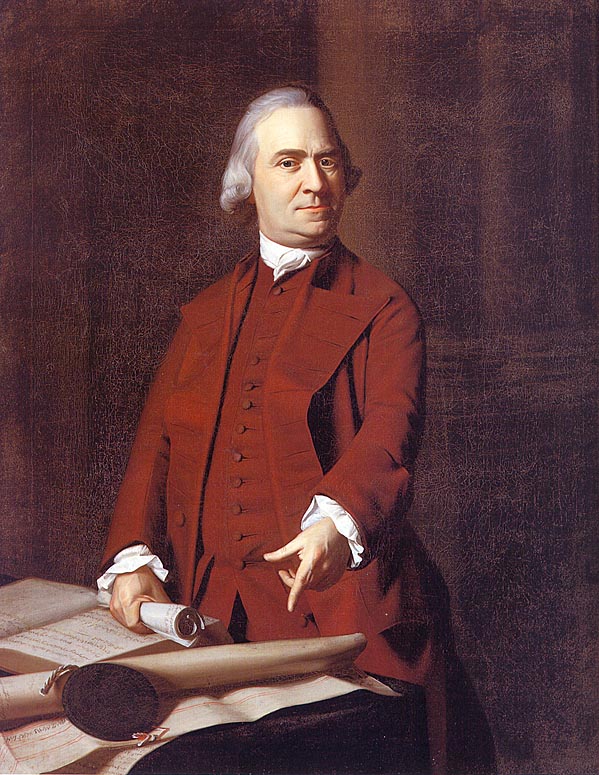 Left: Portrait of Samuel Adams by Copley Click on image to enlarge Webmaster note: The following series of letters to and from Samuel Adams establish the great respect for this patriot in that others of importance turned to him for advice during times of great urgency. The letters are part of the Ms. Samuel Adams Papers, Lenox Library., and may be found also in S. A. Wells, Samuel Adams and the American Revolution, vol. i., p363-365 and p370-371. Do not use spell check on these documents if you wish to retain the original context and grammar. We are indebted to Miguel and Regina Azucena for this e-contribution, originally published in The Writings of Samuel Adams, Vol II and Vol III, edited by H. A. Cushing c1904 - 1908. For more Sam Adams (the orations, not the beer!) follow this link to his more famous work, The Rights of Colonists The first writing is extracted from Samuel Adams' resolves for the Boston City Council on the subject of the rights of colonists, and includes a list of specific grievances. Of these greivances, number 10 addresses the Dockyards Act, which was the specific law that the British used as cause to send any found Gaspee attackers to England for trial. List of Infringements 20 Nov 1772 The next letter is a tirade of Adams about the Gaspee commission of inquiry, published under his editorial pen name of "Americanus." It was published widely, at least in the Newport Mercury, December 21st, 1772, and reprinted in the Providence Gazette, December 26th, 1772, and in the Virginia (Jamestown) Gazette on Thursday, January 28, 1773.. It should be stated that historian Charles Rappleye in Sons of Providence: The Brown Brothers, the Slave Trade, and the American Revolution (Simon & Schuster, 2006) believes Americanus to be Stephen Hopkins. The letter to Adams is from RI Deputy Governor Darius Sessions, RI Chief Justice Stephen Hopkins, John Cole, Esq, and the influential Moses Brown. It was a plea for advice on how the Colony of Rhode Island should respond to Britain convening a special commission of inquiry to discover the people involved in the Burning of the Gaspee. This commission had been instructed by King George III to deliver any persons so indicted to the Royal Navy for transport to England for trial and later execution. Note the the letter was important enough to have been written on Christmas Day. Sessions et al to Adams 25 Dec 1772 The first hurried response from Adams is dispatched only three days later and attests to the importance Adams paid to the matter. Adams to Sessions 28 Dec 1772 The more extensive response from Adams is of the utmost historical importance, for in it, one can see Adams evolve the idea of resurrecting the Committees of Correspondence, which will ultimately lead to the unification of the Colonies on the road to independence. It is true that Boston had established an intra-colony Committee of Correspondence on Nov 2, 1772, but this writing here expressly promoted the idea of Committees to correspond between the individual Colonies. Adams to Sessions 2 Jan 1773 Adams later wrote to Sessions counseling against Governor Wanton sitting on the Royally appointed commission of inquiry into the Burning of the Gaspee. He also suggests that the Rhode Island Assembly formally object to these proceedings. Adams to Sessions -- Feb 1773 Adams then corresponded about the Gaspee Affair with Richard Henry Lee, a Virginia statesman and revolutionary of like ilk to Samuel Adams himself. Richard Henry Lee is generally credited with initiating the concept of the intercolonial Committees of Correpondence by advocating for its formation within the Virginia House of Burgess, which was done March 12, 1773 <see The Committees of Correspndence> In this letter Lee expresses to Adams the alarm felt by Virginia colonists over the Gaspee matter and asking for further details and analysis. There is not, however, any mention of Committees of Correspondence.. Lee to Adams 4 Feb 1772 Finally, we present Adams' response to Lee, in which Adams invites the reestablishment of formal Committees of Correspondence between the Colonies to assess such threats to liberty. This letter was penned a month after the initial passage by the Virginia House of Burgess establishing such a Committee of Correspondence, so we cannot credit Sam Adams with the first sembence of the idea, although it is clear that he and Richard Henry Lee thought alike. It is also possible that some triangular correspondence was going on between Adams, Richard Henry Lee, and Lee's brother and close friend of Adams, Arthur Lee, or others, that transmitted the idea. Adams to Lee 10 April 1773 Since we have opened the can of worms related to which Colony actually called first for the establishment of the intercolonial Committees of Correspondence, we will answer that question here by citing the writings of Thomas Jefferson. From: The Works of Thomas Jefferson in Twelve Volumes. Federal Edition. Collected and Edited by Paul Leicester Ford. Found online at Library of Congress, American Memories Collection, [<http://memory.loc.gov/ammem/mdbquery.html> Type in "Gaspee" in search field] Thomas Jefferson Papers, Thomas Jefferson, July 27, 1821, Autobiography Draft Fragment, January 6 through July 27. Original Images at pages 521-522 of 1302. 1821.
Jan. 6. ...The origination of these commees of
correspondence between
the colonies has been since claimed for Massachusetts,
and Marshall II.
151, has given into this error, altho' the very note
of his appendix to
which he refers, shows that their establmt was
confined to their own
towns. This matter will be seen dearly stated in a
letter of Samuel
Adams Wells to me of Apr. 2, 1819, and my answer of
May 12. I was
corrected by the letter of Mr. Wells in the
information I had given Mr.
Wirt, as stated in his note, pa. 87, that the
messengers of Massach.
& Virga crossed each other on the way bearing
similar propositions,
for Mr. Wells shows that Mass. did not adopt the
measure but on the
receipt of our proposn delivered at their next
session. Their message
therefore which passed ours, must have related to
something else, for I
well remember P. Randolph's informing me of the
crossing of our
messengers.
|
| THE
RIGHTS OF THE COLONISTS, A LIST OF VIOLATIONS OF RIGHTS
AND A LETTER OF
CORRESPONDENCE. Adopted by the Town of Boston, November 20, 1772. A List of Infringements & Violations of Rights 10th - The Act passed in the last Session of the British Parliament, intitled, An Act for the better preserving his Majestys Dock Yards, Magizines, Ships, Ammunition and Stores, is, as we apprehend a violent infringement of our Rights. By this Actany one of us may be taken from his Family, and carried to any part of Great Britain, there to be tried whenever it shall be pretended that he has been concerned in burning or otherwise destroying any Boat or Vessel, or any Materials for building &c.any Naval or Victualling Store &c. belonging to his Majesty. For by this Act all Persons in the Realm, or in any of the places thereto belonging (under which denomination we know the Colonies are meant to be included) may be indicted and tryed either in any County or Shire within this Realm, in like manner and form as if the offence had been committed in said County, as his Majesty and his Successors may deem Most expedient. Thus we are not only deprived of our grand right to tryal by our Peers in the Vicinity, but any Person suspected, or pretended to be suspected, may be hurried to Great Britain, to take his tryal in any County the King or his Successors shall please to direct; where, innocent or guilty he is in great danger of being condemned; and whether condemned or acquitted he will probably be ruined by the expense attending the tryal, and his long absence from his Family and business; and we have the strongest reason to apprehend that we shall soon experience the fatal effects of this Act, as about the year 1769 the British Parliament passed Resolves for taking up a number of Persons in the Colonies and carrying them to Great Britain for tryal, pretending that they were authorised so to do, by a Statute passed in the Reign of Henry the Eighth, in which they say the Colonies were included, although the Act was passed long before any Colonies were settled, or even in contemplation. - |
| From
the
Providence Gazette,
of
Saturday, December 26, 1772 -also republished in many
other American
newspapers and later in the London
Evening Post, Saturday March 20th, 1773: To be, or not to
be,
that's the question ; whether our unalienable rights
and privileges are
any longer worth contending for, is now to be
determined. Permit
me, my countrymen, to beseech you to attend to your
alarming situation.
The stamp act you opposed with a spirit and resolution becoming those who were truly solicitous to transmit to posterity those blessings which our forefathers purchased for us in the wilds of America, at an immense expense of blood and treasure. But behold, an evil infinitely worse, in its consequences, than all the revenue laws which have been passed from the reign of Charles the First, to this time, now threatens this distressed, piratically plundered country. A court of inquisition, more horrid than that of Spain or Portugal, in established within this colony, to inquire into the circumstances of destroying the Gaspee schooner; and the persons who are the commissioners of this new-fangled court, are vested with most exorbitant and unconstitutional power. They are directed to summon witnesses, apprehend persons not only impeached, but even suspected! and them, and every of them, to deliver them to Admiral Montagu, who is ordered to have a ship in readiness to carry them to England, where they are to be tried. Three of the commissioners are a quorum, who are directed to apply to General Gage, for troops to protect them in their offices, and preserve the colony from riots and disturbances. The royal commission for these gentlemen, together with their instructions, transmitted to Admiral Montagu, who, upon being notified that they are convened in conformity to their appointment, is to attend them, and then deliver their commission and instructions, and to be aiding with his sage counsel and advice, whenever necessary. So much has transpired, respecting this alarming star-chamber inquisition. And who among the natives of America, can hear it without emotion? Is there an American, in whose breast there glows the smallest spark of public virtue, but who must be fired with indignation and resentment, against a measure so replete with the ruin of our free constitution? To be tried by one's peers, is the greatest privilege a subject can wish for; and so excellent is our constitution, that no subject shall be tried, but by his peers. Tina establishment is the grand barrier of our lives, liberties and estates; and whoever attempts to alter or invade this fundamental principle, by which the liberties of the people have been secured from time immemorial, is a declared enemy to the welfare and happiness of the King and state. The tools of despotism and arbitrary power, have long wished that this important bulwark might be destroyed, and now have the impudence to triumph in our faces, because such of their fellow subjects in America, as are suspected of being guilty of a crime, are ordered to be transported to Great Britain for trial, in open violation of Magna Charta. Thus are we robbed of our birth-rights, and treated with every mark of indignity, insult and contempt; and can we possibly be so supine, as not to feel ourselves firmly disposed to treat, the advocates for such horrid measures with a detestation and scorn, proportionate to their perfidy and baseness? Luxury and avarice, a more fatal and cruel scourge than war, will ere long ravage Britain and ultimately bring on the dissolution of that once happy kingdom. Ambition, and a thirst for arbitrary sway, have already banished integrity, probity and every other virtue, from those who are entrusted with the government of our mother country. Her colonies loudly complain of the violences and vexations they suffer by having their moneys taken from them, without their consent by measures more unjustifiable than highway robbery; and applied to the basest purposes,—those of supporting tyrants and debauchees. No private house is inaccessible to the avarice of custom-house officers , no place so remote whither the injustice and extortion of those miscreant tools in power, have not penetrated. Upon the whole, it is more than probable, it is an almost absolute certainty, that, according to the present appearances, the state of an American subject, instead of enjoying the privileges of an Englishman, will soon be infinitely worse than that of a subject of France, Spain, Portugal, or any other the most despotic power on earth; so that, my countrymen, it behooves you, it is your indespensable duty to stand forth in the glorious cause of freedom, the dearest of all your earthly enjoyments; and, with a truly Roman spirit of liberty, either prevent the fastening of the infernal chains now forging for you, and your posterity, or nobly perish in the attempt. To live a life of rational beings, is to live free; to live a life of slaves is to die by inches. Ten thousand deaths by the halter, or the axe, are infinitely preferable to a miserable life of slavery in chains, under a puck of worse than Egyptian tyrants, whose avarice nothing less than your whole substance and income, will satisfy; and who, if they can't extort that, will glory in making a sacrifice of you and your posterity, to gratify their master the devil, who is a tyrant, and the father of tyrants and of liars. AMERICANUS.
|
| To
Samuel Adams: Providence
Dec 25, 1772
We doubt not you have before this heard of the difficulties this Colony labors under, on account of the destruction of the Gaspee, they being such as becomes the attention of the Colonies in general (though immediately to be executed on this only). As they affect in the tenderest point the liberties, lives, and properties of all America, we are induced to address you upon the occasion, whom we consider as a principal in the assertion and defence of those rightful and natural blessings; and in order to give you the most authentic intelligence into these matters, we shall recite the most material paragraphs of a letter from the Earl of Dartmouth to the Governor of this Province, dated Whitehall, Sept. 4th, 1772. [Then follows the extract from the Secretary's letter.] You will consider how natural it is for those who are oppressed, and in the greatest danger of being totally crushed, to look around every way for assistance and advice. This has occasioned the present troubles we give you. We therefore ask that you would seriously consider of this whole matter, and consult such of your friends and acquaintance as you may think fit upon it, and give us your opinion in what manner this Colony had best behave in this critical situation, and how the shock that is coming upon us may be best evaded or sustained. We beg you, answer as soon as may be, especially before the 11th of January, the time of the sitting of the General Assembly. Darius Sessions
Stephen Hopkins John Cole Moses Brown |
| TO DARIUS
SESSIONS.1
BOSTON Decr 28 1772
SIR This day I had the Honor of receiving a Letter signd by yourself and other Gentlemen of Note in Providence. The Subject is weighty, & requires more of my Attention than a few Hours, to give you my digested Sentiments of it; neither have I yet had an Opportunity of advising with the few among my Acquaintances, whom I would chuse to consult upon a Matter, which in my Opinion may involve the Fate of America. This, I intend soon to do; and shall then, I hope, be able to communicate to you (before the Time you have set shall expire) such Thoughts, as in your Judgment, may perhaps be wise and salutary on so pressing an Occasion. Thus much however seems to me to be obvious at first View; that the whole Act of Parliament so far as it relates to the Colonies, & consequently the Commission which is founded upon it, is against the first Principles of Government and the English Constitution, Magna Charta & many other Acts of Parliament, declaratory of the Rights of the Subject; & therefore the Guardians of the Rights of the Subject will consider whether it be not their Duty, so far from giving the least Countenance to the Execution of it, to declare it, ipso Facto null & Void. This Commission seems to be substituted in the Room of a Grand Jury, which is one of the greatest Bulwarks of the Liberty of the Subject; instituted for the very Purpose of preventing Mischeife being done by false Accusers. By the Act of Parliament of the 25th of Ed. 3d (in the true Sense of the Words the best of Kings) it is establishd, that none shall be taken by Suggestion made to the King or his Council (which seems to me to be the present Point) unless it be by Indictment or Presentment of good & lawful People of the same Neighbourhood, where such Deeds be done - And, "if any thing be done against the same it shall be redressd & holden for none." But certain Persons proscribd in the Colony of Rhode Island, are to be taken without such Indictment or Presentment, & carried away from the Neighborhood where Deeds unlawful are suggested to the King to have been committed, & there put to answer contrary to that Law, which even so long ago was held to be the old Law of the Land. - One Reason given in the Act for taking away that accursed Court called the Star Chamber was, because all Matters examinable & determinable before that Court might have their due Punishment and Correction by the Common Law of the Land and in the ordinary Course of Justice elsewhere. But here seems to be a stopping of the ordinary Course of Justice; & by setting up a Court of Enquiry founded upon a Suggestion of evil Deeds made to the King & of certain Persons supposd to be concernd therein, Jurisdiction is given to others than the constituted ordinary Courts of Justice, & in a Way other than the ordinary Course of the Law, that is, an arbitrary Way to examine & draw into Question Matters & things which, by the Act for regulating the privy Council it is declared, that neither his Majesty nor his privy Council have or ought to have any Jurisdiction Power or Authority to do. In short, this Measure appears to me to be repugnant to the first Principles of natural Justice. The interrested Servants of the Crown, and some of them pensiond, perhaps byassd & corrupted being the constituted Judges, whether this or that Subject shall be put to answer for a supposd Offence against the Crown, & that in a distant Country, to their great Detriment & Danger of Life & Fortune, even if their Innocence shd be made to appear. What Man is safe from the malicious Prosecution of such Persons, unless it be the cringing Sycophant, and even he holds his Life and Property at their Mercy. It should awaken the American Colonies, which have been too long dozing upon the Brink of Ruin. It should again unite them in one Band. Had that Union which once happily subsisted been preservd, the Conspirators against our Common Rights would never have venturd such bold Attempts. It has ever been my Opinion, that an Attack upon the Liberties of one Colony is an Attack upon the Liberties of all; and therefore in this Instance all should be ready to yield Assistance to Rhode Island. But an Answer to the most material Part of your Letter must be referd, for the Reasons I have given, to another Opportunity. In the mean time I am with due Regards to the Gentlemen who have honord me with their Letter Your assured Friend & very hbl Servt____________________________________Samuel Adams Editor's Note:
1 Of
Providence,
R. I. Under date of December 25, 1772, Deputy Governor
Sessions, Chief
Justice Stephen Hopkins, John Cole, and Moses Brown
had written to
Adams
with reference to the Gaspee affair and to
Lord Dartmouth's
letter
to the Governor of Rhode Island of September 4, 1772.
A copy is in S.
A.
Wells, Samuel Adams and the American Revolution, vol.
i., pp. 363-365.
A copy of a letter, under date of February 15, 1773,
from Sessions,
Hopkins,
Cole, and Brown to Adams, acknowledging the receipt of
three letters
from
Adams in response to their letter of December 25,
1772, is in ibid.,
pp.
370, 371. In this letter to Adams his correspondents
comment as
follows:
"At or about the time we wrote you, we transmitted
copies of the same
to
several gentlemen in North America, from the most of
whom we have
received
answers, agreeing nearly in sentiments, with those you
were pleased to
communicate to us though no one has entered into a
disquisition of the
subject so fully and satisfactorily as you have." The
original letter
is
also in the Lenox Library.
|
| TO DARIUS
SESSIONS.
BOSTON Jan 2 1773.
SIR, I wrote you on Monday last acknowledging the Receipt of a Letter directed to me from your self & other worthy Gentlemen in Providence. The Question proposed was in what manner your Colony had best behave in this critical Situation & how the Shock that is coming upon it may be best evaded or sustaind. It appears to me probable that the Administration has a design to get your Charter vacated. The Execution of so extraordinary a Commission, unknown in your Charter & abhorrent to the principles of every free Government, wherein Persons are appointed to enquire into Offences committed against a Law of another Legislature, with the Power of transporting the persons they shall suspect beyond the Seas to be tryed, would essentially change your Constitution; and a Silence under such a Change would be construed a Submission to it. At the same time it must be considerd that an open declaration of the Assembly against the Appointment & order of the King, in which he is supported by an Act of the British Parliament, would be construed by the Law Servants of the Crown & other ministers such a Defiance of the Royal Authority, as they would advise proper to be recommended to the Consideration & Decision of Parliament. Should your Governor refuse to call the Commissioners together, or when called together, the civil magistrates refuse to take measures for arresting & committing to Custody such persons as upon Information made shall be chargd with being concernd in burning the Gaspee, or if they should issue their precepts for that purpose the Officers should refuse to execute them, the Event would be perhaps the same as in the Case of an open Declaration before mentiond, for in all these Cases it would be represented to the King & the parliament that it was to be attributed to what they will call the overbearing popularity of your Government, & the same pretence would be urgd for the Necessity of an Alteration in order to support the Kings Authority in the Colony. As the chiefe Object in the View of Administration seems to be the vacating your Charter, I cannot think the Commissioners in case they should meet together, would upon any of the aforementiond Occasions, chuse to call upon General Gage for the Aid of the Troops or make any more than the Shew of a Readiness to execute their Commission; for they might think the grand purpose would be sufficiently answerd without their Discussing such danger to their Reputation, if not their persons. If the foregoing Hypotheses are well grounded, I think it may be justly concluded that since the Constitution is already destined to suffer unavoidable Dissolution, an open & manly Determination of the Assembly not to consent to its ruin would show to the World & posterity that the people were virtuous though unfortunate, & sustaind the Shock with Dignity. You will allow me to observe, that this is a Matter in which the whole American Continent is deeply concernd and a Submission of the Colony of Rhode Island to this enormous Claim of power would be made a Precedent for all the rest; they ought indeed to consider deeply their Interest in the Struggle of a single Colony & their Duty to afford her all practicable Aid. This last is a Consideration which I shall not fail to mention to my particular friends when our Assembly shall sit the next Week. Should it be the determination of a weak Administration to push this Measure to the utmost at all Events, and the Commissioners call in the Aid of troops for that purpose it would be impossible for me to say what might be the Consequence, Perhaps a most violent political Earthquake through the whole British Empire if not its total Destruction. I have long feard that this unhappy Contest between Britain & America will end in Rivers of Blood; Should that be the Case, America I think may wash her hands in Innocence; yet it is the highest prudence to prevent if possible so dreadful a Calamity. Some such provocation as is now offerd to Rhode Island will in all probability be the immediate Occasion of it. Let us therefore consider whether in the present Case the Shock that is coming upon you may not be evaded which is a distinct part of the Question proposed. For this purpose, if your Governor should omit to call the Commissioners together, in Consequence of a representation made to him by the Assembly, that the Innovation appears to them of a most dangerous Tendency; and altogether needless, inasmuch as the same Enquiry might be made as effectually (and doubtless would be) by a Grand Jury, as is proposed to be made by the Commissioners; which would be agreable to the Constitution & in the ordinary Course of Justice. A representation of this kind made by the Assembly to the Governor, would afford him a reasonable plea for suspending the Matter till he could fully state the Matter to Lord Dartmouth & the odious light in which the Commission is viewd by that & the other Colonies as a measure incompatible with the English Constitution & the Rights of the Colonists together with the fatal Consequences of which it might probably be productive. This perhaps could not be done till the rising of Parliament, & before the next Session a war or some other important Event might take place which would bury this Affair in Oblivion. Or if it should ever come before Parliament in this Manner, the Delay on the part of the Governor would appear to be made upon motives of sound prudence & the best Advice which would tend to soften their Spirits. And besides, its appearing to be founded not directly on the principles of Opposition to the Authority of Parliament, the sacred Importance of Charters upon which many of the Members hold their Seats, might be considerd without prejudice, & the Matter might subside even in Parliament. Should that be the Case it would disappoint the designs & naturally abate the Rigour of Administration & so the Shock might be evaded. If, without being called together by Governor Wanton who is first named, the rest of the Commissioners should meet upon the Business of their Commission, which I cannot suppose they will do, especially if the Governor should acquaint them with the Reason of his not calling them, it would show a forward Zeal to execute an order new arbitrary & universally odious, & how far that might justly insence the people against them personally, & lessen them in the Esteem of all judicious Men, they would do well calmly to consider; and how far also they would be answerable for the fatal Effects that might follow such a forwardnesss all the world and Posterity will judge: For such an Event as this will assuredly go down to future Ages in the page of History, & the Colony & all concernd in it will be characterizd by the part they shall act in the Tragedy. Upon the whole it is my humble Opinion, that the grand Purpose of Administration is either to intimidate the Colony into a Compliance with a Measure destructive of the freedom of their Constitution, or to provoke them to such a Step as shall give a pretext for the Vacation of their Charter which I should think must sound like Thunder in the Ears of Connecticutt especially. Whatever Measures the Wisdom of your Assembly may fix upon to evade the impending Stroke, I hope nothing will be done which may by the Invention of our Adversarys, be construed as even the Appearance of an Acquiescence in so grasping an Act of Tyranny. Thus I have freely given my Sentiments upon the Question proposed; which I should not have venturd to do had it not been requested. I have done it with the greatest Diffidence because I think I am fully sensible of my Inability to enter into a Question of so delicate a Nature & great Importance especially as I have not had that opportunity to consult my friends which I promisd my self. I hope the Assembly of Rhode Island will in their Conduct exhibit an Example of true Wisdom Fortitude & Perseverance. And with the greatest Respect to the Gentlemen to whose superior Understanding this and my former Letter to you is submitted, I remain, Sir Your assured friend & humble servantP.S. I beg just to propose for Consideration whether a circular Letr from your Assembly on this Occasion, to those of the other Colonies might not tend to the Advantage of the General Cause & of R Island in particular; I should think it would induce each of them, at least to injoyn their Agents in Great Britain to represent the Severity of your Case in the strongest terms.Samuel Adams To the Hon Darius Sessions Esqr to be communicated |
To DARIUS SESSIONS. [February --,
1773.]
SIRAs I am informd the Commissioners are all now in Newport, and your Assembly is to meet this day I am anxious to know precisely the Steps that are or shall be taken by each. I hope your Governor will not think it proper for him to act in the Commission if the others should determine so to do. Will it not be construed as conceding on his part to the Legality of it? Every Movement on the Side of the Commissioners & the Assembly must be important. I trust no Concessions will be made on your part which shall have the remotest tendency to fix a precedent; for if it is once establishd, a thousand Commissions of the like arbitrary kind may be introducd to the utter ruin of your free Constitution. The promoters of ministerial measures in this Town are pleasd to hear from one of the Commissioners that they are treated with great respect: Even common Civility will be thus colourd to serve the great purpose. Will it not be necessary at all Events for the Assembly to enter a protest on their Journal against so unconstitutional a proceeding. This is the Sentiment of a Gentleman here whose Judgment I very much regard. Such has been the constant practice of the Assembly of this province in like Cases, for some years past. You will see by our Governors Speech what Use is made of Mistakes of this Sort; they are even Improved as Arguments of our having voluntarily consented to be the Vassals of the British Parliament. Indeed the Doctrine he has advancd strikes at the root of every civil Constitution in America. If it be admissible, you have no just Cause to complain of the present Measure for it is founded upon the Authority of that parliament, to the Jurisdiction of which notwithstanding your Charter, you remain subject. I shall receive a Letter from you by the return of the post if your Attention to the publick Affairs will admit of it, as a great favor. In the mean time I beg you to excuse this hasty Scrawl & believe me to be &c Samuel Adams
|
|
To Samuel Adams Feb. 4, 1773
Sir,From a person quite unknown to you some apology may be necessary for this letter. The name of my brother, Dr. Arthur Lee of London, may perhaps furnish me with this apology. To be firmly attached to the cause of liberty on virtuous principles is a powerful cause of union, and renders proper the most easy communication of sentiment, however artfully disunion may be promoted and encouraged by tyrants and their abettors. If this be true in general, how more certainly is it so in that particular state of affairs in which every scheme that cunning can form, or power execute, is practised to reduce to slavery so considerable a portion of the human species as North America does and may contain. Every day's experience proves this to an attentive observer. Among other instances in proof, if I mistake not, the manner of resenting the loss of the Gaspee is one. At this distance, and through the uncertain medium of newspapers, we may never perhaps have received a just account of this affair. I should be extremely glad, sir, when your leisure permits, to have as true a state of the matter as the public with you has been furnished with. At all events, this military parade appears extraordinary, unless the intention be to violate all law and legal forms, in order to establish the ministerial favorite, but fatal precedent of removing Americans beyond the water, to be tried for supposed offences committed here. This is so unreasonable and so unconstitutional a stretch of power, that I hope it will never be permitted to take place while a spark of virtue or one manly sentiment remains in America. The primary end of government seems to be the security of life and property; but this ministerial law would, if acquiesced in, totally defeat every idea of social security and happiness. You may easily, sir, perceive that I understand myself writing to a firm and worthy friend of the just rights and liberty of America, by the freedom with which this letter is penned. Captain Snow, of your town, who comes frequently here, and who takes care of this, will bring me any letter you may be pleased to favor me with. Richard Henry Lee
|
| To
R. H. Lee Boston, April 10,
1773
SIR---Your Letter to me of the 4th Feb last, I receivd with singular Pleasure; not only because I had long wishd for a Correspondence with some Gentleman in Virginia, but more particularly because I had frequently heard of your Character and Merit, as a warm Advocate for Virtue and Liberty. I have often thought it a Misfortune, or rather a Fault in the Friends of American Independence and Freedom, their not taking Care to open every Channel of Communication. The Colonies are all embarkd in the same bottom. The Liberties of all are alike invaded by the same haughty Power: The Conspirators against their common Rights have indeed exerted their brutal Force, or applied their insidious Arts, differently in the several Colonies, as they thought would best serve their Purpose of Oppression and Tyranny. How necessary then is it; that ALL should be early acquainted with the particular Circumstances of EACH, in Order that the Wisdom & Strength of the whole may be employd upon every proper Occasion. We have heard of Bloodshed & even civil War in our Sister Colony North Carolina; And how strange is it, that the best Intelligence we have had of that tragical Scene, has been brought to us from England! This Province, and this Town especially, have sufferd a great Share of Ministerial Wrath and Insolence: But God be thanked, there is, I trust, a Spirit prevailing, which will never submit to Slavery. The Compliance of New York in making annual Provision for a military Force designed to carry Acts of Tyranny into Execution: The Timidity of some Colonies and the Silence of others is discouraging: But the active Vigilance, the manly Generosity and the Steady Perseverance of Virginia and South Carolina, gives us Reason to hope, that the Fire of true Patriotism will at length spread throughout the Continent; the Consequence of which must be the Acquisition of all we wish for. The Friends of Liberty in this Town have lately made a successful Attempt to obtain the explicit political Sentiments of a great Number of the Towns in this Province; and the Number is daily increasing. The very Attempt was alarming to the Adversaries; and the happy Effects of it are mortifying to them. I would propose it for your Consideration, Whether the Establishment of Committees of Correspondence among the several Towns in every Colony, would not tend to promote that General Union, upon which the Security of the whole depends. The Reception of the truly patriotick Resolves of the House of Burgesses of Virginia gladdens the Hearts of all who are Friends to Liberty. Our Committee of Correspondence had a special Meeting upon this Occasion, and determined immediately to circulate printed Copies in every Town in this Province, in order to make them as extensively useful as possible. I am desired by them to assure you of their Veneration for your most ancient Colony, and their unfeigned Esteem for the Gentlemen of your Committee. This indeed is a small Return; I hope you will have the hearty Concurence of every Assembly on the Continent. It is a Measure that I think must be attended with great and good Consequences. Our General Assembly is dissolved; and Writs will soon be issued according to the Charter for a new Assembly to be held on the last Wednesday in May next. I think I may almost assure you that there will be a Return of such Members as will heartily cooperate with you in your spirited Measures. The most enormous Stride in erecting what may properly be called a Court of Inquisition in America, is sufficient to excite Indignation even in the Breast the least capable of feeling. I am expecting an authentick Copy of that Commission, which I shall send to you by the first opportunity after I shall have receivd it. The Letter from the new Secretary of State to the Governor of Rhode Island, which possibly you may have seen in the News papers, may be depended upon as genuine. I receivd it from a Gentleman of the Council in that Colony, who took it from the Original. I wish the Assembly of that little Colony had acted with more firmness than they have done; but as the Court of Enquiry is adjournd, they may possibly have another Tryal. I have a thousand things to say to you, but am prevented by Want of Time; having had but an hours Notice of this Vessels sailing. I cannot however conclude without assuring you, that a Letter from you as often as your Leisure will permit of it, will lay me under great Obligations.--- I am in strict
Truth
Sir Your most humble servt Samuel
Adams
|
| Back to Top | Back to Gaspee Virt |