Gaspee Virtual
Archives Virtual
Archives |
| The
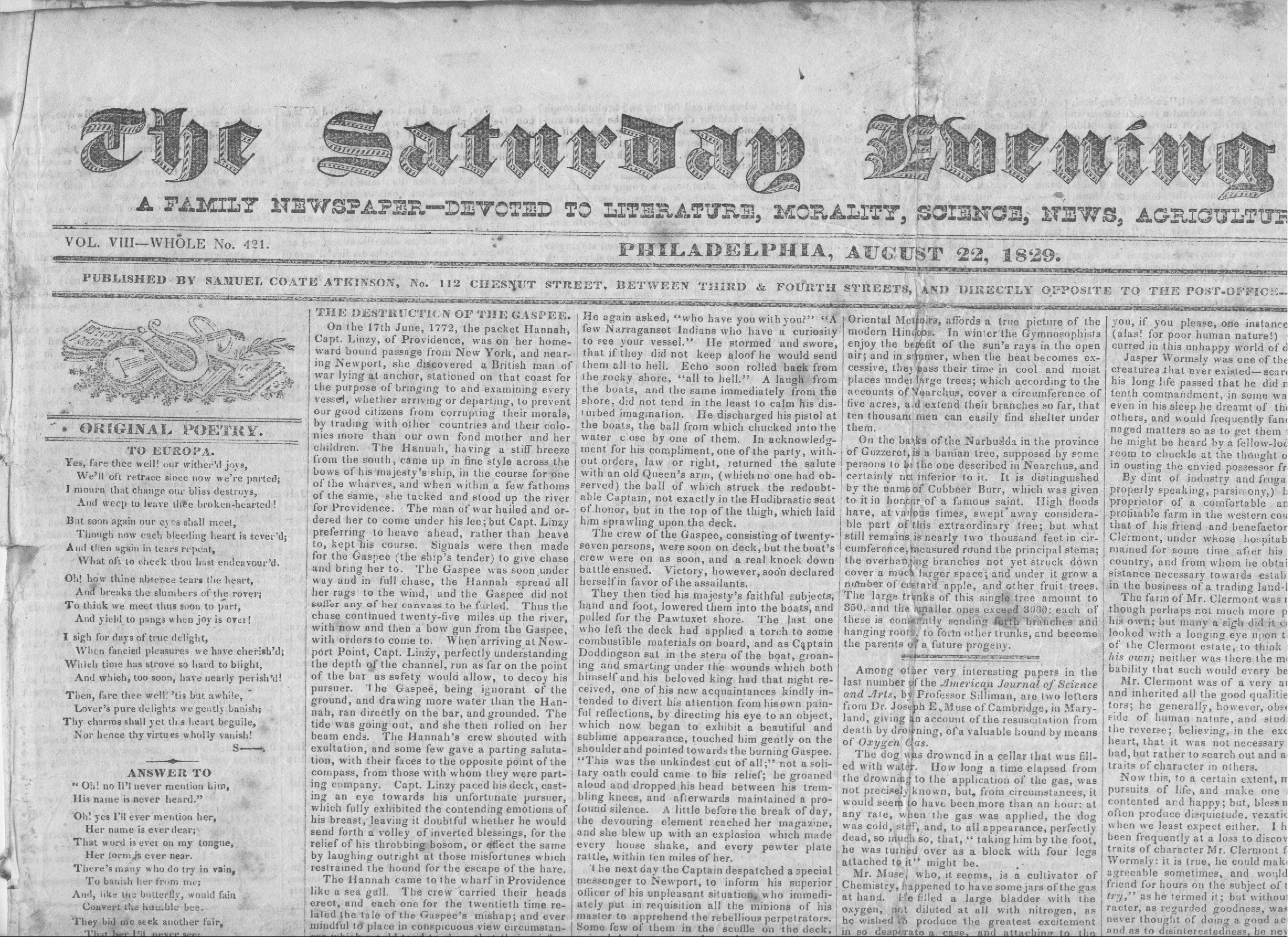
Saturday Evening Post, August 22, 1829 |
 (Click
on image to enlarge) (Click
on image to enlarge)Webmaster commentary: The following article was discovered from a July 2003 eBay auction of an old edition of the Saturday Evening Post. It was published on Page 1, above the fold even, and, in fact, was the lead story. It was apparently first published in a Putney, Vermont newspaper in February, 1829 and was written by someone called Varro. It next appeared in the Providence, RI Cadet and Statesman on March 25, 1829. This newspaper was published by former RI Governor Arthur Fenner, and the introductory remark by the editor stated that the article, "is a faithful delineation of an event interesting to every American as the commencement of those hostilities which finally led to our separation from the mother country." In reading the article from an informed view, it appears that the source the unnamed reporter interviewed was probably Ephraim Bowen, one of the last surviving members of the crew that burnt the Gaspee, and who died in 1841. As is well known, Bowen gave his accounting to the press in the more widely repeated 1839 account. But this article, published ten years before, contains many of the factual errors Bowen was known to have perpetuated in his later article. In particular, the date of June 17th, 1772 is known to have actually been June 9, 1772. Captain Linzy of the Hannah was actually Captain Benjamin Lindsey. Lieutenant Doddingston (misspelt with two middle 'd's) was actually Lt. Dudingston. Newport Point is probably the reporter's misinterpretation of Namquid Point (now Gaspee Point). Note the first paragraph of this article, for in it appears a carefully worded, genteel sentence that indicates that the crew of the Hannah mooned the Gaspee once the latter was grounded and helpless. Peter Crooch, the town drummer, is previously unknown to us, and the very extensive character description reminds us of someone pretending to write like Charles Dickens. Perhaps the reporter was attempting to impress his editors. Most people at the time related that Daniel Pearce was the drummer. The article is presented below exactly as it was written in 1829. |
| The
Saturday Evening Post. Vol. VIII-Whole No. 421. Philadelphia, August 22, 1829 The
Destruction
of the Gaspee. The Hannah came to the wharf in Providence like a sea gull. The crew carried their heads erect, and each one for the twentieth time related the tale of the Gaspee's mishap; and ever mindful to place in conspicuous view circumstances which would tend to show that their misfortune arose from their own consummate skill and good management. The excitement ran high among the good citizens of Providence; to have one of their vessels chased by a man of war, or rather the cur dog of a man of war, they felt to be a stigma upon their character they could not succumb. Soon was heard the thundering noise of old P. Crooch, the town drummer. Peter was formerly drummer in the French war; he was a chubby built fellow, about five feet three inches high, and as to symmetry of form resembling a Florida duck. His coat was made of cotton cloth, in those days called fustian; the nap or furze, long since worn off, showing the magnitude of each thread; of the color of a leaf in December. When spread out it formed a circle, except that the shears made a straight line across the bottom. His small clothes were originally deer skin, but for want of the same material, to supply a few vacancies which time and service had effected, his wife had nicely fitted in a part of the hide of one of the bleating race. They extended just below the point of the knee, hiding but a small share of the flaxen stockings, which dame Crooch knit for her jolly Peter. His shoes, which were something of the same hue of the patches on his breaches, were confined to his feet by a huge pair of silver buckles, which Peter said once belonged to a French officer. He would not exactly say that he took them from a dead man's feet, but that the feet which once wore them would need buckles no longer. His hat was a real helmet a la Mancha; it was given him while in the service of his captain, made of real beaver, round on the top, being originally cocked up, but he had from time to time cut and rounded the brim as it cracked off in spots, until it had but little more left than an old basin. His face was round and much the color of his shoes, occasioned by the bad whiskey furnished him while in the service. One eye was sightless, covered with a film, giving him the appearance of quizzing those with whom he conversed. Thus sallied forth, blink-eyed, twadling Peter, beating "to arms, to arms," through the streets and lanes, flanked by boys and idlers, which increased at every step, until, having assembled a huge concourse of children of every age from five to twenty and five, he brought, them to a stand still in front of a broad shed, erected at the end of one of the stores, where for a moment he seemed to expend all his wrath on the head of his drum, and then ceased, and casting up his eye to the top of the shed, there appeared a tawny Narragansett Indian, dressed in full costume.—He first gave a shrill whoop, which attracted every eye, he then commenced in good English:—"those who feel disposed to go upon a secret, saucy expedition, that may possibly give their necks a tight cravat, will appear on Sheldon's wharf this evening, precisely at nine o'clock, dressed as you see; me," turning round to exhibit. his savage vestment. He continued, "let none come except stout hearts, and blood to the back bone." He vanished from their sight.— "Who was that Indian?" dropped from mouths without number, and no one could answer, but all supposed that Peter was able to gratify their curiosity, and to the oft repeated question, Peter, with a knowing twist of his sound eye, always replied, "if the old man knows two things, he will keep one for his own use." Before the hour appointed more than five hundred were on the wharf, and among them were many of the most active and influential citizens of Providence, who were very busy in examining those who offered themselves for the expedition. They made short work of it, and soon sixty-four hale, saucy fellows, which were adjudged worthy "to pass muster." They were then placed in eight long boats, belonging to the different vessels then lying at the wharves, and in each boat was placed the three or four baskets full of paving stones. Thus equipped with a strong and steady pull at the oar, they slided swiftly down the river, and within half a mile of the Gaspee, they received their instructions from one who, by common consent, was considered commander-in-chief of the expedition. With muffled oars, they rowed silently towards her, and when within a few rods they were hailed by the sentinel on board. No answer being given he discharged his piece, and received in return a discharge of paving stones, which caused him to make a precipitate retreat. At this instant Capt. Doddingson, the commander of the Gaspee, appeared on his deck, which was an inclined plane, somewhat askew, as the vessel lay-upon her beam ends, and as the tide receded, she partly rolled upon her side. This Capt. Doddingson was as pert a little fellow as ever mounted an epaulette, well versed in the vocabulary of profane terms. He demanded the name of the leader. The answer he received was "the sheriff of the county of Kent." He again asked, "who have you with you?" "A few Narragansett Indians who have a curiosity to see your vessel." He stormed and swore, that if they did not keep aloof he would send them all to hell. Echo soon rolled back from the rocky shore, "all to hell." A laugh from the boats, and the same immediately from the shore, did not tend in the least to calm his disturbed imagination. He discharged his pistol at the boats, the ball from which chucked into the water close by one of them. In acknowledgment for his compliment, one of the party, without orders, law or right, returned the salute with an old Queen's arm, (which no one had observed) the ball of which struck the redoubtable Captain, not exactly in the Hudibrastic seat of honor, but in the top of the thigh, which laid him sprawling upon the deck. The crew of the Gaspee, consisting of twenty-seven persons, were soon on deck, but the boat's crew were on as soon, and a real knock down battle ensued. Victory, however, soon declared herself in favor of the assailants. They then tied his majesty's faithful subjects, hand and foot, lowered them into the boats, and pulled for the Pawtuxet shore. The last one who left the deck had applied a torch to some combustible materials on board, and as Captain Doddingson sat in the stern of the boat, groaning and smarting under the wounds which both himself and his beloved king, had that night received, one of his new acquaintances kindly intended to divert his attention from his own painful reflections, by directing his eye to an object, which now began to exhibit a beautiful and sublime appearance, touched him gently on the shoulder and pointed towards the burning Gaspee. "This was the unkindest cut of all," not a solitary oath could come to his relief; he groaned aloud and dropped his head between his trembling knees, and afterwards maintained a profound silence. A little before the break of day, the devouring element reached her magazine, and she blew up with an explosion which made every house shake, and every pewter plate rattle within ten miles of her. The next day the Captain despatched a special messenger to Newport, to inform his superior officer of his unpleasant situation, who immediately put in requisition all the minions of his master to apprehend the rebellious perpetrators. Some few of them in the scuffle on the deck, gained broken arms, banged eves, and other honorable wounds, and all who could not return home during the absence of daylight, found a friendly shelter among some of the inhabitants of Pawtuxet, who felt no particular emotions of sympathy for the king or his naval officers. Finding every attempt for discovering the actors to be fruitless, he despatched a vessel to England to inform his royal master of the insulting indignity offered the crown and the people of his realm, in this small and despised colony. The king immediately sent over his proclamation, offering a reward of £1000 sterling for the said sheriff of Kent, and £500 per man for either or every one of the said Indians. But as there did not happen to be any one at that time in Providence, or in the whole plantation, very much in want of cash, he has never to this day been called upon to pay the aforesaid reward. |
| Back to Top | Back to Gaspee Virtual Archives |