Gaspee Virtual
Archives Virtual
Archives |
| Research
Notes on Captain Christopher Sheldon (1732-1799) The Gaspee Days Committee at www.gaspee.COM is a civic-minded nonprofit organization that operates many community events in and around Pawtuxet Village, including the famous Gaspee Days Parade each June. These events are all designed to commemorate the 1772 burning of the hated British revenue schooner, HMS Gaspee, by Rhode Island patriots as America's 'First Blow for Freedom' TM. Our historical research center, the Gaspee Virtual Archives at www.gaspee.ORG , has presented these research notes as an attempt to gather further information on one who has been suspected of being associated with the the burning of the Gaspee. Please e-mail your comments or further questions to webmaster@gaspee.org. |
| Evidence implicating
Christopher Sheldon:
In the John Sheldon of
Providence (and Records of His Descendants) by Keith M. Sheldon,
1984, Whippoorwill Publishing, Evansville, IN, a genealogical
reference, in the Footnotes on page 771 (and
referring to the Christopher) entry, we find the following:
[11], p28 Christopher
Sheldon, #1423, owner of the Sheldon Wharf in Providence,
participated
in rebellious action of June 10, 1772 which captured and burned the
British revenue boat "Gaspee" at Gaspee point in Narragansett Bay.
From Sheldon Family Association Quarterly VIII:1, January 1993, p. 263 by Irving Sheldon:
One of the first violent affairs that presaged the Revolution was the
attack on, and the burning of the British ship, the “Gaspee,” grounded
on the point now known as Gaspee Point on the Providence River one
evening in June of 1772. Our late cousin, Hazard Knowles, has told us
in the past of the tradition in his branch of our family that
Christopher (Sheldon) was in charge of one of
the longboats which rowed down from
Providence that night.
'Hap'
Knowles
was a revered founding member of the Gaspee Days Committee.
In the June 7-8, 1978 Gaspee Days special supplement to the Warwick Beacon, p23, he was
interviewed:Knowles' own
great great grandfather, Christopher Sheldon, was a skipper on one of
John Brown's long boats, he said. His ancestry dates back to the
original commander of the Pawtuxet Rangers, Samuel Aborn, whose sword
Knowles carries as a member of today's Rangers.
Note that
one
doesn't proclaim that one was 'skipper' of a simple longboat, unless
that longboat is involved in attacking the Gaspee.The following brief passage is excerpted from the website of the late psychologist William Sheldon: <http://www.innerexplorations.com/catpsy/ws.htm>. The passage (speaking of his boyhood and upbringing) reads: And all over the
pre-Revolutionary war homestead where he grew up he saw the evidence of
where he had come from.
On the night of June 10th, 1772 Christopher Sheldon had joined 8 rowboats full of Providence men who made their way with muffled oars to his majesty's ship Gaspee, sent to enforce the stamp act, and burned her. |
| Biographical Notes:
by Joe E. Sheldon , a decendant-relative Most of the source material for the following article comes from Sheldon Family Association Quarterly VIII:1, January 1993, p. 263 by Irving Sheldon, and from John Sheldon of Providence (and Records of His Descendants) by Keith M. Sheldon, 1984, Whippoorwill Publishing, Evansville, IN. Christopher Sheldon was
born in Providence Rhode Island on February 18, 1732. Four days later
on February 22 a notable gentleman named George Washington was born in
a different locale. Both were to be involved in the events of the time
but especially the French and Indian War and the American Revolutionary
War. As a youth and young man Christopher was born
into a family intertwined
with many of the other area families by marriage since Providence was a
town of about 4,000 individuals. At least two of these were the
Tillinghast and the Fenner families, both well known locally. His
father was
Town Treasurer for many years and, according to Chase, Providence
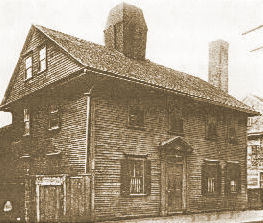
houses, 1779, had built a sizable house near the still standing
warehouse on South Main Street.
Christopher Sheldon
married his cousin,
Rosanna Arnold, before he was 21, and they had two sons and
three
daughters (all born in Providence) before she died in 1766:
Further genealogy is available in Wayne G.
Tillinghast, The Tillinghasts in
America: The First Four Generations (2006). Sometime prior to the French and Indian War
time period he began
working for the Brown family mercantile interests and served as a
Master on several of their ships which career he continued for much of
the rest of his time as a seaman. During the French and Indian War, he
functioned as a privateer on two Brown ships, both of which were
captured in 1764, the snow, Dolphin
and the schooner, Rosanna. After that time he worked
with the Brown family in more “normal” maritime efforts as
master of the brig, George, (
1767-1771) which sailed between Providence
and Paramaribo, Surinam for Nicholas Brown & Co. One record
that Irving Sheldon discovered was
a bill for carrying a French
captain to Antigua. A Rhode Island privateer had captured this
gentleman, and this was a step in returning the captain to French
territory. For his services, Christopher billed the
Colony. Another is a letter from Sheldon to his bosses, the Brown
brothers: Paramaribo,
December
13th, 1767
Gentlemen:
After my
respects to you, these may serve to inform you of
my safe arrival here on the 28th November after 37 days passage (to a
bad market). Brought all my horses in, but some of them in bad order.
Met with loss of eight sheep only.
That one very hard gale of wind which began with me on the 29th of October in Latitude 34 40 Longitude 62 (650 miles or so northwest of Bermuda) from the SSW to the WNW but the height of the gale was from WSW to WbyS which continued to blow hard for about sixty hours in which time scudding made several days difference in the length of my voyage by falling to windward further than I had expected. I think we had very great luck in saving our stock through such a gale; I‘ve not had so hard a one for several voyages past, and must give the “George” the praise of being the best vessel for scudding that ever I sailed in. She proved much the same for tightness in the gale as at other times, making about the same water as she did when left home, but now makes very little I judge then occasioned by some open pace in her upper works.” etc. The Gaspee raid is well documented both in the Gaspee Virtual Archives and in the Bucklin Society websites which between them give many wonderful insights into the life and times of the Gaspee Affair. It is left to the reader to thoroughly investigate both websites for very extensive information. In mid 1772 at the time
of the Gaspee raid, Captain Christopher Sheldon was 40 years old and Captain
Joseph Tillinghast (a known Gaspee Raider and longboat captain) was
38. Probably both would have known John
Mawney, the “physician” on the Gaspee raid since Tillinghast
eventually married Mawney’s sister. As we shall see from later events,
Christopher was both well known and well respected by his
contemporaries and was heavily involved in the First Baptist Church in
Providence. In addition (and since I
mentioned earlier that the Sheldon and Tillinghast lines were
intertwined by marriage) as some additional food for thought, the
Fenners and Sheldons were likewise intertwined since Richard Fenner
married Abigail Sheldon in 1716. This would further strengthen the
possibility of Christopher's involvement in the raid. Since John
Brown had seen to it that ship captains known to him were to
command the longboats, it seems to be quite likely that Captain
Christopher Sheldon was in charge of one of the longboats being of an
age (40) to have some mature judgment and with experience in
privateering as well as then working for the Browns. In addition, the
Browns were involved in the Baptist Church as was not only Christopher
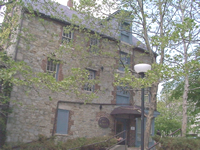
but his family before him. In 1784 Christopher built a warehouse
building (which still stands and
is used as the law offices of Homonoff, Levine &
Pulner) at 369 South Main Street. The structure is one of the very few
in the vicinity that survived the devastating fire just about a year
after Christopher’s death in 1799. It is today a very gracious and
charmingly restored example of a building constructed in 1784 as
attested to by its cornerstone and as may be seen in the Library of
Congress website dealing with the Historic American Building Registry.
The building was mislabeled by a local society as to who built it and
when but perhaps that will now be corrected. And then there’s this,
appearing in the
Saturday, Nov. 16, 1799 Providence
Gazette: Died: On
Thursday morning, very suddenly, Cap't Christopher Sheldon, in the 68th
year of his age, much and deservedly lamented. He was for many years an
able and experienced nautical commander, and he sustained many offices
of trust, the duties of which he discharged with that integrity and
benevolence which marked his character through his life. He was
universally esteemed as an honest man, a sincere Christian, and a
highly valuable and useful citizen. His funeral will be attended
tomorrow afternoon, immediately after divine service, when the friends
of the deceased, and citizens in general, are invited to attend.
His etate was adminsiered by fellow Gaspee
raider Capt. Joseph Tillinghast. To sum it all up,
Christopher was a man of his times active in civic and religious
affairs of the town and was well regarded by his peers. It also seems
likely he was indeed a Gaspee raider and was one of the many of them
that were, out of respect, protected from any possible British
intrusions. Even at the time of his death it was probably too close to
the actual event to speak publicly about such things due to concern
about reprisals. Many people are not aware of the fact that those loyal
to the Crown persisted in various forms of agitation and mischief until
almost the Civil War. Addendum: |
|
Land issues: An issue of the Saturday
Evening Post of August 22, 1829 has a narrative that says the
Gaspee
raid was launched from the Sheldon Wharf but this location is not as
widely accepted as the one normally cited - Fenner’s Wharf.. The 1829
narrative, it should be noted (which some think might have had Ephraim Bowen as the source), was some 10 years
closer to the actual event than that of the 1839 Bowen account whose
primary source then was his 86 year old memory.
Christopher’s
father was
“Deacon” (active in the Baptist church) Joseph Sheldon, a grandson of
Pardon Tillinghast and the Sheldon family owned a goodly amount of land
in the southern part of Providence (all of the general locale of where
Sheldon Street still stands). The Sheldon area of land was
mostly just south of the Tillinghast land, but another Sheldon parcel
to the north extended to the river and that was land upon which the
good Deacon had built a 144-foot wharf. In those times having a
waterfront outlet was very helpful to conducting trade of any sort.
This land was also the location where a building at 369 South Main
Street is now located which is only two blocks south of the Sabin
Tavern
location as well as Fenner’s wharf,
locations where the plot to attack the Gaspee was formulated and from
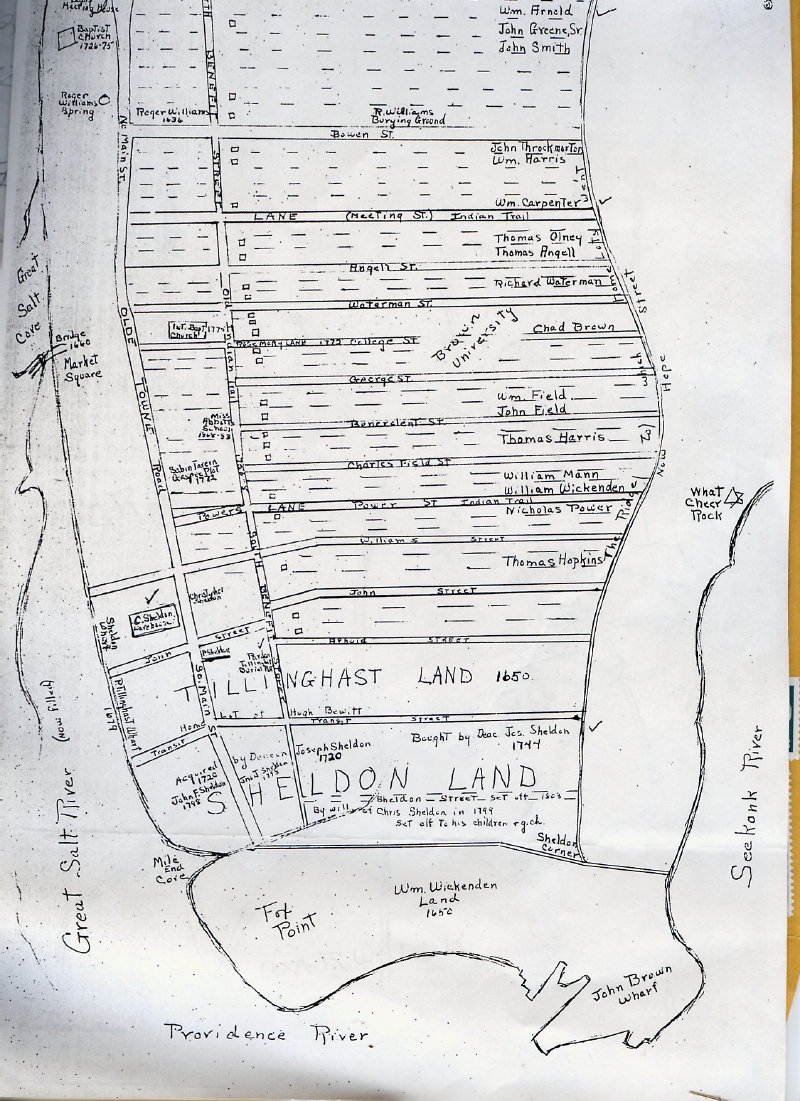
where they departed on their mission. Christopher Sheldon, appears at IB2 and IB3 grids on the map of 1770 Providence taxpayers, as well as a Pardon Sheldon at IB2, and a Land? Sheldon at ID3. I believe the mystery of "Land Sheldon" can be easily clarified. I have consulted some hand sketched maps from family sources (again, not sure of origin, etc.) about this mystery since there WAS no Land Sheldon per the 932 page John Sheldon of Providence ... genealogical book by Keith M. Sheldon. Instead, these casual maps show what would also be called a "Land Tillinghast" and I would doubt there were such a Tillinghast at the time. Instead, in the case of both "Lands", this map shows them to be "Sheldon land" and "Tillinghast land" with the Sheldon land being contiguous and to the south of the Tillinghast land. The "Sheldon land" was contiguous to the north of Mile End Cove - Fox Point - John Brown Wharf - William Wickenden land and went further north to Transit Street where it met the Tillinghast land (which stretched east to west from The Ridge (now Hope Street, I believe) to the river on the west encompassing Pardon Tillinghast's burial site. At the west terminus on this "T. land" was the Tillinghast Wharf and to the north of that wharf was the adjacent Sheldon Wharf (on the land where 369 South Main still stands). |
| For his role in the attack and burning of the HMS Gaspee in 1772, the Gaspee Days Committee recognizes Captain Christopher Sheldon as a true American patriot. |
| Back to Top | Back to Gaspee Virtual Archives |