Gaspee Virtual Archives Virtual Archives |
| Dr.
(Col.) John Mawney (1751-1830) by Dr. John Concannon
The Gaspee Days Committee at www.gaspee.COM is a civic-minded nonprofit organization that operates many community events in and around Pawtuxet Village, including the famous Gaspee Days Parade each June. These events are all designed to commemorate the 1772 burning of the hated British revenue schooner, HMS Gaspee, by Rhode Island patriots as America's 'First Blow for Freedom' TM. Our historical research center, the Gaspee Virtual Archives at www.gaspee.ORG , has presented these research notes as an attempt to gather further information on one who has been suspected of being associated with the the burning of the Gaspee. Please e-mail your comments or further questions to webmaster@gaspee.org. |
| Evidence
to Indict John Mawney: The source proving John Mawney's participation in the Gaspee attack is that of his own first-hand account, handwritten in the archives found in the Rhode Island Historical Society, and as later published, in an edited form, in 1826 by the Providence American and Gazette. Senator Theodore Foster, a lifelong friend of Mawney's, had urged him to publish his recounting of the attack on the Gaspee. Dr. Mawney would have been 21 years old at the time of his participation in the attack on the Gaspee. |
| Biographical
Sketch: John Mawney was born in 1751 and was a descendant of rather wealthy French Huguenots. His father, also John Mawney, was born in East Greenwich in 1718 and married Amey Gibbs in 1745 (see http://www.gencircles.com/users/joanolsson/1/data/11678). John Mawney (1718) was described in his daughter's later obituary as being a merchant from Providence. We find the senior John Mawney's (1718) name in a partnership with Stephen Hopkins as owners of the Rhode Island privateering ship Reprisal, in 1745 during King George's War1A. The elder John Mawney also had served as Sheriff of Providence from 1746 to until his death in 1754, dying only three years after the younger John was born, but leaving a sizable estate1. According to Wayne G. Tillinghast in The Tillinghasts In America: The First Four Generations. (RI Genealogical Society, 2006), p312-316 7, John's maternal uncle, Dr. Ephraim Bowen, was executor for the estate of John Mawney (1718), and managed the large real estate holdings for the benefit of young John Mawney (1751). This is the very same Dr. Bowen whose son (and Dr. John Mawney's first cousin), Ephraim Bowen, Jr., gives the most retold account of the burning of the Gaspee. Mawney was apparently well educated, was known to study the Classics, and could speak Latin. All of these skills were essential for anyone pursuing the study of medicine and surgery. It is probably accurate to state that he was a medical student at the time of his participation in the attack on the Gaspee in 1772. Fellow Gaspee raider Ephraim Bowen, Jr. stated that at the time of the raid, "John Mawney, who had for two or three years been studying physic and surgery, ...." Mawney, in the preface to his own statement about his recollection of the attack on the Gaspee indicates that he was personally acquainted with several persons who had been shot and killed at the Boston Massacre of 1770; this suggests that he may have been receiving some of his medical training in Boston during that time. On the other hand, it stretches Mawney's credibility with his assertion that among the five Colonists killed at the Boston Massacre were, "two of my intimate acquaintances and friends." Four of those killed were likely dockworkers or sailors, only Samuel Maverick was possibly an apprentice to a dentist. Since he was recognized in 1781 as a Regimental Surgeon he must have had some formal medical education, but such education was not standardized back then in the Colonies. It would be unlikely that he trained at a European medical school for he was probably too young to have been accepted at the time. He more probably trained as an apprentice under his uncle, Dr. Ephraim Bowen, and later with his first wife's father, Dr. John Wilson, in the Hopkinton, Massachusetts area, not far from the Northern border with Rhode Island. It is also important to know that 'Surgeons', as he was, were often quite differently trained than the 'physicians' that used herbs and concoctions (see Solomon Drowne, MD). It can only assumed that John Mawney was akin to a Doogie Howser MD; and it's not unheard of at the time. At age 20, his close friend, Theodore Foster, had already graduated Brown University, married and had a child, completed a law degree, and began practicing law in Providence, RI. The early completion of their educations probably stems from the lack of a formalized educational routine in eighteenth century America, so that they were not held back by the necessity of finishing each school grade level that we have today. And the practice of surgery, at that time, had a somewhat limited skill set to master since general anesthesia was not invented until 1842. A busy surgeon's practice likely consisted of lancing boils, general wound care, setting broken bones, and performing amputations when necessary with plenty of alcohol and a bullet to bite. In 1781 Mawney was appointed surgeon of the 3rd Company of Providence, [Second Regiment, Providence County Militia]. The RI Historical Society has in its possession an empty wooden box for which the provenance indicates it was a case for the surgical instruments of Dr. Mawney. He is not known to be listed in any local directory of notable doctors of the time2. While he was supposedly trained as a surgeon, he was never known to have practiced much surgery or medicine after his stint in the Revolutionary War. But then, the practice of surgery or medicine at the time was arduous and frequently not well paid. Since Mawney was wealthy to begin with, he must have felt no economic imperative that forced him into a continuing role in that occupation. 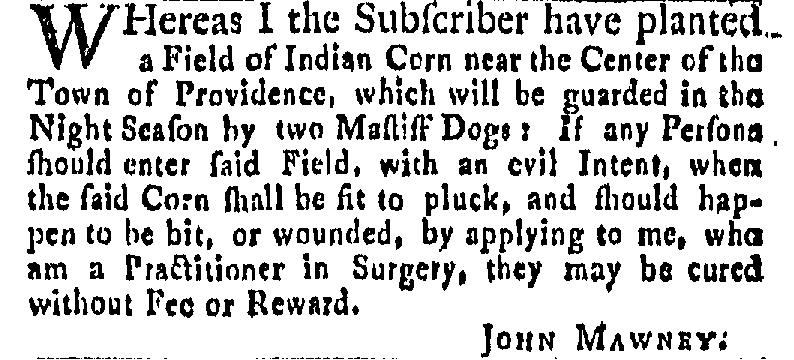 Right: Doctors
were generally not
allowed to advertise their services so it is not
surprising that we do
not see ads in the local newspapers; but we do
find a rather
bizarrely humorous
newspaper ad advising the public that the field of
corn owned by Right: Doctors
were generally not
allowed to advertise their services so it is not
surprising that we do
not see ads in the local newspapers; but we do
find a rather
bizarrely humorous
newspaper ad advising the public that the field of
corn owned by John Mawney, "Practitioner of Surgery" was being guarded by two mastiffs, but he would attend to anyone bitten, free of charge. (Providence Gazette, 12 June 1773, p3). European mastiffs were large and ferocious watch dogs that were a dying breed until interbred with the American bull dog in the late 1800s to create the more commonly known bull-mastiff of today.. It can be surmised from historical accounts of the Gaspee incident, however, that Doctor Mawney gave fairly competent care to the wounded Lt. Dudingston. He removed the bullet from the wound site above the groin. The 'scrapping of lint' was likely an attempt to promote clotting of the wound, and to prevent abcess formation by keeping the wound open to granulate Remember, there were no antibiotics available at the time. He then applied what appears to be a pressure bandage over the site and was able to adequately stem the hemorrhage. Given the location of the wound and the lack of antibiotics or of definitive surgical closing of the musket ball wound, it is truly wondrous that Dudingston survived the attack at all. In fact, Dudingston's wound to the groin was not to the testicles, but just off to the side, nearby on the leg. He is known to have fathered four children by 1806. On the other hand, Dudingston, in his December 1772 petition for relief to King George III claims that the musket ball was still embedded in his groin, and may have traveled down to his knee, If true, the ball might have split, and Mawney only removed a portion of it. In either event, Dr. Mawney was wise to have declined the invitation of one Dr. Henry Sterling to visit with the recovering Lt. Dudingston. Had Dudingston recognized him, Mawney might have been hung as a traitor to the Crown. Newspaper and journal accounts of the Revolutionary
period
cite that Mawney
in 1774
was appointed quartermaster for the Providence Troop of
Horse, in
1775
was a charter member of Captain General's Cavaliers,
described as the
crack troops within the State, and which fought at the
battle of Rhode
Island. One source claims that he was
Captain
of a sloop, Gaspee, "as one of the most
conspicuous
actors
in this remarkable event."3
In
1781 Mawney was appointed surgeon of the 3rd Company
of Providence, in 1785 was a Lieutenant., and between
1789 to 1792 was
Lieutenant Colonel, Commanding, of the First Regiment of
Providence
County. That honor may have been largely
ceremonial as the
Revolution had been over for 10 years, but on the other
hand, there was
no regular, standing US Army at the time so the local
militias stood
ready to fill that void should it have been
needed. We have no
evidence, as of yet, as to whether Dr. Mawney was
deployed in action
either in state or out of state. Unfortunately, because
he died
in 1830, we can find no
application for pension based on any service in the
Revolutionary War.
We can, however, assume that he was never grievously
wounded since he
did not apply for a invalid pension that was offered in
earlier years.
After 1794 Mawney removed from Providence to his inherited farmland in neighboring Cranston. Mawney's other estate comprised 94 acres; a large portion of what is now known as the Elmwood neighborhood in the West End of Providence, nearby or within the confines of the adjoining city of Cranston. In Providence land evidence documents he called himself a 'yeoman' which at the time referred to a farmer that worked his own farm, in this case at his Cranston estate in the Elmwood area, though he probably had hired help. It was likely located not far from, if not on, the site of Mawney Street in Providence. In the summer of 1802 he was advertising in the Providence Phoenix land for lease off of Pleasant Street, and in June of 1815 he was advertising for lease or sale both his estates in Cranston and in Providence. He may have been overpriced; for he ran the ad for over three years, and the Providence estate was sold at auction in March 1825. Sometime around 1778 he resided in just over the
northerly
RI-MA
border in Hopkinton, MA where both his first and second
wives families
were from. In 1788 John Mawney was among those
listed in the Providence
Gazette as Justices of
the Peace for Providence, and in 1792 as both a Town
Auditor and a
Clerk of the Market. In 1792, ads in the Gazette listed him
a sheriff (as
was his late father), often chasing horse thieves.. He
was elected as
Representative to the General Assembly several time
between 1796 and
1801, and frequently served on the Cranston town council
between 1797
and 1817. In 1798, he was appointed a Justice of the
Peace for
Cranston. Between 1801 and 1803, John
Mawney was listed as Sheriff for Providence County.
In 1791 he
was listed as a member of the Providence Society for the
Abolition of
Slavery It was common to have slaves in the
1750-1770 era, and he
refers to a
Pero (presumably his household slave) in his statement
about his
participation in
the Gaspee
attack, but it
should be pointed out that Mawney was an
Abolitionist in his later years. A notice of
1805 lists him as a member of the Providence, Cranston,
and Johnston
Detecting Society, and in 1809 he was president of that
society. According to The Records of the Original Proceedings of the Ohio Company : Ohio Company Series (Marietta, Ohio: Marietta Historical Commission, 1917, 564 pgs) a Colonel John Mawney was an active stake holder in Ohio land development in the 1790s, as was Gaspee raid leader Abraham Whipple., and in fact we find an ad taken out by John Mawney in the 2April1796 Providence Gazette regarding a stake holder meeting in Providence of the Ohio Purchase Company.
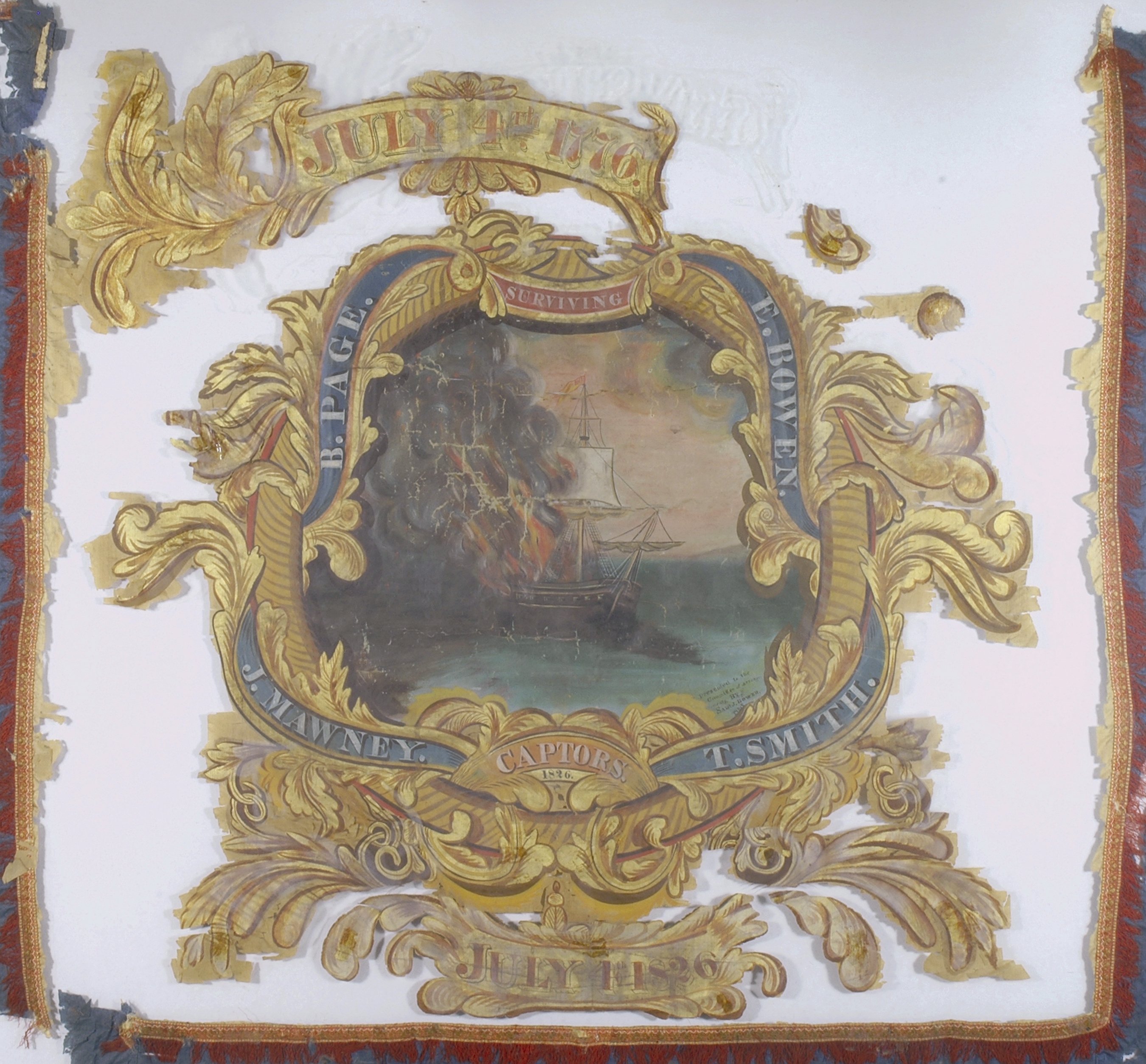
We are told tales of how he rode in a carriage during the 50th Anniversary Gaspee Parade of 1822, and often in the 4th of July Parades with Ephraim Bowen et al to be ceremoniously honored as part of the crew that burned the Gaspee6. Dr. Mawney died at the age of 80 at his Cranston
estate.
John's
obituary
appeared
on March 2, 1830 in the Providence Phenix.
His grave
stone
states that Dr. Mawney achieved the rank of Colonel in
the Rhode Island
Militia. He is buried in the Old North Burial Ground at
Providence, as
is his father, and not far from his fellow Gaspee
raider, Joseph
Bucklin. |
|
Notes: 1A. Chapin, Howard M., Rhode Island Privateers in King George's war : 1739-1748 (Providence: Rhode Island Historical Society :, 1926, 246 pgs), p177.1 . www.bucklinsociety.net/ Visited June, 2000. 2. Personal communication, Dr. Stanley Aronson, RI Medical Society, May, 2000. 3. Service Records and Cemetery Inscriptions of Revolutionary Soldiers, Beacon Pole Hill Chapter, DAR, 1934. [While this is probably a misinterpretation of some confusion by other historians, it is interesting to postulate about the American Continental Navy having a ship named after the Gaspee attack.] 4. Providence Journal, April, 1972. 5. Potter, Elisha R. Memoir concerning the French settlements and French settlers in the colony of Rhode Island, Genealogical Publishing Co, Baltimore, MD, 1968. 6. The Bridge, newsletter of Pawtuxet Village Association, June, 2000. 7.Tillinghast, Wayne G., The Tillinghasts In America: The First Four Generations. (RI Genealogical Society, 2006), p312-316 |
| Genealogical
Addendum: For further facts on the Mawney family, see A Mawney Line of Descent, by Stanley W. Arnold, Jr., Rhode Island Genealogical Register, Vol 11 ( 1988) at 202 et seq.1 . The following is adapted from: http://www.gencircles.com/users/joanolsson/1/data/11688 This information is obviously taken from a late 19th century source. THE MAWNEY FAMILY: John Mawney (1718 - 1754), son of Col. Peter Mawney (1689 - 1754) and Mary Tillinghast (1694 - 1726), died just before his father, and his will is recorded in Providence. He married, October 29, 1745, Amey Gibbs (1725 - 1805), daughter of Robert Gibbs (1697 - 1769), who is described on his tombstone in the North Burial Ground, as descended from the family of Sir Henry Gibbs (1593 - 1667), of Dorsetshire, England. Amey Whipple Gibbs (c1700 - 1757), wife of Robert Gibbs, was daughter of Col. Joseph Whipple (c1662 - 1746), and widow of (???most logically, John [c1694 - 1719]???) Crawford. The five children of John Mawney and Amey Gibbs Mawney were: 1. Mary (c1746 - 1757), died aged eleven years. 2. Nancy or Anne (1747 - 1765) died aged seventeen
years.
Married by
Joseph
Potter, Justice. Obituary in Providence
Gazette of 9March1765 names her as "Miss Anne
Mawney" 3. Pardon, born at Providence, December 27, 1748; died August 6, 1831 on the homestead, in East Greenwich, given him by his grandfather's will. He married Experience Gardiner (1751-1815), daughter of Caleb Gardiner (c1710-___), of South Kingstown and had 15 children (see http://www.whipple.org. One offspring of this marriage was Amey Mawney (1777-1864) who married William Earle Tillinghast (c1777/8 - 25 Apr 1817), who happened to be the son of Gaspee raider Captain Joseph Tillinghast, Dr. John Mawney's best friend. Joe Tillinghast and John Mawney lived together around the time of the Gaspee Affair in 1772. Another offspring of Pardon and Experience Mawney was a John G. Mawney b 1770, not our guy, but a source of potential confusion. 4. Dr. John Mawney (c1751-1830), a physician, sometime sheriff of Providence county, and was in the expedition that burnt the Gaspee. He died in Cranston, on 3 March 1830, in his 80th year, and was buried in the North Burial Ground, as are many fellow Gaspee raiders. He married, first, Nancy (or Mary Ann) Wilson (dau. of Dr. Wilson of Hopkinton, MA) on 2 Dec 1775; married second, Elizabeth Prentice Clarke (1765-1803), married 5 APR 1784 in Hopkinton, MA. We can't find a trace on Nancy. Curiously, neither of his wives under any name variation are listed separately as being buried with him, or even appear with the last name Mawney in the RI Historical Cemeteries Database. They may have been buried in their home town of Hopkinton, MA. For that matter, neither does his mother, Amey (Gibbs) Mawney. . Children: a. John W., married Ruth, daughter of John Gladding, He died at his father's farm in 1816 after a long illness and left one child, Elizabeth, who married William A. Cole, and resided in Shakapee, Minnesota. Note: this John may have been son of Dr. John Mawney and his first wife, Nancy Wilson.5. Hannah (c 1753 - 1789), daughter of John Mawney (1718) and Amey Gibbs, married Stephen Harris (son of David and Martha [Jenckes] Harris), January 23, 1775. She died at the age of 36, leaving one son, Stephen M. Harris, father of the late Almoran Harris. |
| Special thanks to Wayne G. Tillinghast whose notable new book, The Tillinghasts In America: The First Four Generations. (RI Genealogical Society, 2006), p312-316 is a compendium of genealogical and biographical information on Dr. John Mawney, and many other Gaspee Raiders. |
| For his prominent part in the attack on the HMS Gaspee in June of 1772, the Gaspee Days Committee recognizes John Mawney as a true American patriot. |
| Return to Top | Back to Gaspee Virtual Archives |
 Dr. John Mawney's
large home lot appears on the map of
Dr. John Mawney's
large home lot appears on the map of