Gaspee Virtual Archives Virtual Archives |
| Catherine
William's Account
of the Burning of the Gaspee Excerpted from: Williams, Catherine, Biography
of Revolutionary Heroes: Containing the Life of Brigadier Gen. William
Barton and also of Captain Stephen Olney. Providence, Published
by the author, 1839, pp 19-24.
|
| INTRODUCTORY
REMARKS. It has often been a question, where the first active opposition to the encroachments of the British Government was offered. We believe the question may now be fairly settled, and that honor awarded to Newport, R.I. The first act of popular resistance to the arbitrary conduct of the officers of that government, it appears, was in that town. It was in the destruction of an armed British sloop, called the Liberty, which had been fitted out in Boston to enforce the revenue laws, and was directed to examine and detain all vessels suspected of violating them. It was caused by the sloop firing on a Captain Packwood, of Connecticut, who in resentment for the liberties taken in searching his brig, had left there without permission. Great discontent had been felt previous, at the arbitrary and overbearing deportment of the officers; and the populace had got to the right temperament to seize the first occasion that presented to chastise their insolence. Accordingly, having assembled a large company on the Long wharf, where the sloop of war lay, they demanded the man who fired at Captain Packwood. The officer of the sloop made a feint of looking for him, but contrived not to find the right one; and probably fearing a scene of violence, the whole company, except one mate, abandoned the sloop and came on shore. The populace then went on board, cut her cables, and she drifted over to a wharf on the Point. Here she was again boarded, her masts cut away, and all her armament-and stores of war thrown overboard; they then scuttled her, and left her to the mercy of the waves. They subsequently set fire to her, and taking her boats, dragged them through the streets to the Parade, where they set fire to them. Tradition says, that owing to the keels of the boats being shod with iron, a stream of fire followed them as they were dragged over the pavement with violence. This, in the year 1769 (if we except the general spirit of insubordination manifested at the act passed in September, 1764, to tax the Colonies, and the famous stamp act trod close upon its heels,) was the first. A very general impression on the minds of persons who have never read that act, seems to be, that it was a small addition to the price of paper for deeds, bonds, wills, and a few more conveyances, such as one generally calls upon a lawyer to write; and we recollect hearing the question propounded more than once -- What great evil could there be in having to buy a peculiar kind of paper a little more costly to execute an instrument on, which was rarely wanted and must be recorded, and therefore, not improperly bearing some stamp upon it? Having never read the act ourselves, we were unable give the particulars, but since having perused it, we are not at a loss to discover the cause of the burning indignation manifested by all classes of people. It almost surpasses belief, that the British Government could have believed it possible for say, class of men to submit to; to think of giving a duty upon every thing, the smallest piece of paper for even receipts and notes of hand; the price rising in proportion to the sum specified. Thus, for a piece of paper for securing a sum of money between 10 and £20, one shilling; between 20 and £30, one shilling and sixpence, and. so on. For a license to sell spirituous liquors, the paper cost ten shillings, and for retailing wine a stamp paper cost £4; that was "in case they did not take out a license for selling spirituous liquors." Thus punishing the venders of wine, because they did not sell rum. Conscience! Not only that it would have taken the half of every man's substance, a person who did much business would have to keep running all the time, unless he laid in a cargo of these papers. It seems, however, that they were never used in the Colonies, and in general not permitted to land. An advertisement for a newspaper must be stamped, and cost two shillings. This act, as well as it might be, was the cause, and doubtless, cause sufficient, had no other existed, for a dismemberment of the Colonies. No person of even ordinary intellect, but what saw in this, the beginning of a contest, destined only to end in the utter separation of the Colonies from the parent government. From this time, though the odious stamp act was shortly repealed, the affections of the people were alienated, and each subsequent motion watched with jealousy. The duty upon tea, so highly resented some years after, was only three cents upon a pound; but knowing it was going to form a precedent for greater exactions and oppressions, was, as every one knows, resisted with a degree of violence that set the whole country in a flame, and was the immediate precursor of the Revolution. The destruction of the sloop Liberty in Newport made no other alteration except in the management of the thing. The revenue laws still continued to be enforced with much severity, but the conduct of the officers was more guarded. They still adhered to the right of search, but dared not put it in practice, until about three years after, in June 1772, one Lieutenant Dudingston was stationed in Narragansett Bay, in a tender called the Gaspee, for the enforcement of revenue laws, (which of themselves, by the way, were exceedingly oppressive,) seemed disposed to exercise his authority with a high hand. There were others then in the harbor of Newport, who had commenced the old method of compelling every vessel to round to, and suffer an universal overhauling, or in the case of refusal, they had ventured in several instances to send a few shot after them, not to do much damage to be sure, but just to show their authority. On the 10th of June, the commander of the Gaspee, who had for some days past boarded, searched and otherwise insulted several outward and homeward bound vessels, attacked a sloop called the Hannah, a Providence and New York packet, commanded by one Lindsey, of Providence, ordering, her to " come to." The packet, however, took no notice, but kept straight on her course up Narragansett Bay. Lieutenant Dudingston then called out, and ordered her to take down her colors in passing (that is, to lower them to the Royal standard,) still the sloop kept on, when the Gaspee fired on her and gave chace. Captain Lindsey, whose light craft could ran much nearer the shore, managed to decoy the tender, until they had, in following the sloop, run upon a Point, about five miles from Providence, called Namquit Point, where they were fairly aground. Captain Lindsey made all sail then for Providence, and reported the affair. Great indignation was expressed on the occasion, and it being suggested by some spirited individuals in the town that it would be easy to board and burn her, where she the was. They forthwith, proceeded to drum up for volunteers, literally, for they employed a man by the name of Price to go about street with a drum inviting all good citizens to meet at a place named ______(Sabin's Tavern--ed), to concert measures for surprising the Gaspee. In the evening, about 54 persons collected, and calling themselves Narragansett Indians, proceeded to the place where the unfortunate Gaspee still lay agound, where they boarded her, wounding the commander and putting the men on shore. They then set fire to the vessel and burned her up. The Point has since been called Gaspee point. Of the 54 said to be engaged in that affair, only one is now living, viz. Col. Ephraim Bowen. John Brown, a merchant of Providence, acted as kind of a leader, calling himself the Sheriff of Kent. They generally had some title by which they designated each other. The names of those brave and resolute citizens, as far as they have come to our knowledge, are as follows: Captain
Benjamin (actually Samuel-ed) Dunn,
John Brown,
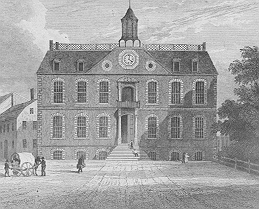
Captain Benjamin Page, Com. Abraham Whipple, Captain Turpin Smith, Colonel Ephraim Bowen, Captain John B. Hopkins, Dr. John Mawney, Joseph Bucklin, Captain Harris, Captain Shepard, Joseph Jenckes, There were but about fifteen men in the Gaspee, but when the boats came along side of her, they pretended to make some show of resistance, but Dudingston being wounded at the first onset, they immediately desisted. The commander was carried below, and Dr. John Mawney and Col. Ephraim Bowen went down and dressed his wounds, after which they put him in a boat and sent, him after his men ashore at Pawtuxet. He was received into the house of a Mr. Rhodes, and permitted to send to one of the ships off Newport, for his physician, who attended him several days before his removal. A bolder project, and more harmlessly executed, we believe has seldom been hazarded. From this time, the frequent discontents in the seaports were followed up by similar tumults. The destruction of the tea in the harbor of Boston, occurred next year after the Gaspee affair, viz. 1773. The beginning of 1774 was signalized by the spirited resolutions of the different ports. Newport was one of the first, who, in town-meeting, passed resolutions to refrain from the use of tea, and to oppose its sale in the Colony. .................... Upon the arrival of the news of the burning of the Gaspee in England, three Commissioners were sent by the British government to investigate the business, and make proclamation of reward for be persons of those who burnt it. They had the lower room in the Court House in Newport opened, where the elections were held, and with great state and solemnity paraded themselves on the high seat, overshadowed by tremendous great wigs. The proclamation was to any who could give information of the persons concerned, or leading to the detection of persons concerned in the burning of the Gaspee. This was done for three days in succession, but the proclamation and the wigs failed to frighten any one into giving information. The same solemn farce was then acted over in Providence, with the same success. The reward offered was ₤1000 for the Sheriff of Kent, the name by which John Brown was called; ₤1000 for the leaders, and ₤500 for "any of all the clan." We would remark that in all the accounts we have seen, of the destruction of the Gaspee, it has been asserted that the company, or a part of them, were disguised as Narragansett Indians. This was not the case. They were not disguised in the least. They merely called themselves Narragansett Indians. They took care however not to call each other by name. In fact there was very little talking done. They did not go down in the boats until after dark, and having accomplished their business, took them and returned. |
| Back to Top | Back to Gaspee Virtual Archives |