Gaspee Virtual Archives Virtual Archives |
| Welcome
Arnold (1745-1798) The Gaspee Days Committee at www.gaspee.COM is a civic-minded nonprofit organization that operates many community events in and around Pawtuxet Village, including the famous Gaspee Days Parade each June. These events are all designed to commemorate the 1772 burning of the hated British revenue schooner, HMS Gaspee, by Rhode Island patriots as America's 'First Blow for Freedom' TM. Our historical research center, the Gaspee Virtual Archives at www.gaspee.ORG , has presented these research notes as an attempt to gather further information on one who has been suspected of being associated with the the burning of the Gaspee. Please e-mail your comments or further questions to webmaster@gaspee.org. |
| Evidence implicating Welcome
Arnold: Old Providence: A Collection of Facts and Traditions relating to Various Buildings and Sites of Interest in Providence. Merchants National Bank of Providence: Providence, 1918, Page 12: The Gaspee went aground
off
Namquid Point; and, as the tide was ebbing, Captain Lindsey know that
she could not get under way again until early the next morning.
Lindsey hastened to Providence, and there told the story, which brought
about the meeting in Sabin Tavern. Welcome Arnold and John Brown
were among the leading men of the gathering.
During the early twentieth century many banking and commercial
institutions commissioned history books that were largely paid
advertising for the firm, and which included long biographies of the
founders and board members of the company, in additional to local
historical vignettes. Old Stone Bank published a noted six volume set
of Rhode Island history. These books were typically given out as
free gifts to depositors, something akin to the later popular trend of
giving away toasters for opening a new account. History would be
more an item of interest to the older population that had presumably
more accumulated wealth, and of which the banks hoped to access.
Note here, that the retelling of the Gaspee Affair presented here in
the Merchants Bank history, perpetuates some of the errors of the
original story as told by Ephraim Bowen. We do not know the
source of the writer's attestation about Welcome Arnold being at the
Sabin Tavern meeting (he was not named by Bowen), but there is an
extensive bibliography at the end. The unnamed writer appears to
have been a hired historical writer for Walton Advertising &
Printing Company.of Boston.On the historical marker erected nearby the original location of Fenner's Wharf, along Water Street in Providence is the following inscription: In the decade before the Revolutionary War, the British were enforcing revenue laws by stationing maritime law enforcement vessels in Newport Harbor and Narragansett Bay. In 1769, Newport citizens burned the British sloop Liberty in protest of violations of their rights. Meanwhile, the particularly aggressive British schooner Gaspee forced every vessel to strike its flag and allow boarding for customs inspections.Welcome Arnold would've been 27 years old at the time of the attack on the Gaspee. All of this, of course, does not prove that he was an actual participant in the raid, but considering that the vast majority of known raiders were prominent Providence merchants or sea captains, it seems more than likely that he was along for the ride. |
Biographical Information:
 Left: Signature
of Welcome Arnold on 1776 RI Assembly script note. Left: Signature
of Welcome Arnold on 1776 RI Assembly script note.
Welcome Arnold was a well known merchant and ship owner from
Providence
during the 18th century, and he frequently advertised his
shop in each of the local newspapers. Much of the following is
painstakingly gleaned from the Early
American Newspapers Collection available through the NEHGS websites. According to map research conducted by Leonard Bucklin (see 1770 List of Providence Taxpayers), Welcome Arnold and his eight siblings, all children of Jonathan and Abigail Arnold, were living most probably on South Main Street in Providence prior to the time of the Gaspee attack in 1772. This was a short four streets North of the intersection of Planets Street with South Main Street, the location of the Sabin Tavern, in which was planned the Gaspee raid. An ad appears in the Providence
Gazette 22May1773 for the firm of Caleb Greene and Welcome
Arnold selling at their store near the Great Bridge an assortment of
English goods, India goods, and lime by the hogshead. A latter ad in
April 1775 announced the desolution of that firm. By June 1775 Welcome
Arnold had moved out into his own shop across from the Baptist Church
on Main Street and sold English goods, West-India goods, fabrics,
lumber, snuff, flour, molasses, sugar, coffee, wine, iron goods, and
pig iron. By 1781 his store goods had evolved into an ecclectic
mix most reminiscent of a Woolworth's 5 & 10 cent store popular in
the 1930s, except his store also sold a variety of liquor, wine, and
tobacco. In December 1782 his store was broken into and he offered a
reward for the return of the fabrics, and the capture of the
thieves. In 1783 he advertized for lumber to be delivered to his
farm at Conanicut (Jamestown, RI). He frequently advertized to
purchase barrel staves and hoops, shipping horses, and lumber for
warehouses, so he quite likely was involved in the inland shipping
business. In January 1786 he moved his store down the street and was
selling mostly liquors, and (it figures) turpentine. He was also
in the business of selling supplies to commercial fishermen and of
buying up flax-seed. He purchased large shipments from Russia of iron,
hemp, netting, and sailcloth. In late 1787 Welcome Arnold
apparently sold his
flax-seed business to Joseph Lawrence. This flax seed business might've
been related to the production of linen cloth, fishing nets, paint
solvents, or perhaps medicine. In 1789 he won a suit judgment of $71
from a client that apparently had paid him in devalued paper money. According to Ships and
Shipmasters
of Old Providence (Providence Institute for Savings, 1919, p36)
Welcome Arnold was heavily involved in owning privateering vessels
during the Revolutioary War, and lost over 30 of them. He
subsequently made sure not to own any vessel outright, but to spread
his ownership interest over many boats so as to lessen the risk. In 1788 Nicholas Brown and Welcome Arnold spent $25,000 to construct a rum distillery at Providence's Fox Point neighborhood. Apparently Welcome Arnold, like fellow Gaspee raider John Brown, dabbled in the triangle trade of rum for slaves for molasses for rum. From: Papers of the American Slave Trade, Series A: Selections from the Rhode Island Historical Society <http://www.lexisnexis.com/academic/guides/Aaas/amsltr0102.pdf> Rum produced for the African slave trade had fueled Rhode Island’s economic expansion before the Revolution. Though it gradually declined in importance after the war, it was still the exclusive domain of the state's leading merchants. When the U.S. Congress declared an excise tax on distilled spirits in 1791, this had the dramatic result of inspiring the Whiskey Rebellion in western Pennsylvania, but the reaction was more peaceful in Rhode Island. While western distilleries were often small operations run by backwoods farmers to supplement their meager incomes, the Rhode Island rum distilleries were a major industry, and the excise tax was just another business expense.Welcome Arnold's name also appears in a list of clients for spermaceti oil, along with his son-in-law Zachariah Allen, and pre-eminent spermaceti trader and leaders of the Gaspee Raid, John Brown and Joseph Brown (of the firm Brown & Benson). <http://www.library.hbs.edu/hc/sfa/princegardner.htm> (Prince Gardner Ledger, 1788-1798). Spermaceti oil was used in making candles, and was at the time a hot commodity traded in Rhode Island during the pre-Revolutionary days. He's also noted in Catherine Williams' Biography of Revolutionary Heroes: Containing the Life of Brigadier Gen. William Barton and also of Captain Stephen Olney. Providence, Published by the author, 1839, (p95) that Welcome Arnold was known to have been running privateer ships along the East Coast during the Revolution, and loosing at least two such vessels to British interception. Specifically, we find him on a list of owners of privateers in 1782 as owner of the Yorick (Field, Edward, State of Rhode Island and Providence Plantations at the End of the Century: A History. Boston, Mason Publishing Co. 1902, Vol II, pp424-430). He does not appear in a list of RevWar pension applicants, but, in either event, would've died before such applications were taken.
In 1772 he was a Deputy
(RI Assembly) from Smithfield at which time he was also appointed as a
Justice of the Peace. In
1777, 1786, and 1788 he helped crew the fire engine near the Great
Bridge, and in 1790 was appointed a Fireward[en].. In 1778 he was
elected representative to the Assembly from Providence along with known
Gaspee raiders Paul Allen and John Brown, and fellow suspect Theodore Foster. He was biennially
reelected up until his death in 1798. He had also been elected a
Deputy Assistant to the Assembly to represent Providence in 1782, akin
to the more modern-day State Representative. He was also a
Speaker of the Rhode Island Assembly five times. In 1778
he actively encouraged the adoption of the Federal consititution by
Rhode Island. In 1778 Welcome Arnold was appointed to the City
Audit
commission, and was elected to the Providence Town Auditor in 1779. In
1787 he was
appointed by the Providence Town Council one of the overseers of the
new hospital, and in 1788 was appointed to the Committee to
Superintending and Regulating the Market. We also see his
signature applied to monetary instruments used in
Rhode
Island at the time. He helped John Brown,
Christopher Sheldon
and others mark out the channel for the Providence River in 1788, and
in 1790 he was appointed a Surveyor of the Highways, and appointed onto
the original Providence Public School Committee and helped purchase the
lands and buildings for its first schools. He achieved national prominence as a Commissioner of High Court in dispute between Connecticut and Pennsylvania over land in northeastern Pennsylvania. From: <http://www.supremecourthistory.org/04_library/subs_volumes/04_c01_d.html> (stale link 2009) In the summer and fall of 1778 a series of Tory and Indian massacres in the Wyoming Valley had decimated the population, and three years later, seeking to forestall survivors' attempts to resettle and thus re-establish Connecticut claims, Pennsylvania petitioned Congress to adjudicate the matter. The following year in Trenton a five man tribunal was sworn in by Justice Isaac Smith of the New Jersey Supreme Court; this ad hoc body consisted of Welcome Arnold of Rhode Island, David Brearly and William C. Houston of New Jersey, William Whipple of New Hampshire and Cyrus Griffin of Virginia, already serving as a member of the Court of Appeals in Cases of Capture. After forty-two days of elaborate testimony, the court returned a unanimous verdict in favor of Pennsylvania. An effort to convene a new court in 1784, to hear claims of individual tenants, was dismissed, the Continental jurisdiction over individual claimants being in doubt. In 1799 Pennsylvania passed legislation to compensate holders of provable titles from the original settlement, and the matter was finally closed.Several copies of letters to Welcome Arnold from David Howell exist at the University of Virginia Library, <Letters of delegates to Congress, 1774-1789> discoursing on the Connecticut-Pennsylvania disputes as well as the national debt. Like David Howell, a cousin, Jonathan Arnold, was also a RI delegate to the Continental Congress, 1782-1783.
In September 1784, he was appointed a trustee of Rhode Island College (later renamed Brown University), and was on a committee to run a lottery to raise funds for the College in 1798. In 1785 he owned a cargo ship, Rebecca. We also note that in October 1791 Welcome Arnold, Esq. was elected Chairman of the Providence Bank, of which John Brown was President. Welcome Arnold appears in a 1796 list of investors in the Ohio Company as published in Hulbert, Archer Butler, ed., The Records of the Original Proceedings of the Ohio Company (Ohio Company Series, Volume 2) (Marietta, Ohio: Marietta Historical Commission, 1917) pp. 235-242. <http://www.genealogy-quest.com/collections/ohco.html Stale link 2010>. His name appears along with many other men known to have been associated with the Gaspee Affair, including: Abraham Whipple, Samuel Adams, John Brown, Theodore Foster, Joseph Jenks, and John Mawney, and many familiar family names of Gaspee raiders as well.
From http://www.gaspee.com/SabinTavern.htm: Shortly after the attack on the Gaspee, Ephraim Bowen confirms that the Sabin's Inn was sold in 1785 to Welcome Arnold, whose 1780 house still stands further up on Planet Street, and lived in it until his death in 1798. Welcome Arnold then passed the ex-tavern onto his eldest son, Samuel Greene Arnold, who then passed it on to Samuel's younger brother Colonel Richard James Arnold, for which it was used as his personal residence in the 1830s.
Per the 1790 Federal Census for Providence: Arnold, Welcome 5 2 6 2 *This indicates that in his household he had five males >16, 2 males <16, 6 females, two free persons (probably servants), and no slaves. We know from the offspring below (see genealogy) that he would in 1790 have been 1-2-5, so we can't explain the four other males over 16 years that were in his household at the time, but they were probably his parents (his father being 82 at the time) and three other men. According to the RI Historical Cemeteries Database, Welcome Arnold is buried with his wife in the Old North Burial Ground in Providence, the site of internment for many other Gaspee raiders. ARNOLD, WELCOME 1745c - 30 SEP 1798 PV001His estate claims notice was published in October 1799 by his son, Samuel Greene Arnold. Among the honors bestowed on Welcome Arnold is the naming of the Urban League of RI's Welcome Arnold Shelter, providing temporary quarters for 107 men, women, and children in the Cranston and Providence area. We also note the 1972 History PhD thesis for Brown University by Franklin Stuart Cole entitled: Welcome Arnold (1754-1798), Merchant of Providence: The founding of an enterprise |
| Genealogical Information The following information is culled from searches on Ancestry.com, Whipple.org, RI Historical Cemeteries Database, etc. Welcome ARNOLDNote that the custom of the time was to reuse names of deceased prior children (Eliza, Samuel, and Welcome Jr.) |
| We conclude that Welcome Arnold was involved in at least planning the raid on the Gaspee, and in all logical conclusion participated in the attack itself. We therefore acknowledge him as an American patriot. |
| Back to Top | Back to Gaspee Virtual Archives |
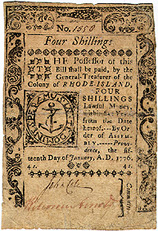 Left:
Four Shillings note produced by the Rhode Island general Assembly, 1776.
Left:
Four Shillings note produced by the Rhode Island general Assembly, 1776.